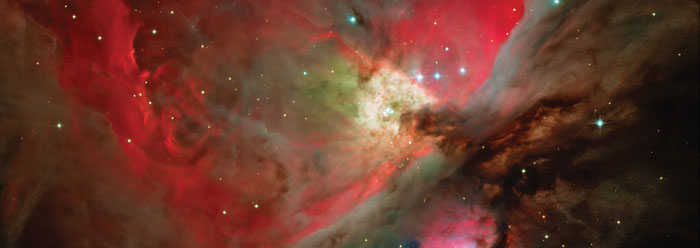
It is intuitively obvious that to get from a Big Bang to intelligent astronomers looking for evidence of the bang through telescopes, the amount of organization in the universe must have increased over time dramatically. Lately, astronomy has uncovered much more dynamism in space than previously recognized--but much of it is destructive, not creative.
The Smithsonian Astrophysical Observatory reported that, about 500 years ago, something explosive happened in Orion that sent at least 40 stars careening outward at speeds up to 300,000 miles per hour. They are not sure what happened, but it had to have been enormously powerful to fling out that much material that fast. "The energy in this explosive display is estimated to be as much as that from a hundred trillion suns; nothing else quite like it is known."1
The Orion Nebula is often portrayed as a "nursery of massive stars." Even its rare supernovae are described as "pregnant" with creative energy: "The birth of massive stars involves a subset of the processes that produce all stars, while their deaths, as supernovae, will scatter into space the rich mix of chemical elements made in their nuclear furnaces, elements without which life could not exist."1 The statement suggests that these explosions are ultimately giving birth to highly-organized complexes of matter called living cells.
An unusual space-derived origin for life was proposed by New Scientist, which asked, "Was life founded on cyanide from space crashes?"2 In one sentence, we have two destructive energetic things--crashes and cyanide--leading to life. The article later spoke of "life-giving poison."
LiveScience called black holes "powerhouses of the universe." That they may be, but they are formed from the destruction of stars and result in singularities, where all information and order is lost. What these energetic events create, if anything, is high-power cosmic rays that rip through our flesh after traveling across the universe. "We detect some of these particles on Earth, where they still pack such a punch they can knock out electronics systems," according to the article.3 The author does not try to ascribe creative powers to black holes or cosmic rays, but it should be noted that energy and organization are not one and the same.
The UK Science and Technology Facilities Council reported that one of the most energetic explosions known in space is enabling astronomers to probe the "dark ages" of the universe.4 Gamma-ray bursts are thought to occur when massive stars run out of fuel and collapse. The rebound sends shock waves that are the most luminous events known. The astronomers say this distant burst occurred when the universe was just five percent of its current age, but that it involved the destruction of a star that must have been formed some other way.
Each of these stories presented only destructive forces at work. Dr. Henry M. Morris, founder of the Institute for Creation Research, famously noted that a bull in a china shop expends a lot of energy but creates no order. Unless that energy is channeled and converted into useful work, the input of raw energy into a system is always destructive. The bottom-up philosophy requires construction, not destruction. It is only a philosophy--not the evidence--that tries to find creative powers in explosions.
References
- The Explosive Disintegration of a Young Stellar System in Orion. Smithsonian Astrophysical Observatory Weekly Science Update, October 23, 2009.
- Shiga, D. Was life founded on cyanide from space crashes? New Scientist. Posted on newscientist.com November 6, 2009.
- Moskowitz, C. Black Holes: Powerhouses of the Universe. LiveScience. Posted on livescience.com November 9, 2009.
- Astronomers explore 'last blank space' on map of the Universe. Science and Technology Facilities Council press release, October 28, 2009.
* David Coppedge works in the Cassini Program at the Jet Propulsion Laboratory. The views expressed are his own.
Cite this article: Coppedge, D. 2010. Cosmic Energy: Creative or Destructive? Acts & Facts. 39 (5): 17.