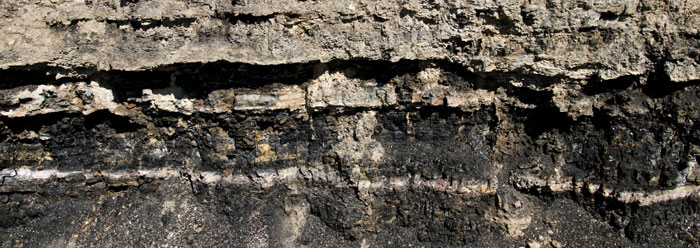
 Fossils are normally found loosely in the order predicted by the geologic column, which maps the earth's strata. This chart, which can be found in all treatments of the subject, is presented as a column of fossils, with the earliest at the bottom and the most recent at the top. But in reality, it is only a column of proposed evolutionary development.
The fossil order, such as it is, could just as well (or better) fit the progression of encroaching Flood waters. In the lowest levels are found marine invertebrates. Increasing heights (not more recent time periods) bring fossils that lived along the shore, followed by more terrestrial sediments and fossils. The ordering trend is not due to evolutionary development, but to global Flood inundation.
There are, of course, many fossils that could fit in any/all time periods. For instance, clams, in great variety, are found in virtually every layer containing multi-celled fossils, and they are alive today. Clams may vary according to their environment, but they are still clams. Remember--variety is not evolution. There are some fossils, however, that cannot be made to fit the evolutionary timeline at all. Such fossils, called anomalous fossils, are found in layers totally out of kilter with evolution.
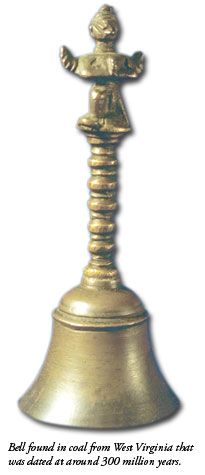
The most startling such evidence is human artifacts, such as the bronze bell shown here. It was encased in a large piece of coal. Standard dating of the bituminous coal seam from which it was taken dates it from the Carboniferous Period, approximately 300 million years old. Certainly no human artifact could reside in such "ancient" strata. This "fossil" is anomalous indeed.
The boy who found it in the 1940s discovered it while shoveling coal into his home's furnace. One chunk, about 15 inches by 20 inches in area and 6 inches thick, was too large, and when he broke it a metal object protruded. Diligence completely removed all coal from the bell, which had a two-inch stem between the bell and a "human-like" figure on top--a man in a kneeling position, with arms and wings. Records show the coal had been excavated from a shallow mine near his home in Buckhannon, West Virginia.
The discoverer attended an ICR seminar in the mid 1970s with his amazing find. I asked if ICR could perform some tests on it. It migrated with me to Oklahoma University in 1975, where I remained on the faculty until 1984 and had access to numerous analytical devices and experts in several fields to help analyze the bell.
Nuclear Activation Analysis determined it to be primarily of bronze with a curious admixture of zinc. A micro probe showed no residual traces of coal. Historians compared the bell to artifacts from "all" cultures, and concluded the most similar artifact was from ancient Babel, with the figurine representing a pagan god. Both have a "horn" (broken on the bell) and wings. The face on both is eerily similar. A convention of bell experts did not know its place of origin, although some felt there was a similarity to semi-ancient bells made in India. Their suggestion was that some early American dropped a foreign bell down a well, to be incorporated into the coal.
But what about the Flood? While processes operating during the Flood would have destroyed most artifacts, there is a possibility metallic objects could have survived, and people before the Flood did work with metal. Coal comes from land plants, and it would be conceivable that a metallic, human artifact could survive. There have been several artifacts like this one found, but all are poorly documented and therefore unusable. I would never use questionable evidence for creation and the Flood without a disclaimer. I present this one here because the possibility is so intriguing.
* Dr. Morris is President of the Institute for Creation Research.
Cite this article: Morris, J. 2010. An Amazing Anomalous Fossil. Acts & Facts. 39 (2): 16.