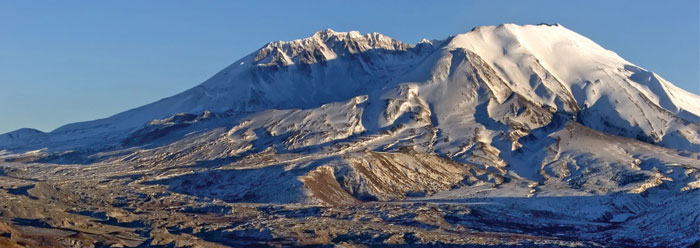
Readers of Acts & Facts know of ICR's long-standing research interest in Mount St. Helens, the volcano in Washington state that erupted on May 18, 1980. Attendees of many ICR seminars have likewise been introduced to the fascinating lessons learned there. This eruption provided remarkable insight into the great Flood of Noah's day, for it produced geologic products and landforms that mirror those stemming from the Flood. Its results included:
- up to 600 feet of water-deposited sediments, which look strikingly like those found worldwide in the greater geologic record;
- a deep, eroded canyon through those sediments that has been dubbed the "Little Grand Canyon";
- fresh basalts that are dated by radiometric means to be over two million years old;
- a log mat of about four million trees, a forest that was catastrophically ripped from the ground and is now floating in a nearby lake;
- a thick peat layer accumulating under the mat that is poised to become a coal deposit;
- upright floating logs that have the signature appearance of the petrified forest at Yellowstone National Park.
The comparison between a recent volcanic eruption and the Flood may seem tenuous, until one realizes that the Flood, while dominantly a hydraulic cataclysm, was also triggered and energized by a tectonic convulsion of earth's surface. The first mechanism God used to judge the earth was when "all the fountains of the great deep [were] broken up" (Genesis 7:11), sending tsunamis and mudflows across the continents, no doubt accompanied by mega volcanic eruptions. This was followed by an upwarping of the ocean bottom, spilling its contents onto the continents. Then came the months-long downpour of rain.
Consider that most of the damage done by the 1980 Mount St. Helens eruption was water related, not volcanic. The glacier on the mountain's summit suddenly melted, sending avalanches of water and debris cascading down the mountainside, depositing thick, water-saturated sediments on the lower slopes and throughout the drainage basin.
ICR has found that there is no better "first dose" of creation material than the lessons learned at Mount St. Helens. It has often been an individual's introduction to creation thinking, made all the more powerful because the eruption was so well observed. Earth features that had been considered to have taken long ages to be accomplished, were seen to happen rapidly, almost instantaneously. It also has been a conviction to those Bible-believing Christians who had thought it necessary to compromise Christian doctrine with the millions of years demanded by evolution. The Flood has always been the key to understanding earth history, for, on the authority of the Word of God, where could you go on earth and not encounter a flooded terrain? To eliminate the Flood from one's thinking guarantees an incorrect evaluation.
ICR's Dr. Steve Austin has been the lead scientist on our work in the area, having often journeyed to the mountain to conduct research. He has also led numerous ICR tours to Mount St. Helens, which informed many tour participants of the evidence there. Co-author of the attractive book Footprints in the Ash (available from ICR), he has delivered numerous professional lectures and published several technical articles on its details. Just this fall, he led a field trip of professional geologists into the blast zone in conjunction with the Geologic Society of America's annual meeting, which we reported on in our December issue.
Also located at Mount St. Helens is the 7 Wonders Museum, operated by Lloyd and Doris Anderson, who lead creation-based tours of the mountain.1 We rejoice to see so many ministries working so diligently to take the message of creation to all who need to hear.
Reference
- For more information and ministry opportunities with the museum, visit www.creationism.org/sthelens.
* Dr. Morris is President of the Institute for Creation Research.
Cite this article: Morris, J. 2010. Lessons from Mount St. Helens. Acts & Facts. 39 (1): 14.