Just this last September 30, we heard of major earthquakes measuring up to 8.0 on the Richter scale and the resulting tsunami which hit the coast of American Samoa. Many people perished in waves up to two meters higher than normal sea level. Yet for all its ferocity, it paled in comparison to a much greater catastrophe which hit just five years ago.
We all remember when it happened. On the day after Christmas 2004, we were shocked to view the devastation and human heartbreak as a major tsunami hit the coastlines of the Indian Ocean nations and numerous Pacific islands, leaving untold misery in its wake. Now that the waves have subsided, what lessons can we learn? What inferences can students of earth history, both creationists and evolutionists, draw about the past regarding the question of origins?
The tsunami set was generated by one of the largest earthquakes on record, 9.3 on the Richter scale, along a major convergent plate boundary. Its epicenter was 50 km west of Sumatra at a depth of 30 km, and ruptured a lengthy section (about 1,600 km) of the boundary, with multiple pulses lasting several terrifying minutes. The nearly instantaneous underwater movements imparted great energy to the overlying water, causing waves up to 30 m high to race far inland on the typically low-lying coastal plains and islands, with a maximum run-up of 60 m. The several consecutive inundations and following backwash accomplished much geologic work. This area has often seen such devastation, even in historical times, with such tsunamis as that associated with the Krakatau eruption in 1883. Previous unwitnessed events that occurred in the distant past were much more dynamic.
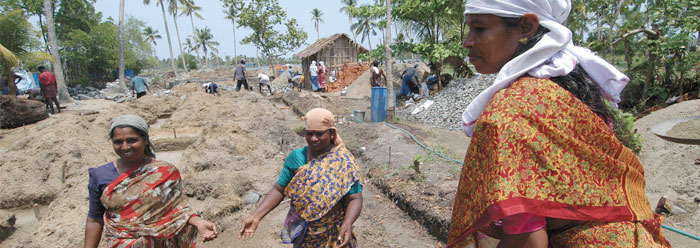
The waves scoured the vegetation cover and often removed any soil present, altering coastline geometry. Surprisingly, it left little more than thin, laminated sand and mud deposits in scattered locations on land. Offshore coral reefs were demolished, with their fragments deposited in huge piles. In the ocean, however, subsequent seismic studies showed underwater mudslides had transported huge portions of these reefs intact, along with large sections of rock. In spite of the extensive devastation, the area has begun to recover in many ways. Obviously, earth's design has spurred regrowth and coastline healing more quickly than doomsayers predicted.
For all its devastation, this set of tsunami hardly compares to some we see in the geologic record. From erosion of submarine canyons, to marine fossils washed high atop Hawaiian volcanoes, it appears the past geologic history of planet earth was dominated by processes and events quite different from and much more dramatic than their counterparts today. One thing is certain. The present is not the key to the past, as oft repeated by those who believe in uniformitarianism.
The Bible presents the great Flood of Noah's day as a great tectonic cataclysm, which restructured earth's surface layers. It mentions the breaking open of earth's internal "fountains," no doubt resulting in devastating earthquakes and continual tsunami. Think of the erosion necessarily caused by such a planetary convulsion and resulting deposition of sediments. The Flood was marked by plate movements, mountain uplifts, basin downwarp, underwater sediment transport, etc. Indeed, "the world that then was, being overflowed with water, perished" (2 Peter 3:6). We live in a rather stable environment, although still quivering from its violent past. Major geologic events which occur today give us a glimpse of past turmoil.
* Dr. Morris is President of the Institute for Creation Research.
Cite this article: Morris, J. 2009. The Christmas Tsunami of 2004. Acts & Facts. 38 (12): 15.