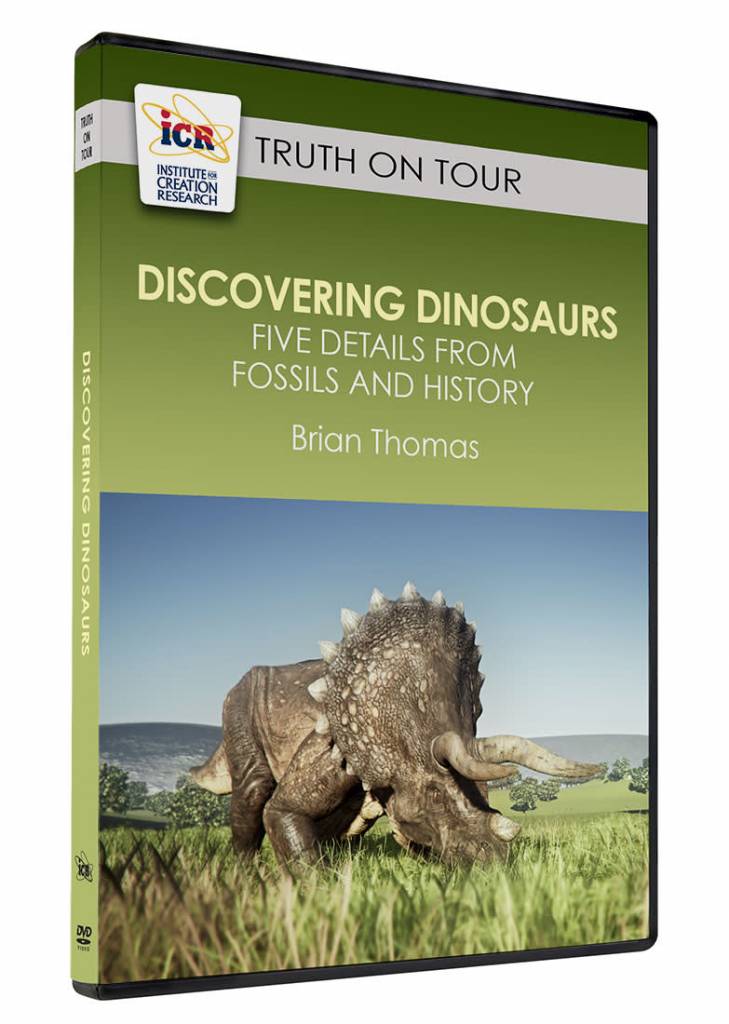
Triceratops is one of the most recognizable dinosaurs, known from partially complete fossilized skeletons to have large armor plate and three horns on its head. At almost 30 feet long, it was perhaps one third the length of Torosaurus, which also had a large armor plate and three horns. Long considered distinct species, paleontologists recently reported data indicating that they actually might be the same species.1 If this identification was wrong for so long, what other dinosaurs might be misidentified?
Presenting at last month’s Annual Meeting of the Society of Vertebrate Paleontological held in Bristol, England, John R. Horner and his graduate student John Scannella demonstrated that known fossils of various sizes of these two dinosaurs line up quite well in a “developmental continuum.”2 Thus, Triceratops may have just been juvenile Torosaurus.
Similarly, the remarkable dragon look-alike fossil Dracorex hogwartsia may have just been a younger version of another known dinosaur. Dracorex shared similar features with the larger Pachycephalosaurus, but Dracorex did not have the same thick bony dome on its head. When first described, Robert Bakker stated, “The lack of a dome is considered not to be an ontogenetic [developmental] feature, but rather it is phylogenetically [evolutionarily] derived.”3
However, the following year at the 2007 Society of Vertebrate Paleontology Annual Meeting held in Austin, Texas, John Horner reported that Dracorex was possibly on the junior end of a line of fossils that show maturation into a Pachycephalosaurus.4, 5 As with Triceratops and Torosaurus, differences in size and appearance could be explained by the fact that the younger members of the species would not carry full adult features until they reached the appropriate age.
Thus, in both cases, Horner has shown the possibility that what were thought of as multiple dinosaurs that evolved separate features and separate sizes and were given separate names, were quite possibly of the same kind. His research has also been featured in a National Geographic News article titled “A Third of Dinosaur Species Never Existed?,” which highlights yet another multi-name, single-species dinosaur. According to Horner, the “Nanotyrannus” is likely just a juvenile Tyrannosaurus rex.6 The article addressed the theory that “as many as a third of all known dinosaur species never existed in the first place.” A smaller number of dinosaur species has significant implications for a question often posed to Bible believers: “How did dinosaurs fit on Noah’s Ark?”
Since it is possible that Dracorex, Triceratops, and Nanotyrannus were actually just juvenile versions of Pachycephalosaurus, Torosaurus, and Tyrannosaurus, respectively, then the almost 1,000 different dinosaur species named today do not automatically represent 1,000 different dinosaur kinds. An even more significant factor that likely inflated the number of named dinosaur species beyond the number of actual kinds is the different appearances of varieties within each kind. One might well imagine the number of species names given just to today’s varieties of dogs were they to be found in the fossil record—especially considering the notoriety and funding generated for paleobiologists when they name new finds.
Creation scientists, working from the premise that certain features of many created kinds are able to undergo variation between generations, have estimated that there may have been only 60 or fewer dinosaur kinds, totaling up to 120 individuals (male and female) on Noah’s Ark.7 The few dinosaur kinds that were able to grow to enormous sizes were likely taken on board as juveniles, and considering that most dinosaurs were not much larger than turkeys, it is certainly feasible that Noah boarded dinosaur passengers.
The existence of dinosaurs presents no problem for the Genesis account of the Flood, and having too many named species does not translate into too many animals for the massive barge that Noah’s family built.8
References
- Scannella, John B. 2009. And then there was one: synonymy consequences of Triceratops cranial ontogeny. Journal of Vertebrate Paleontology. 29 (3): 177A.
- Wong, K. Are Torosaurus and Triceratops one and the same? Scientific American. Posted on scientificamerican.com, September 28, 2009, accessed October 5, 2009.
- Bakker, R. T. et al. 2006. Dracorex hogwartsia, N. Gen., N. Sp., a Spiked, Flat-Headed Pachycephalosauroid Dinosaur from the Upper Cretaceous Hell Creek Formation of South Dakota. Late Cretaceous vertebrates from the Western Interior. New Mexico Museum of Natural History and Science Bulletin. 35: 331- 345.
- Horner, J., M. Goodwin and H. Woodward. 2007. Synonomy Consequences of Dinosaur Cranial Ontogeny. Technical Session IX. Journal of Vertebrate Paleontology. 27 (Supplement to No. 3): 92A.
- Stokstad, E. 2007. Did Horny Young Dinosaurs Cause Illusion of Separate Species? Science. 318 (5854): 1236.
- Handwerk, B. A Third of Dinosaur Species Never Existed? National Geographic News. Posted on nationalgeographic.com October 9, 2009, accessed October 12, 2009.
- Were Dinosaurs on Noah’s Ark? Creation Ministries International. Posted on creation.com July 26, 2000, accessed October 12, 2009.
- “If, as the preponderance of evidence shows, the created kind was equivalent to the family (at least in the case of mammals and birds), then there were only about 2,000 animals on the Ark.” Woodmorappe, J. 1996. Noah’s Ark: A Feasibility Study. Santee, CA: Institute for Creation Research, 7.
* Mr. Thomas is Science Writer at the Institute for Creation Research.
Article posted on October 13, 2009.