The field of biology has provided much support for a recent creation, and physical evidence of very young-looking biological materials from supposedly ancient fossils continues to accrue from around the world, and from various depths under the earth.
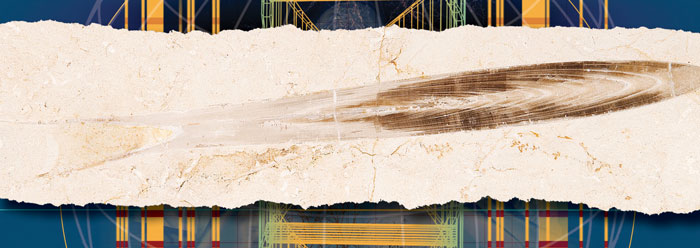
In August of this year, paleontologists in Trowbridge, Wiltshire, England, made a discovery that astounded the evolutionary community. A "150 million-year-old" squid was discovered with an intact ink sac. "It is difficult to imagine how you can have something as soft and sloppy as an ink sac…inside a rock that is 150 million years old," said Dr. Phil Wilby of the British Geological Survey.1 Creationists agree and see this as physical evidence that clearly points to its recent burial and preservation.
"Living fossils" present another kind of dilemma for deep time. Sharks, horseshoe crabs, crinoids, Wollemi pine trees, tuataras, crocodiles, vampire squids, chambered nautiloids, brachiopods, clams, dragonflies, lungfish, and hundreds of other animals and plants have stayed the same over "millions of years," despite significant shifts in their environments and supposed eons of nature-selecting mutations. But living fossils make better sense when viewed from a young-earth creation perspective, wherein natural selection does not generate new forms, and living creatures ought to look similar to their fossilized relatives.
In the past few decades, Darwin-unfriendly discoveries have been made of genetic material (DNA) that is supposedly from very old sources but is found in relatively pristine condition. For example, evolutionist Sangtae Kim discovered DNA sequences from Miocene fossils (supposedly over 5 million years old) and said, "This paper confirms that DNA sequences can be obtained from Miocene-age plant remains."2 And "plants, bacteria, mammals, Neanderthals, and other archaic humans have had short aDNA [ancient DNA] sequences identified."3 How can DNA be so intact after so long, with what is known about DNA decay rates?4, 5
Other samples of viable DNA have been extracted from frozen tissue dated thousands of years old by evolutionists. The energy powerhouse of the cell is called the mitochondria and it contains DNA termed mtDNA. In 2008, samples of mtDNA were extracted from a frozen human discovered in the Alps in 1991. Called the Tyrolean Iceman, he was dated at over 5,000 years old. The DNA was completely and successfully sequenced.6
Speaking of cold temperatures, deep ice cores have been taken from southern Greenland permafrost. Insect and plant materials recovered from them have revealed clean DNA sequences.7 Antarctic ice cores may reveal more DNA samples.
Not only is DNA found where it should not be if evolutionary ages are true, but still-living microbes have been extracted from ancient earth materials. A leader in this fascinating field is evolutionist Raul Cano of the California Polytechnic State University. His work frustrates evolutionary biologists, who maintain that the earth is very old, and therefore consider that his otherwise astonishing results are actually contaminated with recent bacteria. However, other evolutionists have been making similar discoveries.8
It would seem that many scientists are putting the cart before the horse--embracing long ages before they consider the physical evidence that shows otherwise.9 Pristine DNA from these supposedly ancient materials is predicted by the creation model, which numbers the earth's years in the thousands rather than millions.
References
- Ink found in Jurassic-era squid. BBC News. Posted on news.bbc.co.uk August 19, 2009, accessed August 19, 2009.
- Kim, S. et al. 2004. DNA sequences from Miocene fossils: An ndhF sequence of Magnolia latahensis (Magnoliaceae) and an rbcL sequence of Persea pseudocarolinensis (Lauraceae). American Journal of Botany. 91 (4): 615–620.
- Criswell, D. 2006. How Soon Will Jurassic Park Open? Acts & Facts. 35 (6).
- Poinar, H. et al. 1996. Amino Acid Racemization and the Preservation of Ancient DNA. Science. 272 (5263): 864-866.
- Willerslev, E. and A. Cooper. 2006. Pathogenic microbial ancient DNA: a problem or an opportunity? Proceedings of the Royal Society. 273 (1587): 643.
- Ermini, L. et al. 2008. Complete Mitochondrial Genome Sequence of the Tyrolean Iceman. Current Biology. 18 (21) 1687-1693.
- Willerslev, E. et al. 2007. Ancient Biomolecules from Deep Ice Cores Reveal a Forested Southern Greenland. Science. 317 (5834): 111-114.
- Vreeland, R. H., W. D. Rosenzweig and D. W. Powers. 2000. Isolation of a 250 million-year-old halotolerant bacterium from a primary salt crystal. Nature. 407 (6806): 897-900.
- One example of this was documented in Yeoman, B. Schweitzer's Dangerous Discovery. Discover, April 2006
* Mr. Sherwin is Senior Science Lecturer at the Institute for Creation Research.
Cite this article: Sherwin, F. 2009. Squid Fossils, Ancient DNA, and a Young Earth. Acts & Facts. 38 (10): 16.