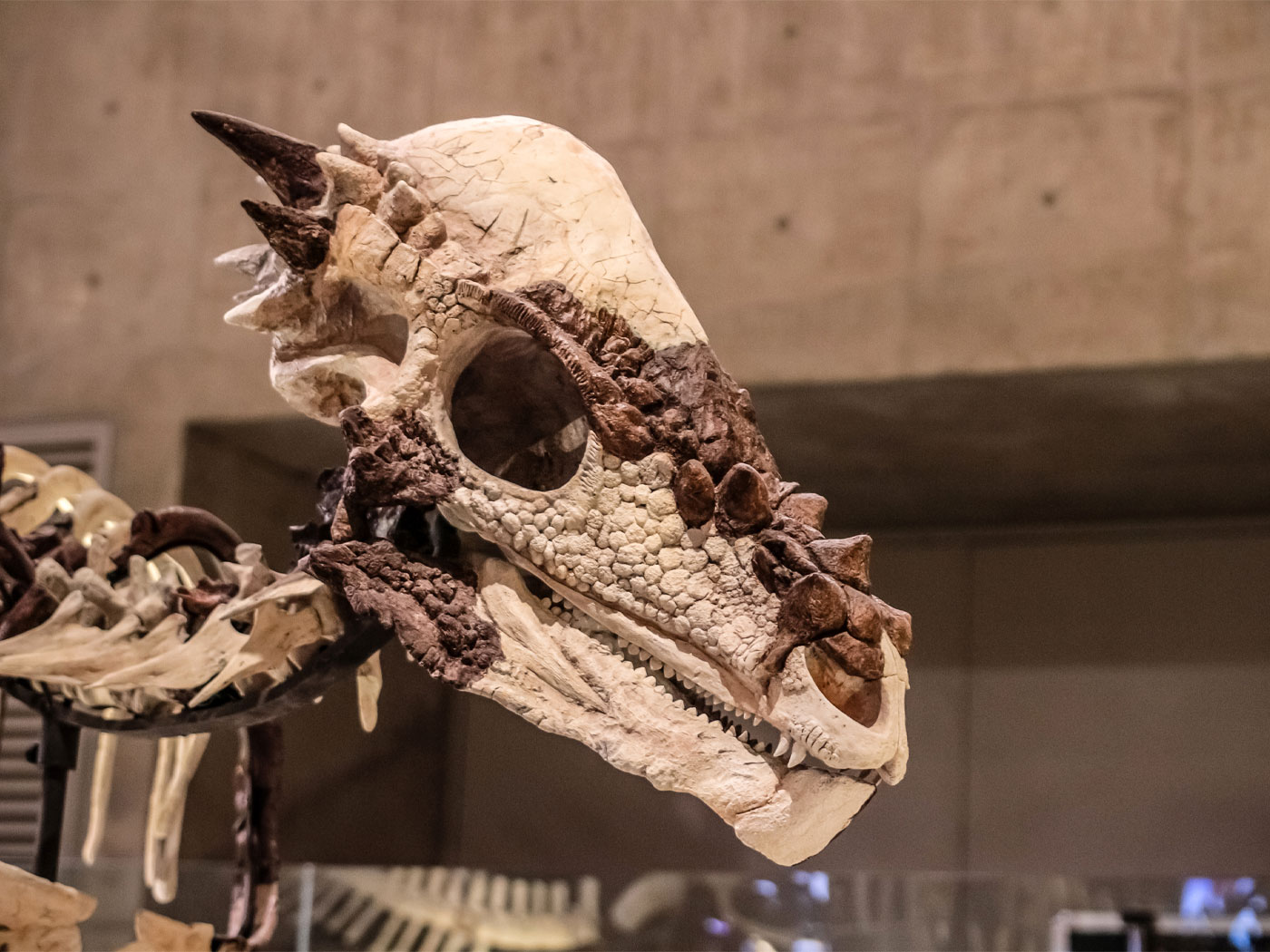
Recently-discovered dinosaur soft tissues, and even blood cells, represent some of the biggest hurdles for long-age evolutionary belief. Soft tissue was found in the femur of a large Tyrannosaurus rex about a decade ago, and more was discovered in another T. rex a few years later. And recently, soft tissues with proteins were found in a hadrosaur from Montana.
In her study of the hadrosaur, paleontologist Mary Schweitzer was able to determine exact amino acid sequences because the proteins were in such good condition, even with a supposed age of 80 million years.1 She found all of the primary proteins of a common connective tissue called the basement membrane matrix, as well as blood cells inside blood vessels similar to what she discovered earlier in the T. rex bones.
The hadrosaur yielded two types of collagen, which are tough, elastic, self-weaving protein fibers that, among other things, give skin and bones their lightweight strength. The protein fibers elastin and laminin were also found in the basement membrane material. Though resilient, collagen fibers have been observed in laboratory settings to decay within a matter of weeks. Studies show that collagen should be unrecognizable after 30,000 years,2 a figure that is only 0.0375 percent of the standard age assigned to the hadrosaur.
Most remarkable in this sample, as well as in the T. rex discoveries, was the presence of blood vessels and blood components, such as hemoglobin.3 This protein decays even faster than collagen, so its presence inside a dinosaur carcass clearly shows that the dinosaurs cannot possibly be as old as evolutionary scientists claim.
Though Schweitzer is an evolutionist, her findings over the years have raised objections from her peers. Some have suggested that the soft tissues were made by bacteria, though this does not fit the observed data.4 In their recent study, Schweitzer’s team confirmed the presence of an amino acid called hydroxyproline, which is a component of vertebrate collagen and which bacteria do not manufacture. Other scientists have maintained that perhaps Schweitzer’s techniques were to blame for these anomalous discoveries. To answer this, Schweitzer had these hadrosaur tissues and proteins extracted and characterized by “a second set of experiments, conducted in a separate lab.”1
“The most parsimonious explanation, thus far unfalsified, is that original molecules persist in some Cretaceous dinosaur fossils,”1 meaning in short that Schweitzer and her team have taken great care to make it painfully clear that these soft tissues really exist and they’re from the dinosaurs in question. Scientists worldwide now need to reconcile their belief in vast eons with these cold, hard facts. The simplest explanation for the presence of blood vessels and their proteins in these bones is that the dinosaurs were recently and rapidly inundated and preserved, just as one would expect to observe in a world that began thousands rather than millions of years ago.
References
- Schweitzer, M. H. et al. 2009. Biomolecular Characterization and Protein Sequences of the Campanian Hadrosaur B. Canadensis. Science. 324 (5927): 626-631.
- "In bones, hydrolysis [breakdown] of the main protein component, collagen, is even more rapid and little intact collagen remains after only 1-3x10⁴ [10,000 to 30,000] years, except in bones in cool or dry depositional environments." Bada, J. L., X. S. Wang, and H. Hamilton. 1999. Preservation of key biomolecules in the fossil record: current knowledge and future challenges. Philosophical Transactions of the Royal Society B: Biological Sciences. 354 (1379): 77-87.
- Boswell, E. Malta bone, MSU scientists help confirm protein findings in dinosaurs. Montana State University press release, April 30, 2009.
- Thomas, B. 2008. Dinosaur Soft Tissue: Biofilm or Blood Vessels? Acts & Facts. 37 (10): 14.
* Mr. Thomas is Science Writer at the Institute for Creation Research.
Article posted on May 12, 2009.