The theory of evolution has numerous problems, some of which are absolutely enormous and for which no adequate solution has even been proposed. The biggest problem comes right at the beginning with the supposedly spontaneous generation of life from non-life. Neo-Darwinian scientists admit this, recognizing that proposed evolutionary scenarios do not model reasonable conditions on earth, and could not have produced anything like the complex life we see all around us--even single-celled life.
The second-biggest problem involves the development of complex invertebrates, animals without a backbone, from single-celled life. How did this transition occur? A robust fossil record of one-celled life has now been found, and of course a truly abundant record of marine invertebrates can be discovered everywhere, from clams to sponges to jellyfish to starfish, etc. The "explosion" of life in the Cambrian system of strata continues to baffle evolutionists, for there is no record showing a transition from tiny single-celled life to complex invertebrates. There are innumerable fossils of invertebrate ocean bottom life, even those with no hard outer shell, but no ancestors of these invertebrates have been identified.
A third huge problem lies in the next step required by evolution. Fish, thought to be the first vertebrates, must have evolved from invertebrates, but again there is no record of this transition. "How this earliest chordate stock |i.e., early vertebrates| evolved, what stages of development it went through to eventually give rise to truly fishlike creatures, we do not know."1 Over the years nearly every invertebrate has been proposed as the ancestor, but each suggestion has only been in vogue for a time. As Dr. Duane Gish--former Senior Vice President at ICR and a well-known creation scientist--likes to say, if evolution can't derive either invertebrates from single-celled life, or vertebrate fish from invertebrates, it is "dead in the water."
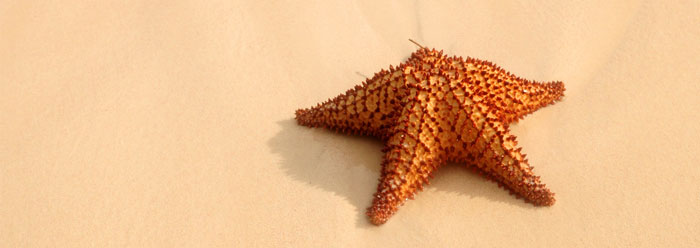
One proposition receiving attention these days is that echinoderms were the creature that evolved into fish. Now, echinoderms usually don't look anything like fish. Their ranks include sea squirts, tunicates, and starfish. These do have a pseudo-spine with a central supportive notochord and a tubular nerve chord, features that are somewhat present in vertebrates, especially in the embryonic stage. It seems that Ernst Haeckel's theory of embryonic recapitulation is more extensive than once thought.2
It has been discovered that during embryonic development, certain features in the gut of the starfish bear similarity to a feature in vertebrate embryos. Further maturity yields a form and function far different from the vertebrate condition, yet this early formative pathway seemingly provides the hoped-for clue evolutionists need. Is this proof that a starfish evolved into a fish that evolved into a human?
It seems to me that they are grasping at straws. Without the assumption of evolution, without the neo-Darwinian scientist's "certain knowledge" that vertebrates evolved from invertebrates, this flimsy link would not merit such attention. How much more scientific it is to recognize the God-designed diversity in creation, and not attribute all living things to a hypothetical common ancestor. Scripture teaches, "All flesh is not the same flesh: but there is one kind of flesh of men, another flesh of beasts, another of fishes, and another of birds" (1 Corinthians 15:39).
References
- Ommanney, F. D. 1964. The Fishes. New York: Time, Inc., 64.
- Also referred to as "ontogeny recapitulates phylogeny," Haeckel's now-discredited theory proposed that an embyro's development reflects the various stages of its evolutionary history.
* Dr. Morris is President of the Institute for Creation Research.
Cite this article: Morris, J. 2008. Evolution's Biggest Hurdles. Acts & Facts. 37 (5): 13.