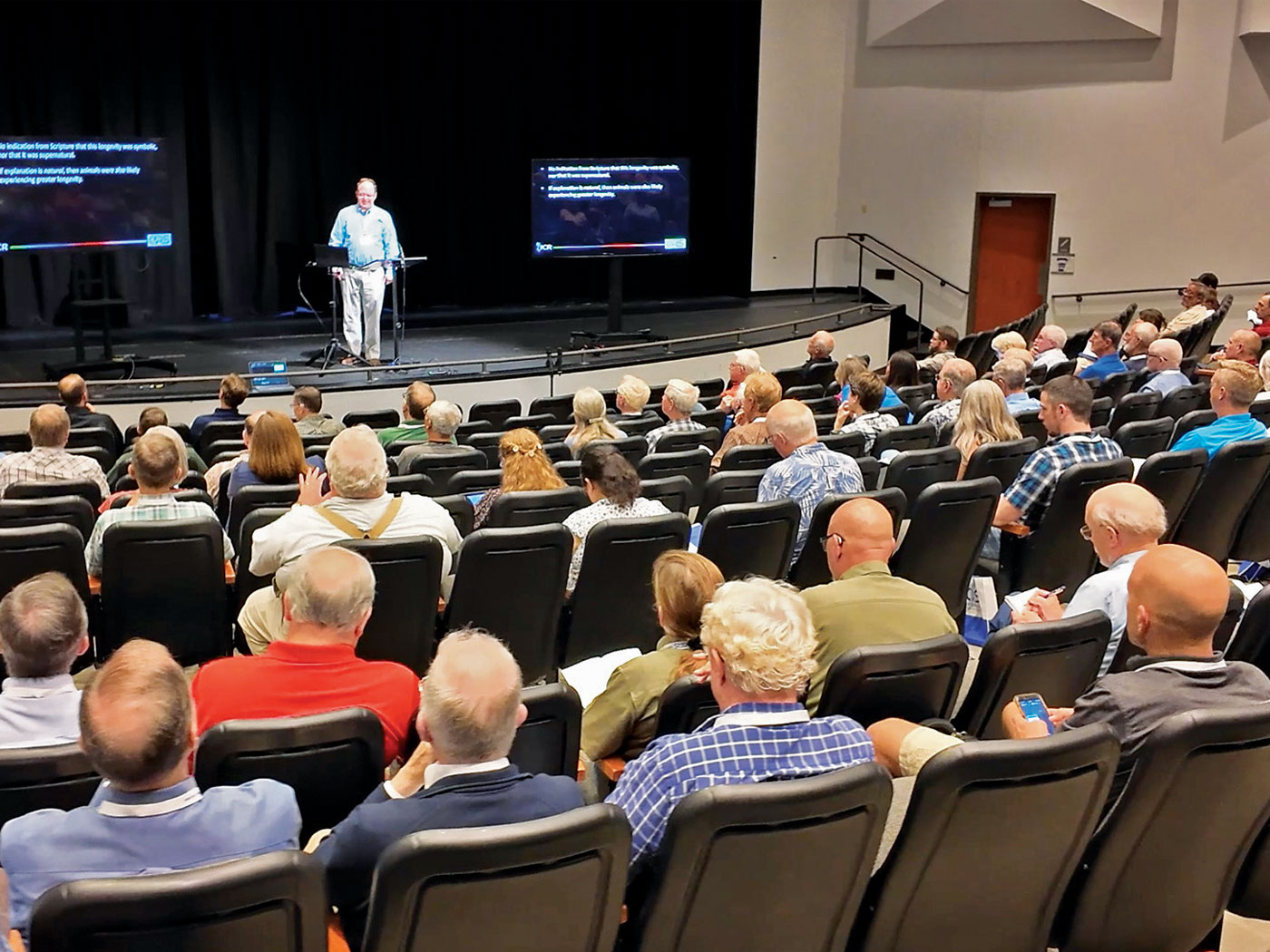
Creation-evolution debates played a primary role in the early upswing of interest in creationism. In the 1970s, debates became major events on university campuses and were often the first time students were exposed to a credible case for creation. Dr. Duane Gish--senior vice president of ICR for 34 years--participated in almost 400 debates; my father, Dr. Henry M. Morris, took part in more than 100. But now the debates have pretty much ceased. Several leading evolutionists cautioned their colleagues to avoid them, and with good reason. The creationists seemed to always win.
Over the years I was involved in about 30 debates and, strangely, enjoyed it. My background is in geology, while the debates mainly centered on biology and paleontology. Whenever one was scheduled, I hopped on the learning curve, reading everything the opposing professor had written. I was often nervous, but afterward wondered--was that the best the evolutionists could do? It seemed that none had good scientific arguments.
My first debate was in high school, right after my father wrote The Genesis Flood with John Whitcomb. Evolution-creation was a hot topic. My biology teacher arranged for the outspoken class evolutionist to debate me, the quietest kid in class. My opponent began by defining evolution as "change." A baby grows into an adult, a caterpillar changes into a butterfly. Change happens, therefore evolution is true. I focused on the evolutionary claim that whales evolved from a land animal. This idea was so ludicrous on its face that no one would believe it. As I recall, I won the debate 28-2.
The theme of defining evolution as change recurred numerous times in later debates. Once I faced the entire faculty of a large university. I insisted that evolution speaks of specific change, of basic types of animals evolving into different types. I challenged the faculty--who had barred students from attending--to demonstrate this sort of transformation from the fossil record. Finally, one brave professor said she was an expert in fossil clams and had evidence that clams had changed. I agreed, but requested that she show how this was proof of evolution. Even with the changes, the clams remained clams.
On a lecture/debate tour in Moscow before the Iron Curtain was lifted, the evolutionists insisted that the main reason they believed in evolution was the existence of pain, suffering, and death, the same reason Darwin gave. The God of the Bible would certainly have done things differently, therefore there is no God and evolution by natural selection is the best alternative. Of course, there is an answer to that: the introduction of sin into God's very good creation. Change happened at the curse, but it wasn't evolutionary change.
Today we face an important choice. Christ offers that we can put off the old and be "renewed in the spirit of your mind" (Ephesians 4:22-24). We can "repent" or change our minds, attitudes, and actions, and accept Christ's solution to the sin problem. We should also repent of our wrong thinking about origins and cease ascribing to natural processes the abilities and intelligence clearly reserved for God.
* Dr. Morris is President of the Institute for Creation Research.
Cite this article: Morris, J. 2008. Reflections on the Debate. Acts & Facts. 37 (3): 3.