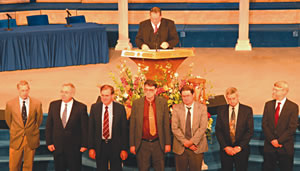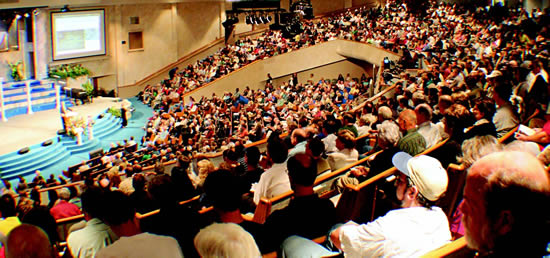
A sell-out crowd of around 2,300 people gathered at Shadow Mountain Community Church in San Diego on Saturday, November 5, 2005, to hear about the groundbreaking discoveries from the RATE research team (Radioisotopes and the Age of The Earth). The conference featured four of the eight RATE scientists (all of whom were present) who presented some of their most noteworthy findings, including Project Manager Dr. Larry Vardiman, who summarized the incredible results and implications from this monumental eight-year project.
Dr. Henry Morris, Founder and President Emeritus of ICR, opened up the conference in prayer, followed by ICR's President Dr. John Morris, who offered a few words of praise and encouragement about this historic breakthrough in creation science. Dr. John recognized the RATE project as the most significant and successful research project in ICR's 36-year history, and expressed his thanks to God for bringing this enormous victory!
Dr. Russell Humphreys, Professor of Physics, was the first scientist to present his discoveries, sharing highlights from his research on helium diffusion that indicate that the age of the earth is only about 6,000 years, and explaining that the helium in radioactive crystals supports this contention.
Dr. Andrew Snelling, Professor of Geology, followed Dr. Humphreys, revealing his close study of radiohalos. His research showed that polonium radiohalos had to have formed rapidly under catastrophic conditions and that their formation is strong evidence for accelerated decay in different periods during earth's history.
 Perhaps one of the most amazing and surprising discoveries was presented by Dr. John Baumgardner, Professor of Geophysics, as he reported that large amounts of carbon-14 found in coal and diamonds supports a young earth and the Biblical account of Noah's Flood. Carbon-14 is a short-lived isotope used for dating organic materials like fossils and has a half-life of only 5,730 years, so finding C-14 in diamonds (as much as one hundred times the detection threshold) is very compelling evidence for a young earth.
Dr. Larry Vardiman, Professor of Atmospheric Science, recapped the results of the RATE research project with the following summary points and implications.
Main summary points:
- A large amount of radioactive decay has occurred.
- Conventional radioisotope dates differ radically.
- Nuclear processes were accelerated during certain periods of earth's history.
- Helium diffusion and carbon-14 in diamonds is strong evidence for a young earth.
Implications:
- Creation and the Flood are genuine historic events.
- The Bible is scientifically reliable—the Scriptures mean exactly what they say!
The conference culminated with the long awaited premiere showing of ICR's new "docudrama," entitled Thousands . . . Not Billions, a two-year video project (just recently completed) which combines drama, scientists summary reports, animations, and illustrations to tell the remarkable story of the RATE research project. The conference ended with a lively question and answer session, and a time of book signing.
The San Diego conference set the stage for future RATE conferences across the country in 2006 and beyond. Plans are already in place for conferences in the Fort Lauderdale, Philadelphia, and Houston areas with others to follow. ICR would like to encourage pastors and Christian leaders to collaborate with us to bring this faith-building message to as many churches as possible. For more information on hosting a conference in your area, please contact ICR's Director of Event Planning, Dave Evans, at 619/448-0900, ext. 6021.