Critics of recent creation ridicule the belief that a universe so vast, composed of so many diverse phenomena and processes running at diverse rates, could be fit into a few thousand years. They are less likely to acknowledge the many and severe problems with an old, evolutionary universe. Some of these problems have become accentuated in recent months. Any cosmological system is going to have its share of challenging phenomena to explain. Before casting stones, a little humility is in order.
A strange cartoon graced the cover of Science News last fall (10/08/2005) that serves as a symbol for a whole class of problems for evolutionary astronomers. It showed a star-shaped old man in a stellar maternity ward. With its title, "Crisis in the Cosmos? Galaxy-formation theory is in peril," the article exposed a running theme in astronomy: as far back as we look, stars and galaxies appear mature.
"Imagine peering into a nursery and seeing, among the cooing babies, a few that look like grown men," Ron Cowen quipped. "That's the startling situation that astronomers have stumbled upon as they've looked deep into space and thus back to a time when newborn galaxies filled the cosmos."
Other recent findings echo this theme of "mature at birth." Consider three examples from March of this year:
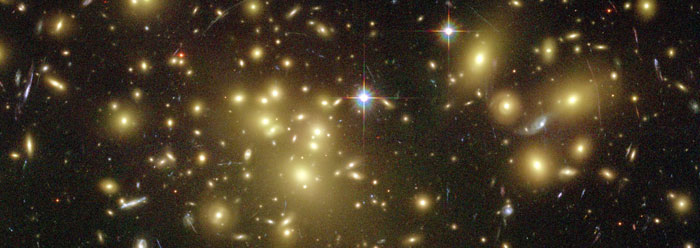
- The Spitzer Space Telescope found clusters of galaxies a third of the assumed age of the universe.
- UV and infrared surveys found "ubiquitous" galaxies at redshift 6.7, corresponding to 5% the assumed age.
- The Swift satellite detected a gamma-ray burst 12.8 billion years old in the assumed time scale. "This means," said Nature (3/9/2006, p. 164) "that not only did stars form in this short period of time after the Big Bang, but also that enough time had elapsed for them to evolve and collapse into black holes."
More examples could be cited. These findings corroborate a January 8, 2002, NASA press release that was considered astonishing at the time: based on Hubble surveys, "the grand finale came first" in stellar and galactic evolution. As far back as telescopes look, they see mature creation, not evolution.
Add to this other problems with evolutionary views. Theories of star formation, galaxy formation, planet formation, globular cluster ages, universal expansion and much more—including some of the best-established ideas in astronomy—have had their share of upsets.
In a sense, this is how science works. No "fact" of science should be immune from challenge by new findings. What this teaches us, though, is that cockiness is out of order. Critics of recent creation should not be the first to throw stones.
Believers expect God's ways to be inscrutable. Creation involved unique processes that could have had unusual effects on our perceptions of space and time. Given the fallibility of human understanding, the reasonable approach in any area of science, especially the historical sciences of ultimate origins, should be to begin with the word of the Eyewitness.
* David F. Coppedge works in the Cassini program at the Jet Propulsion Laboratory.
Cite this article: Coppedge, D. F. 2006. Mature at Birth: Universe Discredits Evolution. Acts & Facts. 35 (10).