Return from Grand Canyon | The Institute for Creation Research

Return from Grand Canyon

ICR just returned from Grand Canyon having completed another successful tour, with both a 10-day rafting option on the Colorado River and a 7-day bussing adventure throughout the American Southwest. Actually the ICR tours not only explore Grand Canyon, but also Mount St. Helens, Yellowstone Park, Galapagos Islands, and now the new tour to Yosemite accomplish several important goals. Some may ask, "Why does ICR offer such `vacation' packages? Isn't ICR's mission an academic and research one?"

Several reasons come to mind. Most obvious, each of the tours are to areas of ongoing ICR research. From radioisotope dating of Grand Canyon rocks to genetic diversity in the Galapagos Islands, important creation questions are being addressed. Furthermore, since ICR receives no government funding for this research, the tours help facilitate and finance it. Often the ICR scientists will be on site a week before the tour arrives, financed by tour "profits," doing the important field mapping and sample collection.

A second major goal of ICR is communication of creation information. Through the tours, numerous Christians have been more thoroughly trained than otherwise possible with first-hand knowledge gained from hands-on interaction with the sites and researchers involved. Tour veterans are thus prepared for a more effective ministry, and even have their own photographs and stories to tell.

Thirdly, these trained tour participants have tasted of the ICR passion for creation and received lasting input regarding creation's relevance to evangelism and society. Bible study and sweet fellowship impress these truths even more fully. These new ICR ambassadors leave better equipped to carry the ICR message into venues an ICR scientist might not reach.

Yes, the tours are a very important aspect of ICR's ministry. Join us if at all possible. The inaugural Yosemite tour this fall would be a good place to start!
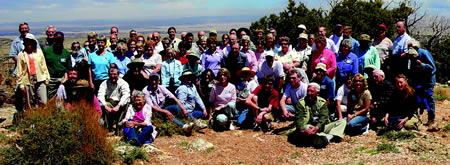
A smiling crowd of creation enthusiasts!

Cite this article: John D. Morris, Ph.D. 2006. Return from Grand Canyon. Acts & Facts. 35 (7).

The Latest
NEWS
Tiny Dinosaur, Big Design: What a New Fossil Really Shows
A new dinosaur fossil from Patagonia (the southern tip of South America) is making headlines. Conventional scientists say it shows how a group of strange...

NEWS
Life Can Rebound “Ridiculously Fast”
In the beginning, God created plants and animals to multiply and fill the earth (Genesis 1:11–13, 20–25). So, when areas are devastated,...

NEWS
Under the Alerce Trees: A Hidden Fungal Ecosystem
Some of the oldest living trees on Earth are in the temperate rainforests of the Chilean Coast Range. Second only to the bristlecone pine in age, these...

NEWS
God’s Architecture: The Hidden Biology in a Paris Icon
In 1889, Paris hosted the Exposition Universelle, a world’s fair celebrating the hundredth anniversary of the French Revolution. To mark the occasion,...

NEWS
Chemical Clues Raise Questions About Early Animals
What if a simple sea sponge could spark a debate about the origin of animal life? A recent study suggests that some of Earth’s earliest animals...

NEWS
Alive with Christ
“Now if we be dead with Christ, we believe that we shall also live with him: knowing that Christ being raised from the dead dieth no more; death...

NEWS
April 2026 Wallpaper
"Ask the Lord for rain in the time of the latter rain. The Lord will make flashing clouds; He will give them showers of rain, Grass in the field...

NEWS
Does Earth Have a Twin?
A possible Earth-like planet 146 light-years away has recently been discovered by citizen scientists.1 The evolutionary community is cautiously...

CREATION PODCAST
Christian PhDs: 5 New Discoveries That Have Atheists SCRAMBLING
From the depths of outer space to the microscopic strands of our DNA, recent scientific discoveries are telling a story secular scientists are scrambling...

NEWS
Giant Virus, Big Claims: Does Ushikuvirus Explain Complex Life?
A newly discovered giant virus called ushikuvirus has been described by conventional scientists as a possible clue to how complex cells evolved. But...