Beautiful, golden fossilized amber begins as resin. Exuded as a sticky liquid from bark or wood, it polymerizes into solid amber. It slowly degrades when left in the open and therefore must be rather quickly buried in dense sediments. There are about twenty amber deposits, the most prominent locations are in the Baltic and Dominican Republic.
Many thousands of amber pieces contain fossils. A variety of animals are preserved in those golden tombs, including insects, crustaceans, tadpoles, lizards, annelids, snails, and spiders. In 1997, a piece of Dominican amber was appraised at $50,000 because it contained a frog. Even hair of mammals has been found. Such preservation gives us an idea of the pre-Flood ecosystem thousands of years ago.
The beautiful and aromatic blue amber of the Dominican Republic is the most rewarding of the ambers for aesthetic and scientific reasons, and holds the record when it comes to fossil content. Not only does this amber contain ten times more insects than Baltic amber, it also is 90% more transparent. Some of the fossilized creatures are extinct, but this is hardly evidence for vertical evolution.
There have even been discoveries of preserved animal and plant DNA, "Amber has preserved ancient life to such infinitesimal detail that it even captures fragments of DNA of the organisms entrapped in it."1 The discovery of DNA segments is not surprising for the creationist. However, it stupefies the Darwinist, because evolutionists maintain that amber is many millions of years old.
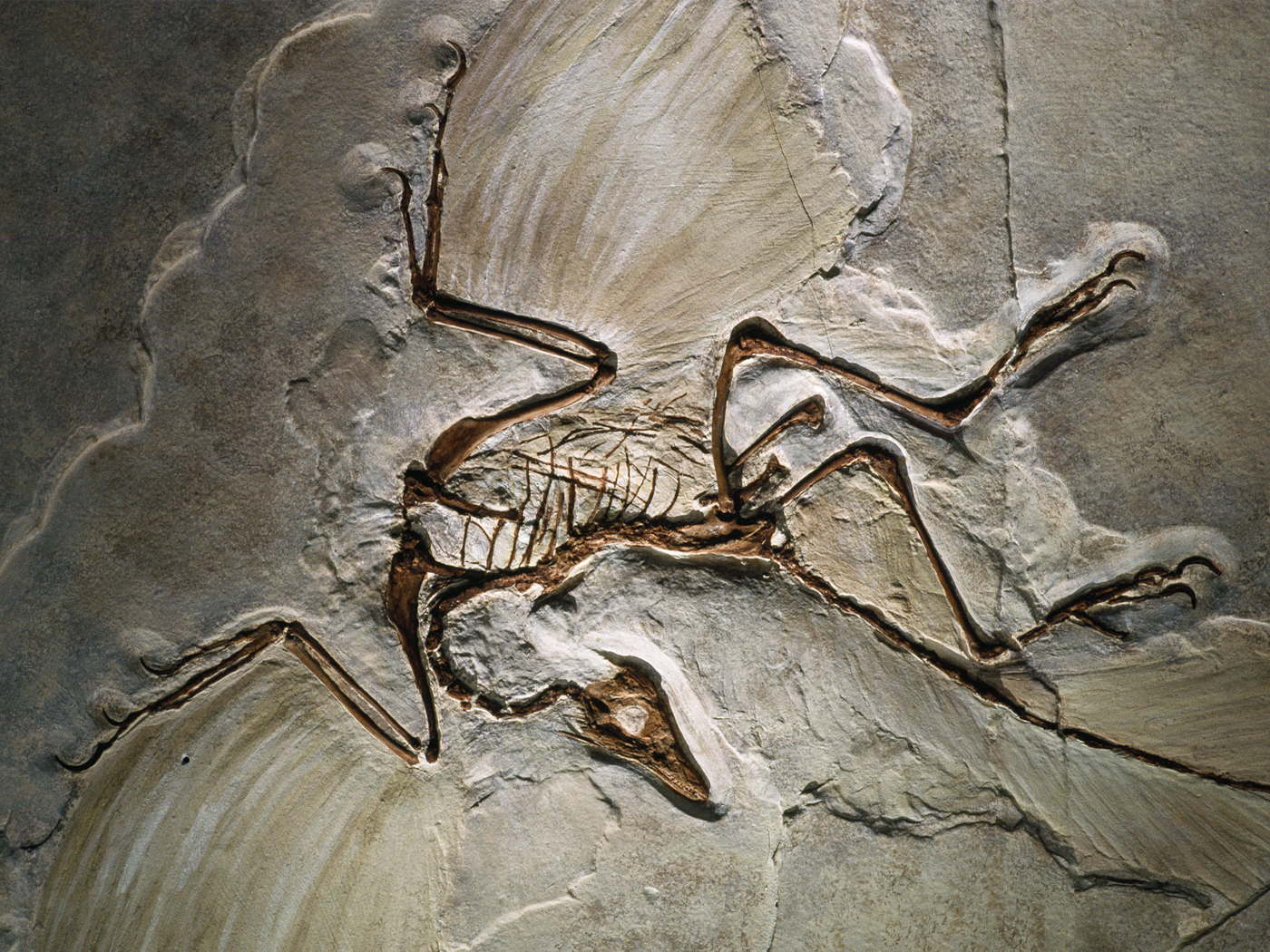
The oldest known amber containing insects is — according to evolutionary dating — 146 million years old. But what is found are animal forms that remain unchanged. Secular biologists are constantly amazed that creatures displayed in such a clear sarcophagus can be identified down to genus or even species. For example, small oak tree flowers have been found dated at "90 million years old," but they are still oak. The same is true for the oldest feather (100% feather — not a transition from a scale), the oldest mushroom, mosquito, biting black fly, and fig wasp. All that is seen in these organisms is no change ("stasis") or the possibility of extinction. This in no way supports the case for macroevolution, but is certainly what creationists expect.
To conclude, just as the mineralized fossils found in sedimentary rock units worldwide fail to support macroevolution, the same holds true for animals and plants found in "ancient" amber. Creation scientists aren't particularly surprised by the plants, animals, and DNA found in amber considering the youth of this planet. Furthermore, creationists have been requesting these creatures in amber should be subjected to Carbon 14 dating. A similar request is made to date the "70 million year old" soft dinosaur tissue recently discovered in eastern Montana (see Origins Issues "The Devastating Issue of Dinosaur Tissue").2 But secular scientists are reticent. Why? The search for truth should actively go where the physical evidence leads.
Endnotes
- http://www.amnh.org/exhibitions/amber/
- See also Yeoman, B. April 2006. Schweitzer's dangerous discovery. Discover, p. 37.
* Frank Sherwin is a zoologist and seminar speaker for ICR.
Cite this article: Sherwin, F. 2006. Amber: A Window to the Recent Past. Acts & Facts. 35 (7).