



To Die Is To Live | The Institute for Creation Research

To Die Is To Live

“For whosoever will save his life shall lose it; but whosoever shall lose his life for my sake and the gospel’s, the same shall save it” (Mark 8:35).

The principle expressed in this verse must be of paramount importance, for it is found repeated in one way or another, probably more often than any other single principle in the New Testament. Note the following examples representing at least four separate messages from the Lord Jesus:

Matthew 10:39: “He that findeth his life shall lose it; and he that loseth his life for my sake shall find it.”

Matthew 16:25: “For whosoever will save his life shall lose it: and whosoever will lose his life for my sake shall find it.”

Luke 9:24: “For whosoever will save his life shall lose it: but whosoever will lose his life for my sake, the same shall save it.”

Luke 17:33: “Whosoever shall seek to save his life shall lose it; and whosoever shall lose his life shall preserve it.”

John 12:25: “He that loveth his life shall lose it; and he that hateth his life in this world shall keep it unto life eternal.”

This remarkable divine paradox-that to die means to live-is also found expressed in many other ways in the epistles. Paul says, for example: “I am crucified with Christ: nevertheless I live” (Galatians 2:20). Note also such Scriptures as Romans 12:1,2; II Corinthians 5:14,15; 6:9,10; Philippians 1:21–24; II Timothy 2:11,12.

There are many pietistic Christians who interpret such passages as implying a so-called “deeper life,” which is attained by certain Christians and not by others, through some mystical experience. However, Jesus did not say to lose one’s life for a deeper life, but for “my sake and the gospel’s!” Christ wants us to live in simple obedience to His will, as recorded in His word, proclaiming in all we say and do that He is Creator, Savior, and coming King. HMM

The Latest
NEWS
Thanks Be Unto God
“But thanks be to God, which giveth us the victory through our Lord Jesus Christ.” (1 Corinthians 15:57) There are innumerable things...

NEWS
Watching PBS: Running Away . . . from the Creator
“On the Run,” the final episode in the PBS series Evolution, tells a story about the evolution of muscles, with a special focus on how horses...

NEWS
Brain Awareness at Death: Beyond the Physical
Death is often pictured as an instant shutdown. The heart stops, blood flow fails, and the brain quiets. But recordings from dying brains suggest the...

NEWS
Watching PBS: Sexually Confused . . . in More Ways Than One
The origin of sex is one of the most obvious difficulties with the evolutionary story. Male reproductive organs are useless without corresponding female...

DAYS OF PRAISE DEVOTIONALS
Winter 2026
...

NEWS
Your Brain Counts Before You Do
Flash three dots on a screen for a split second, and most people can tell how many appeared without counting. Show 20 dots, and the answer becomes less...

NEWS
The Christian’s Higher Duty
“To the distinguished Character of Patriot, it should be our highest Glory to add the more distinguished Character of Christian.”1...

ACTS & FACTS
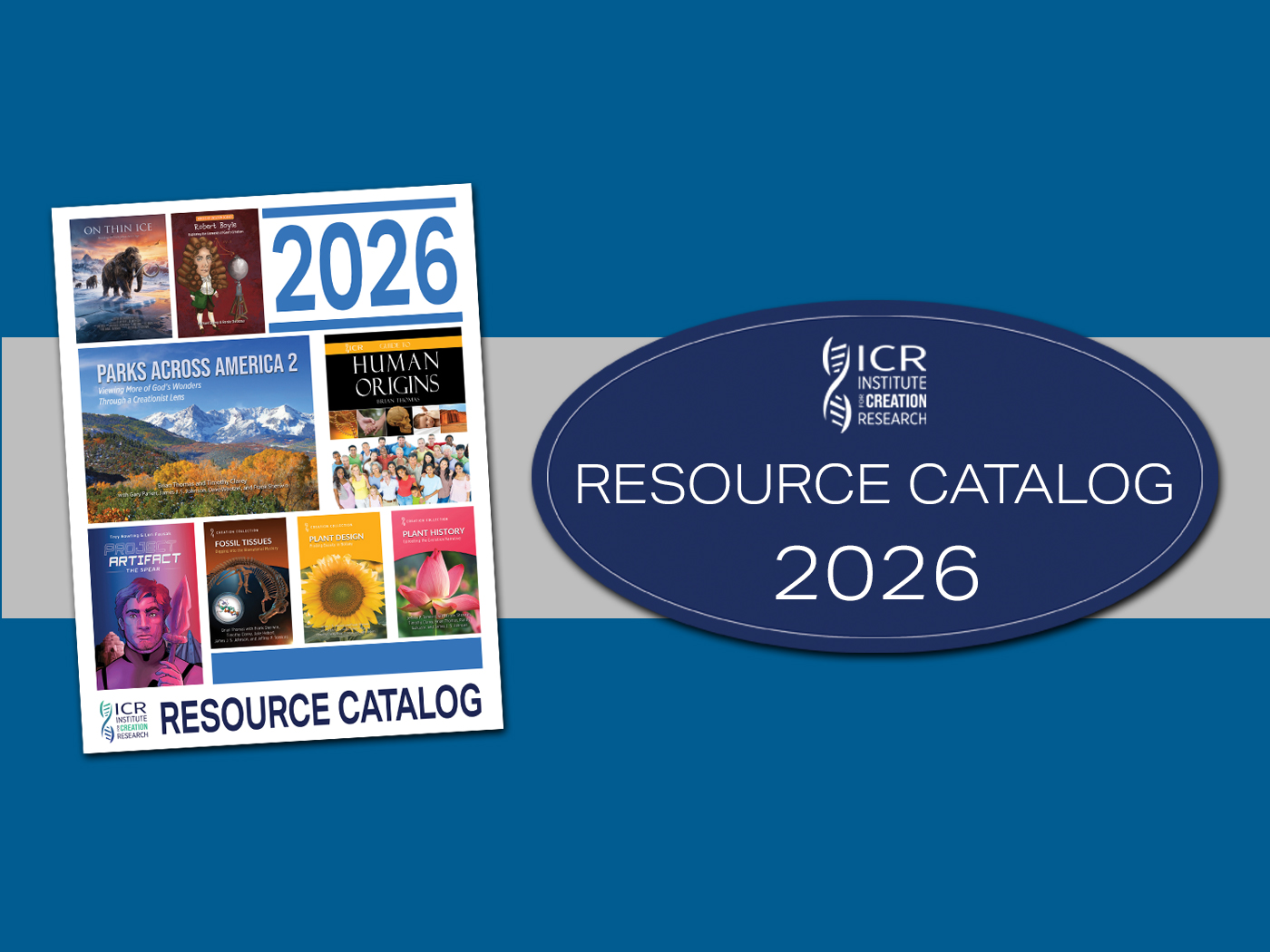
ICR 2026 Resource Catalog
At the Institute for Creation Research, our mission is not only to conduct research demonstrating how science confirms Scripture but also to share this...

NEWS
Watching PBS: An Imaginary (Evolutionary) Elephant Walk
by Jake Hebert, Ph.D., and Michael J. Boyle, Ph.D.* “Make believe” are the first two words in the lyrics of Henry Mancini’s 1961...

NEWS
Engineers Learn from Octopus Arms
An octopus can do something engineers still struggle to copy: control eight soft arms with no bones or fixed joints. Each arm can bend, twist, stretch,...