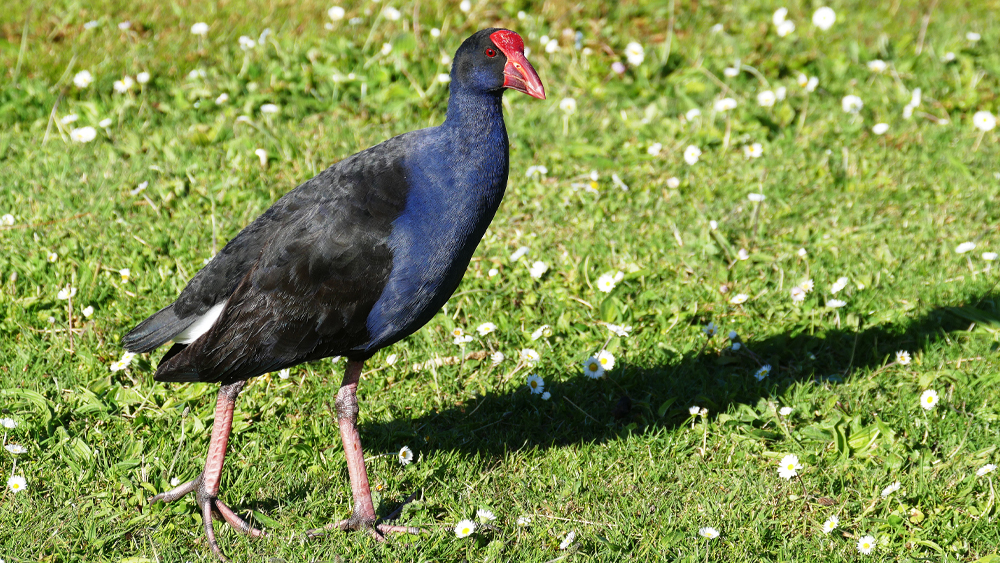
Bird calls are something we often take for granted. After all, when we listen to them, we hear squawks, warbles, and chirps. Could there actually be information, something complex, that they’re transmitting? Scientists now say “yes” after studying a fun-sounding bird from New Zealand—the pukeko.1
Bird sounds are classified into calls and songs. Calls are simple and short, such as an alarm call. Melodious songs, however, are longer and more complex, with varied pitch and tempo. The songs also have defined rhythm and structure that the bird uses in breeding and defending an area.
Intricate? Absolutely.
According to the online Smithsonian magazine, “The calls and songs of some species in these groups [parrots, songbirds, and hummingbirds] appear to have even more in common with human language, such as conveying information intentionally and using simple forms of some of the elements of human language such as phonology, semantics and syntax.”2 For example, a separate report in Current Biology said that the tiny hummingbird has “highly diverse vocal behaviors”3 and can achieve notes so high that only a dog can hear them.4
Researchers based at the University of Konstanz investigated pukekos, or Australasian swamphens (Porphyrio melanotus melanotus). Their work has revealed incredible complexity within call sequences that include prefixes, suffixes, and connecting elements.1
The international team of biologists and ornithologists wanted to know if the pukekos combined individual sound elements of their range of calls to communicate with each other. They recorded 6,093 calls over the course of several days from adult and chick pukekos by placing miniature audio recorders in 17 of their nests.
The scientists identified two organizational tiers in the bird’s communication: calls and call sequences. Each level had its own combination of rules. And according to University of Konstanz news, these “rules guided how such sound elements were combined to form calls.”1 In other words, they found that the combinatorial abilities of this two-tiered system revealed clear structural patterns.
Publishing in the journal Animal Behaviour, the study authors wrote, “This hierarchical combinatorial capacity showed how a relatively limited set of acoustic elements can generate an extensive repertoire of calls.”5 This hardly sounds like the product of chance and time, but rather purpose and design.
Indeed, intricate and rapid bird calls are an amazing confirmation of design. ICR’s Dr. Jeff Tomkins describes another example from the Australian honeyeater’s ability to warn his fellow birds of a hungry hawk making a dive to obtain a smaller bird.
When the honeyeater gives out this important message, it “front-loads” [a lightning-fast, information-rich message] concerning urgency into the first note of the alarm call, allowing other honeyeaters to respond quickly and take cover. Then the honeyeater tags on more specific notes to reinforce the message and signal information to the others on how long they need to remain hidden. And these messages will get longer with more notes in direct relationship to the level of threat.6
This isn’t just a chirp of surprise. It is a sophisticated two-stage alarm packed with critical information dispersed to local honeyeaters. This is much like the “very sophisticated, structured communication system” of the pukeko.1
To conclude, the team discovered that pukekos of New Zealand utilize sound elements to produce calls and in turn combine them to make longer complex call sequences with set rules.5 Lead author of the research, Gabriella Gall, told the University of Konstanz that their “next goal is to find out the exact meaning of sound elements and their combinations.”1
Even though these sound elements and set rules, like all animal communication, fall short of the complexities of human language, they have all the earmarks of a complex code. The pukeko’s information-rich calls are the result of purposefully arranged combinatorial abilities—which point to design and the Designer.7
References
- The Sophisticated Communication of Pukeko. University of Konstanz. Posted on uni-konstaz.de January 20, 2026.
- Mason, B. Do Birds Have Language? Smithsonian. Posted on smithsonianmag.com February 25, 2022.
- Olson, C. et al. 2018. Black Jacobin Hummingbirds Vocalize above the Known Hearing Range of Birds. Current Biology. 28 (5): 204–205.
- Mock, J. Some Hummingbirds Hit Notes So High, Only a Dog Could Hear Them. Popular Science. Posted on popsci.com October 18, 2018.
- Gall, G. et al. Examining Combinatoriality within the Pukeko Vocal Repertoire. Animal Behavior. Posted online before print on sciencedirect.com January 9, 2026, accessed January 29, 2026.
- Tomkins, J. High-Speed Bird Communication Is Complex. Creation Science Update. Posted on ICR.org April 6, 2020.
- Thomas, B. Jay Talking. Creation Science Update. Posted on ICR.org June 29, 2009.
* Dr. Sherwin is a science news writer at the Institute for Creation Research. He earned an M.A. in invertebrate zoology from the University of Northern Colorado and received an honorary doctorate of science from Pensacola Christian College.