In 2020, Hungarian zoologists described the hybridization of a Russian sturgeon and American paddlefish.1 Some sources have reported the scientists created a “franken-fish”—as indeed it looks quite bizarre.2 Researchers, however, are calling it the sturddlefish—with sharp fins and an elongated nose.3
A hybrid in zoology is an offspring produced from a cross between parents of different genotypes (the precise genetic constitution of a cell or individual).4 For example, a zonkey results from a donkey crossed with a zebra; a liger results from a male lion and female tiger producing. This is not evolution, of course—they belong to the horse and cat kind respectively.
How did this recent hybridization happen? The scientists were attempting a type of asexual reproduction between the two species of fish. Gynogenesis is a unique condition whereby a female must copulate before she can produce eggs that will need no fertilization and can develop normally into an individual. In this case, the fish develops from maternal DNA (the egg or oocyte). But the scientists were shocked to discover that fusion did happen via union of the sturgeon and paddlefish, producing about a hundred “sturddlefish” hybrids.3
The Russian sturgeon (Acipenser gueldenstaedtii) is a fascinating “prehistoric” fish that can live up to a century and achieve a length of seven feet. Evolutionists call sturgeons “living fossils” that existed alongside dinosaurs supposedly millions of years ago.3 They live in the waterways of Russia, Bulgaria and Romania. Sturgeons are said to appear in the early Silurian period, over 400 million years ago as 100 percent sturgeons.5
American paddlefish (Polyodon spathula) have always been paddlefish, dating back “millions of years”—as secular scientists would say—yet, like sturgeons, showing no evidence of evolution. Commercial and academic laboratories have found carbon-14 in cartilaginous paddlefish fossil samples.6 Any carbon-14 discovered in samples directly challenges evolution’s millions of years.
Not surprisingly, the American paddlefish is closely related to the Russian sturgeon. They both belong to the order Acipenseriformes but to different families—Acipenseridae and Polyodontidae. Evolutionists are surprised these two fish are so similar as they view them as “separated by 184 million years of evolution” and as coming from an unknown “common ancestor.”3 Creationists see them as having been created only thousands of years ago, belonging to the same created kind.
About 100 of the strange sturddlefish hybrids were accidently produced—not created. Only God can create. The aforementioned Hungarian zoologists worked with what was already present: a Russian sturgeon and American paddlefish, both 100 percent fish (and closely-related). Under the right conditions, facilitated by at least 13 advanced-degree scientists, two fish of the same order can hybridize into bizarre forms such as the fearsome franken-fish (sturddlefish).1 It’s not evolution, just hybridization of God’s created creatures.
Stage image: The sturddlefish has a mix of genes from the Russian sturgeon and the American paddlefish.
Stage image credit: Genes 2020, 11(7), 753; https://doi.org/10.3390/genes11070753, CC BY 4.0. Copyright © 2020. Adapted for use in accordance with federal copyright (fair use doctrine) law. Usage by ICR does not imply endorsement of copyright holders.
References
1. JenÅ‘ Káldy et al., “Hybridization of Russian Sturgeon (Acipenser gueldenstaedtii, Brandt and Ratzeberg, 1833) and American Paddlefish (Polyodon spathula, Walbaum 1792) and Evaluation of Their Progeny,” Genes 11, no. 7 (July 2020): 753.
2. Dino-Franken-Fish Created Accidentally By Scientists in Hungary. The Weather Channel. Posted on msn.com July 23, 2020.
3. Pappas, S. Scientists accidentally create 'impossible' hybrid fish. LiveScience. Posted on livescience.com July 20, 2020.
4. Johnson, J. 2018. Norway's Redchat Defies Evolutionary Speciation. Acts & Facts. 48 (1).
5. Hickman, C. et al. Integrated Principles of Zoology. (New York: McGraw-Hill Education, 2017), 518.
6. Thomas, B. Carbon-14 Found in Dinosaur Fossils. Creation Science Update. Posted on ICR.org July 6, 2015.
*Mr. Frank Sherwin is Research Associate at the Institute for Creation Research and earned his master’s degree in invertebrate zoology from the University of Northern Colorado.
Was a Franken-Fish "Created"?
More DNA Was Created as a Reservoir for the Information of Life
Massive Genetic Study Purporting Human Evolution Debunked
The recent publication of a research paper evoked such headlines as “Massive genetic study shows how humans are evolving.”1,2...
'RNA World' Paper Retracted
The whole concept of how life originated is an insurmountable naturalistic hurdle. Life requires DNA, RNA, and protein in an interdependent triad in...
Prions Pass Traits by Their Shape, Not DNA
Medical students learn classic pathology cases to help them identify diseases and their causes. One such case involved human cannibals who ended up...
More Creation Science Update

December 2025 ICR Wallpaper
"Come now, and let us reason together," Says the LORD, "Though your sins are like scarlet, They shall be as white as snow; Though they...
Claims of 'Freshwater' Plesiosaurs Drowned by the Flood
A new discovery in Morocco’s Saharan Desert has evolutionary scientists making claims that plesiosaurs lived in freshwater too.1 Usually...

Discover the Evidence that Exists for the Bible!
For generations, the Bible has faced skepticism and challenges to its credibility. Critics have questioned whether it is merely a collection of stories...
The Latest
The Lipstick Vine: Evidence of Designed Adaption
In their desire to validate the questionable case for evolution, conventional biologists will appeal to local adaptation, variation, and ecological...
Biblical Giants in the News
Recent claims that an Egyptian papyrus scroll may affirm the past existence of giants have gone viral,1,2 and news outlets still reported...

March 2026 ICR Wallpaper
"Behold, I will do a new thing, Now it shall spring forth; Shall you not know it? I will even make a road in the wilderness And rivers in the desert." (Isaiah...

Creation Kids: Ladybugs
Hi, kids! We created a special Acts & Facts just for you! Have fun doing the activities while learning about the wonderful world God...

North Cascades National Park: Assembled During the Flood and...
North Cascades National Park is sometimes called “the American Alps” for its stunning vistas that average about 5,000 feet above sea level,...

Engineered Genomic Changes in Adaptation
Programmed genome rearrangements (PGRs) are deliberate, genetically controlled changes in an organism’s DNA sequence and chromosome structure...

How Can I Know Evolution Is Wrong?
Evolution pushes Christians to doubt what our Bibles say about creation by asserting impersonal processes made everything over eons. Scripture asserts...

What Is a Charitable Gift Annuity?
A charitable gift annuity (CGA) is a simple, proven way to make a gift to ICR and receive fixed income for life—often at rates higher than CDs....
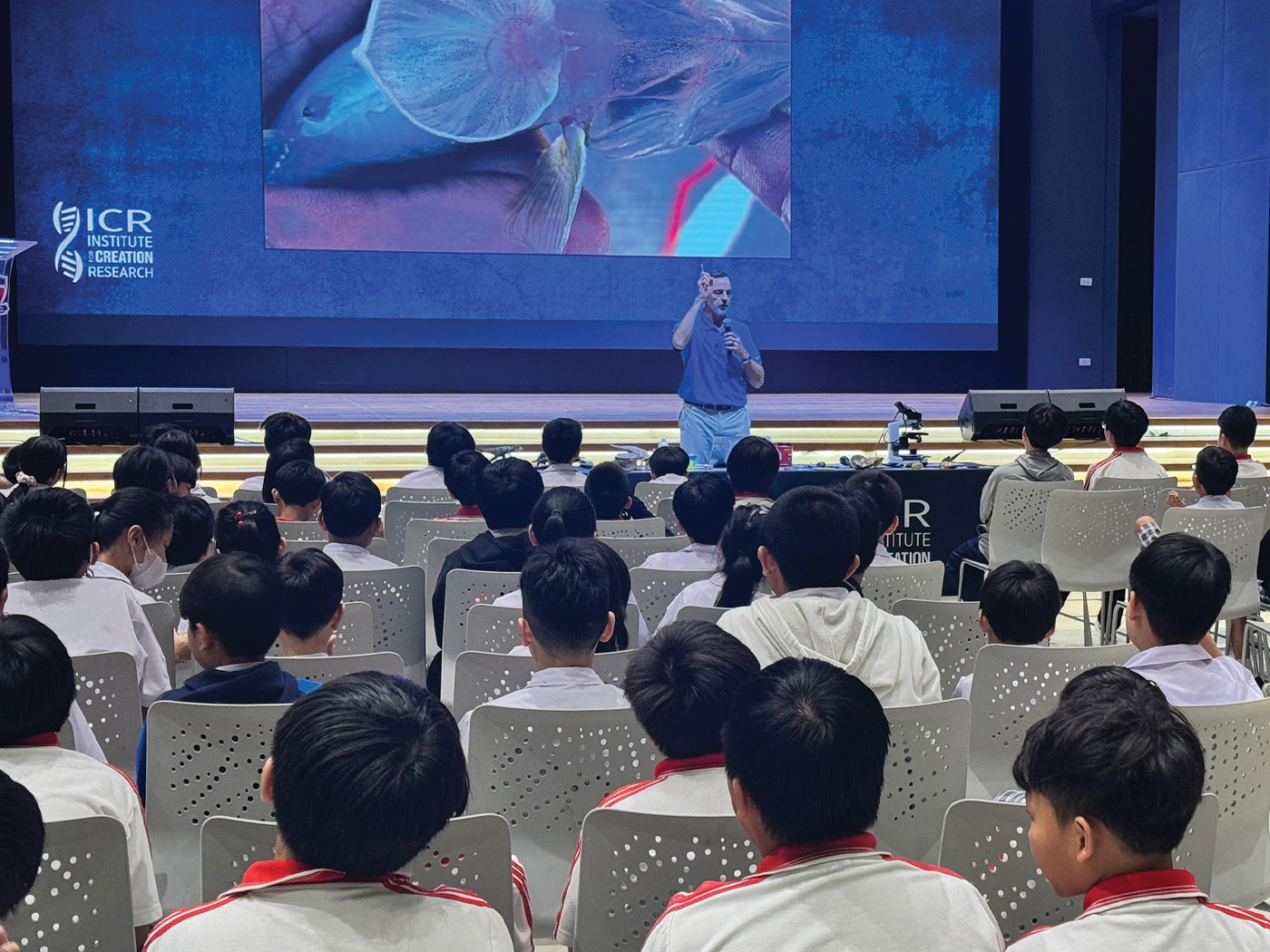
ICR in Thailand
As the unified body of Christ, we marvel when individual notes come together to form beautiful harmonic chords. Dino Dave and Dr. Brian were blessed...

Making a TOBD Easy: A Conversation That Says It All
“I get what you’re saying! And I would love to think about biology from a design perspective, but I don’t even know where to begin,”...
Shop Related Products



The Fossils Still Say No
$29.99