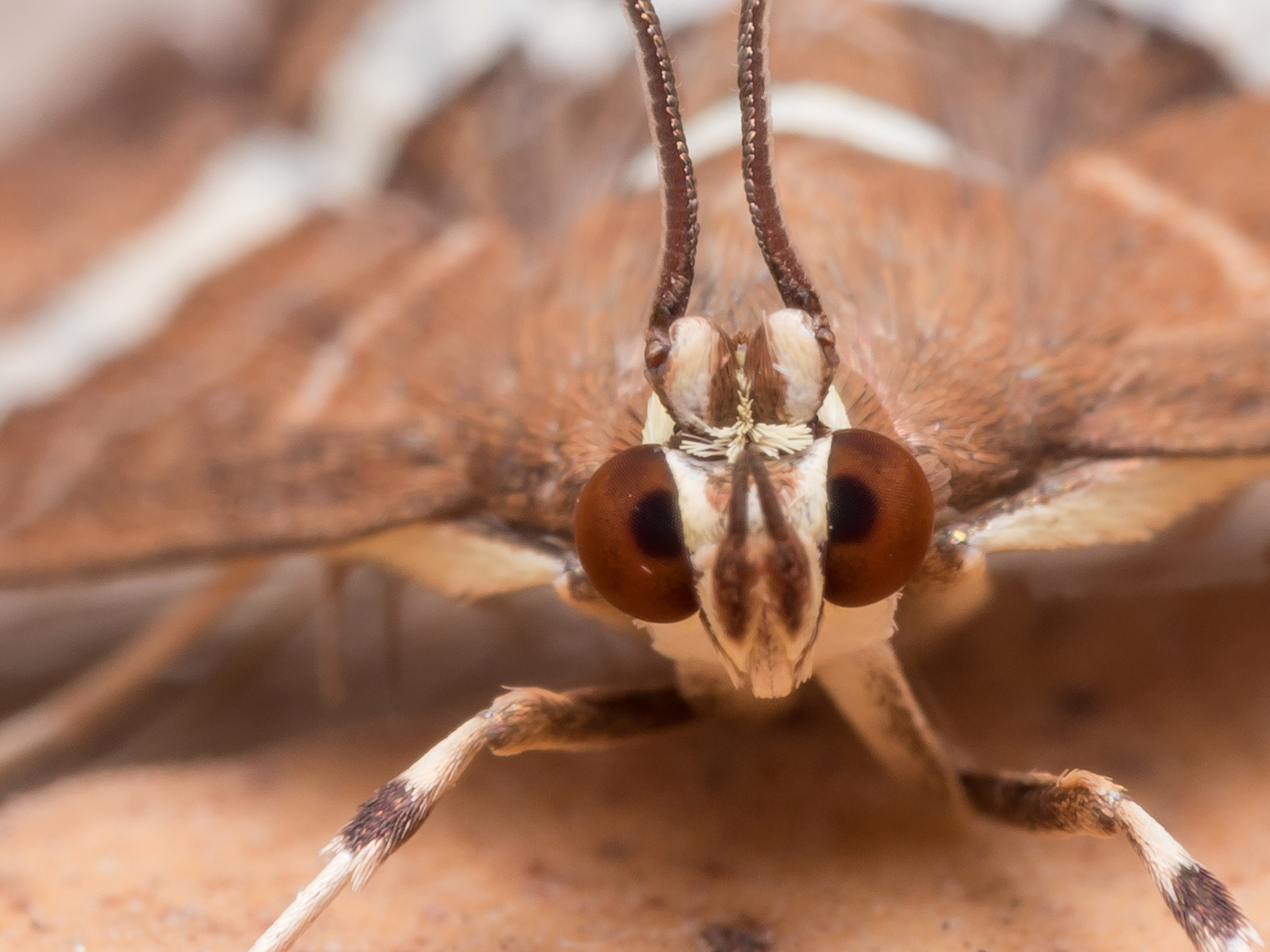
Many students are told about how increasing coal soot during Britain’s 18th and 19th century industrial revolution drove the color change observed in black peppered moths. The famous peppered moth story is one of the most persuasive evidences cited in textbooks in support of evolution. But recent genetic findings are raising questions about the accuracy of the scenario told by evolutionists.
Students are taught that only the white form of the peppered moth, Biston betularia, was known in Great Britain before the widespread burning of coal that covered buildings and trees with black soot. But as trees turned black from pollution, white-colored moths sunning themselves on trunks were easy pickings for birds. Then, as luck would have it, a random mutation occurred that turned some moths black. Subsequently, nature selected against white moths and selected for the black moths. This led to black moths dominating the population until the heavy coal burning period ended.
Previous problems with this account relate to factual distortions about whether peppered moths spend significant amounts of time on tree trunks where they are in danger of being eaten by birds.1 There is also the problem of including into the scientific explanations a flagrant personification of nature as exercising agency to select for and against different colored moths. New research now indicates there may be genetic reasons to question whether the “mutation” causing black coloration was simply a lucky accident or something else.
Back in 2016, a genetic research team led by Ilik J. Saccheri of the University of Liverpool, England, discovered that the black coloration was due to the insertion of a “transposable element” of DNA.2 Transposable elements are mobile stretches of DNA that can be excised from one portion of a chromosome and inserted into a different location. These insertions can change the expression of genes. Saccheri found that a large stretch of DNA exceeding 21,000 base pairs in length was inserted into another section of DNA that regulated the coloration of peppered moths. In fact, of the 105 black moths the team examined 103 (98%) had this identical insertion of the transposable element, but the insertion was absent in all 283 white moths studied. The repetitive insertion of the transposable element in the same location, along with its strong bias toward black moths, raises the question if this might be a regulated event and not truly a fortuitous accident.
A recent paper by Saccheri’s team now extends their research.3 Peppered moths were not the only moth species that responded to pollution by an increase in the frequency of the black variety. In this study the team focused on two other species that had a similar coloration response (see Figure 1). Per evolutionary dating methods, the moths diverged from each other about 40 million years (Myr) ago. Saccheri’s team focused on the gene-controlling coloration because, “Intriguingly, variation within the same gene (cortex) controls melanism for crypsis in the peppered moth, Biston betularia, and mimic wing patterns in Heliconius butterflies. This genetic convergence suggests that cortex, and possibly the region surrounding it, is a genetic hotspot for lepidopteran wing pattern evolution.”
They confirmed that in the two other species that altered regulation of the same cortex gene, the gene was responsible for the black coloration response. Noting such remarkably similar genetic parallels they said, “Our results imply the conservation of a developmental master switch for melanism in geometrid moths spanning 30–45 Myr, the estimated age of the subfamily Ennominae.” Just as important, this supposedly ancient “master switch” in all of the moths enabled what appears to be a regulated, rapid response to 19th and 20th century pollution. They add, “We have shown that parallel phenotypic clines across three co-occurring species, reflecting rapid adaptive responses to the same anthropogenic factor [coal soot], relied on genetic variation at the same locus [gene region].” What they do not yet know is if the change in the two moth species under consideration is due to a transposable element as it is in peppered moths.
Another observation leads one to question if the response to pollution was due to an accidental mutation, which is that these three species of moth were not the only responders. A press release by the University of Liverpool discussed with Sacchei the widespread extent of the dark coloration response to pollution and stated,
To sum up the findings that might steer a scientist to not only question whether black coloration is caused by an accidental mutation but then to consider that the cause could be a regulated mechanism are: genetic hotspots for wing coloration, coloration master switches, transposable elements consistently located to the same gene regulatory region, and the rapid, widespread response across dozens of species.
ICR has been laying the groundwork to develop a theory of biological design as a more scientific alternative to explain biological functions than selectionism.5 The theory is a working hypothesis of how the biological phenomena of growth, metabolism, reproduction, and adaptation function. One major premise of this theory is that biological functions are suitably explained by engineering principles. This theory produced a design-based, organism-focused model to explain the type of adaptation seen in these studies is called Continuous Environmental Tracking (CET).6 CET posits that creatures use the same system elements as a human-engineered tracking system of sensors and logic mechanisms produce appropriate responses to changed environments. As the evidence stands today, the rapid and predictable responses by so many species of moths could be seen as support for a regulated CET response.
References
1. Mikkola, K. 1984. On the selective forces acting in the industrial melanism of Biston and Oligia moths (Lepidoptera: Geometridae and Noctuidae). Biological Journal of the Linnean Society. 21(4): 409-421. Hooper, J. 2002. Of Moths and Men. New York: W. W. Norton and Co., 377.
2. van’t Hof, A. E. et al. 2016 The industrial melanism mutation in British peppered moths is a transposable element. Nature. 534: 102-105. doi:10.1038/nature17951
3. van’t Hof, A. E. et al. 2019. Genetic convergence of industrial melanism in three geometrid moths. Biology Letters. 15: 20190582.
4. Anonymous. 2019. ‘Industrial melanism’ linked to same gene in three moth species. Published at liverpool.ac.uk on October 16, 2019, accessed January 23, 2020.
5. Guliuzza, R. J. 2018. Engineered Adaptability: Adaptive Changes Are Purposeful, Not Random. Acts & Facts. 47 (6): 17-19.
6. Guliuzza, R. J. and P. B. Gaskill. 2018. Continuous environmental tracking: An engineering framework to understand adaptation and diversification. In Proceedings of the Eighth International Conference on Creationism, ed. J. H. Whitmore. Pittsburgh, Pennsylvania: Creation Science Fellowship, 158-184.
*Randy Guliuzza is ICR’s National Representative. He earned his Doctor of Medicine from the University of Minnesota, his Master of Public Health from Harvard University, and served in the U.S. Air Force as 28th Bomb Wing Flight Surgeon and Chief of Aerospace Medicine. Dr. Guliuzza is also a registered Professional Engineer.