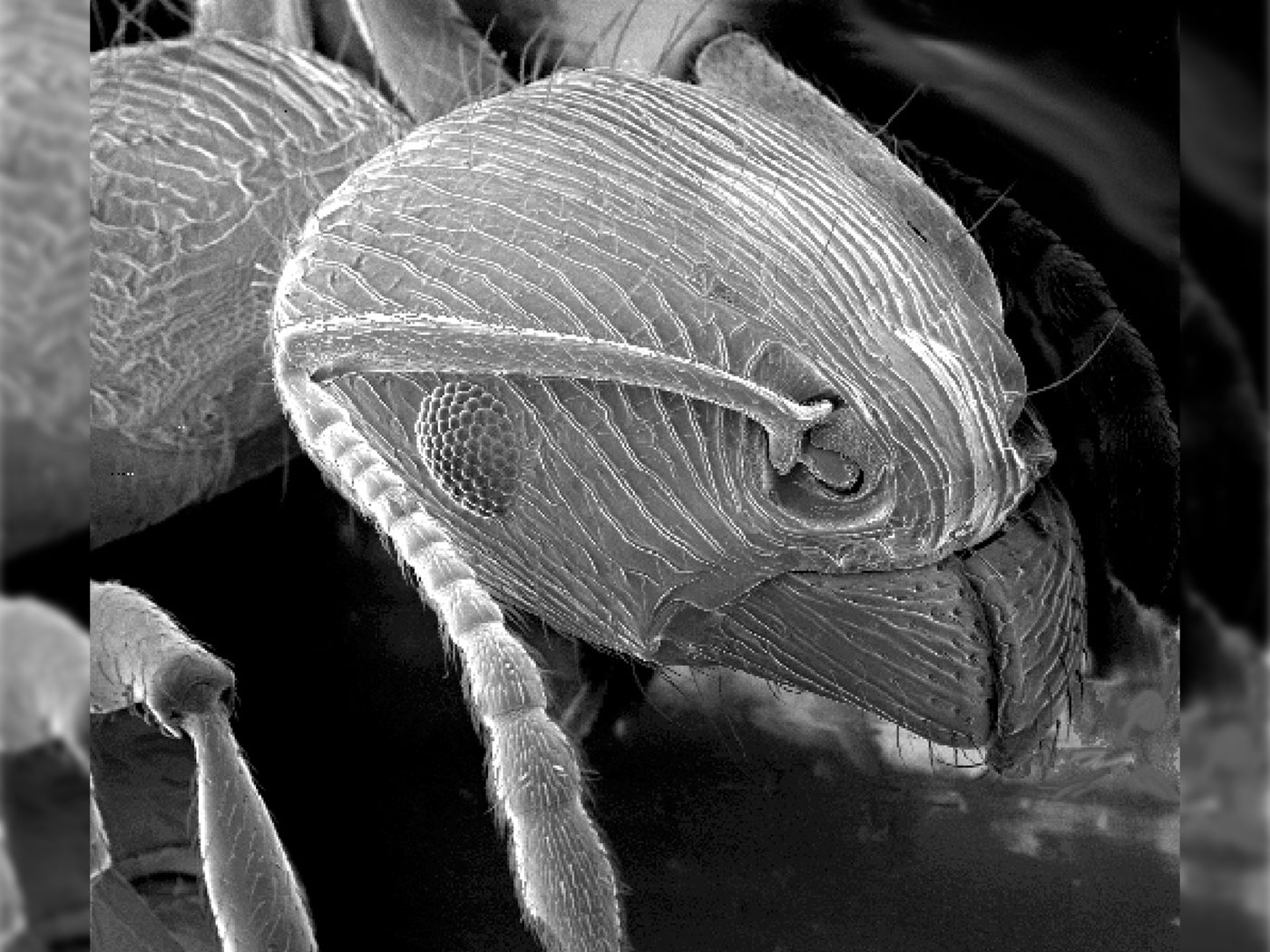
Beetles (order Coleoptera) are a unique but common group of insects easily recognized by the pair of shiny forewings covering their body. These protective wing-cases are called the elytra. Beetles make up almost 40% of the described insects in God’s creation. If all zoologists stopped what they were doing and investigated just the Coleoptera, they would easily be busy well into the next century.
Beetle research continues to amaze. Japanese biologists recently discovered an astonishing structure within the mandibles (mouth pincers) of the horned beetle (subfamily Dynastinae, AKA, Rhinoceros beetle). The insects were discovered to have complex gear-like structures that operate in “completely synchronous movements.”1 Entomologists at the Tokyo University of Agriculture and Technology reported:
In 2013 New Scientist magazine reported unexpected machinery in insect larvae:
The insect Issus coleoptratus is another animal with an unexpected bit of machinery hidden in its body. Its larvae are the first animals known to have interlocking gears, just like in the gearbox of a car.3
Did these complex movements and gear teeth come about by time and chance or plan and purpose? Evolutionists would immediately explain that the gears were not designed, but somehow slowly developed piecemeal. However, an evolutionary publication stated, “It might be that gears are easily broken, and as soon as one tooth is sheared off, the mechanism doesn’t work as well.”3 If that’s true, then how could such a mechanism evolve from teeth that just randomly appeared one after the other? A partial gearbox in a car certainly wouldn’t work, nor would living gears that just randomly intermesh and rotate.
The synchronous movements of the mouth gears of the horned beetle shout design, plan, and purpose! 
The synchronous movements of the mouth gears of the horned beetle shout design, plan, and purpose!
References
1. Ichiishi, W. et al. 2019. Completely engaged three-dimensional mandibular gear-like structures in the adult horned beetles reconsideration of bark-carving behaviors (Coleoptera, Scarabaeidae, Dynastinae). ZooKeys. 813: 89-110.
2. Marshall, M. 2019. Rhinoceros beetles have weird mouth gears that help them chew. New Scientist. Daily News.
3. Marshall, M. 2013. Zoologger: Transformer insect has gears in its legs. New Scientist. Posted on newscientist.com on September 12, 2013, accessed on February 12, 2019.
*Mr. Sherwin is Research Associate is at ICR. He earned his master’s in zoology from the University of Northern Colorado.