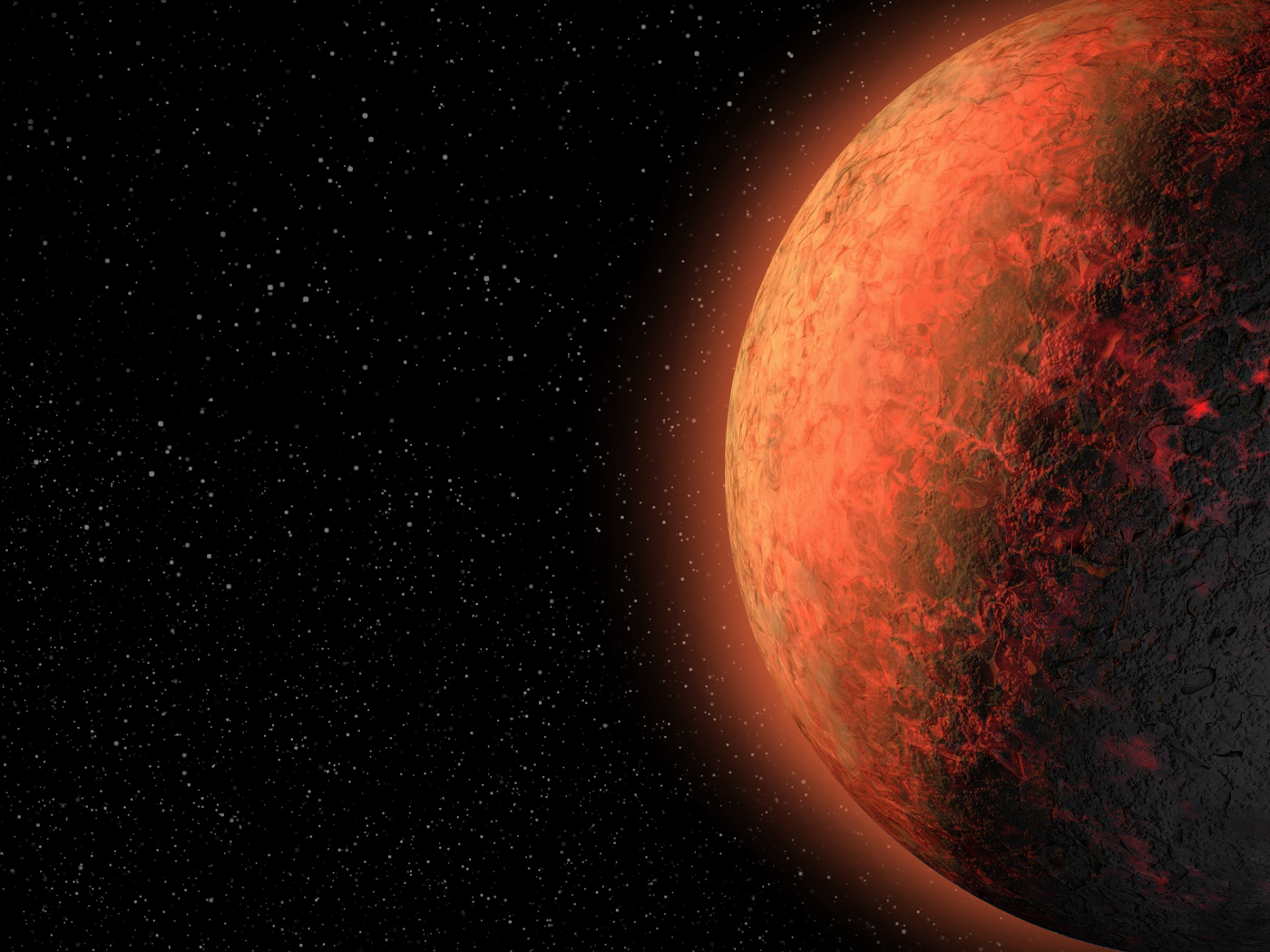
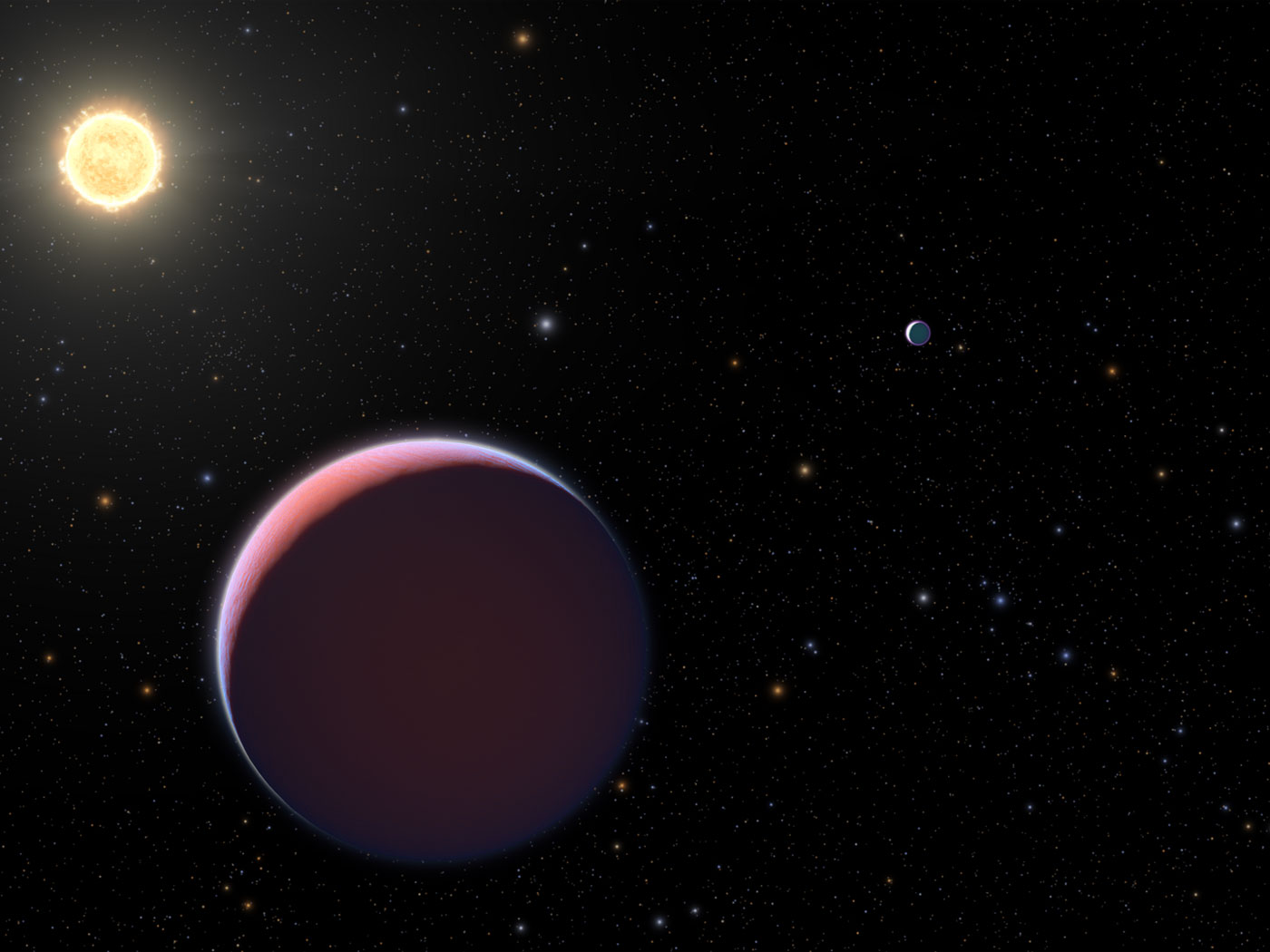
The recent discovery of thirty new exoplanets in other solar systems presents another challenge to the most popular secular theory of planet formation.1,2 These exoplanets are smaller versions of our gas giant Saturn. A recent survey shows that these intermediate gas giants are ten times more common than predicted by the secular theory.3
One of these intermediate gas giants, designated OGLE-2012-BLG-0950Lb, has a mass 39 times that of Earth, whereas Saturn has a mass 95 times that of Earth.
There are two main secular explanations for planet formation.4 They are both variations of the nebular hypothesis that involves a giant disk of gas and dust supposedly left over from the formation of a star. The most popular model is the core accretion model. Supposedly, dust particles coalesce to form larger clumps, these clumps coalesce to form even larger particles called planetesimals, and these planetesimals eventually form “baby” planets. This process, thought to take millions of years, better explains the existence of terrestrial planets, but it has more difficulty explaining the existence of gas giants.4
The second, less popular idea, is called the disk instability model. According to this idea, such disks, if they rapidly cool, can become unstable. Then they break up into large clumps of gas that can form planets relatively quickly, in just thousands of years.4
As mentioned earlier, both are variants of the nebular hypothesis, which suffers from serious problems. Both have difficulty explaining the Sun’s slow overall spin rate, characterized by a lower-than-expected amount of angular momentum. Some references gloss over this problem, asserting that the Sun’s spin slowed down because angular momentum was somehow transferred away from the Sun. The key word is somehow, because secular scientist don’t have a detailed, quantitative explanation for exactly how the Sun did this.5,6 Likewise, recent observations suggest that gas and dust disks surrounding some stars simply don’t possess enough mass to actually make planets.7
Furthermore, many exoplanets completely defy the expectations of the nebular hypothesis. The model predicts that planets in a given solar system should orbit their suns in the same sense that their respective suns are rotating. Yet many exoplanets orbit the “wrong” way!8,9,10
The recent discovery of a significant number of these intermediate-sized gas giants presents the core accretion model with another problem. At the distances at which these gaseous planets are located from their host stars, the accretion model predicts that an enormous amount of solid material is needed for gaseous planet formation. After a rocky/icy core has formed, hydrogen and helium supposedly accrete on and around the core, slowly at first, then much faster in a process called runaway gas accretion.
But runaway gas accretion requires the developing gaseous planet to have a minimum mass of around twenty Earth masses. Once this critical minimum mass is reached, the runaway gas accretion process is so rapid that the gaseous giant quickly balloons in size. For this reason, gaseous planets should be either fairly small, like Neptune, or very large, like Jupiter or Saturn. Gas giants of intermediate size, such as OGLE-2012-BLG-0950Lb, should be quite rare.2
Except that they aren’t. The study showed that these intermediate sub-Saturns are ten times more common than expected.2,3
Natural processes tend to be destructive, not constructive. 
Creation scientists are not at all surprised by these developments. Natural processes tend to be destructive, not constructive. For this reason they are simply incapable of forming the countless wonders we see in the night sky. Rather, they were supernaturally created by God: “In the beginning, God created the heavens and the Earth (Genesis 1:1).”
References
1. Bartels, M. 2019. ‘Sub-Saturns’ May Force Scientists to Revise Idea of How Planets Form. Posted on space.com January 12, 2019, accessed January 15, 2019.
2. Nature’s Magnifying Glass Reveals Unexpected Intermediate Mass Exoplanets. Press Release. W. M. Keck Observatory. Posted on keckobservatory.org January 8, 2019 keckobservatory.org, accessed January 15, 2019.
3. Suzuki, D. et al. 2018. Microlensing Results Challenge the Core Accretion Runaway Growth Scenario for Gas Giants. The Astrophysical Journal Letters. 869 (2).
4. Redd, N. T. 2016. How Was Earth Formed? Posted on space.com October 31, 2016, accessed January 15, 2019.
5. Colgate, S. A. and A. G. Petschek. 1986. Angular Momentum: The cosmic pollutant. Los Alamos Science. Spring: 61-67.
6. Taylor, S. R. 2001. Solar System Evolution: A New Perspective, Second Edition. UK: Cambridge University Press: 63-64.
7. Hebert, J. 2018. Nebular Hypothesis Doesn’t Hold Together. Creation Science Update. Posted on ICR.org October 18, 2018, accessed January 15, 2019.
8. Thomas, B. 2009. Planet’s Reverse Orbit a New Twist in Old Evolutionary Story. Creation Science Update. Posted on ICR.org September 18, 2009, accessed January 15, 2019.
9. Thomas, B. 2010. Planet Formation Theory Collides with Backward-Orbiting Planets. Creation Science Update. Posted on ICR.org April 27, 2010, accessed January 15, 2019.
10. Thomas, B. 2011. Exoplanet Discoveries Demolish Planet Formation Theories. Creation Science Update. Posted on ICR.org January 24, 2011, accessed January 15, 2019.
Dr. Jake Hebert is Research Associate at the Institute for Creation Research and earned his Ph.D. in physics from the University of Texas at Dallas.