




Complex Plant Systems: Rooted in God's Genius
There are at least a half-million species of plants in the world. Although they do not contain living souls,1 plants nevertheless display incredible design features and complex interactions with other plants and insects. Plants have immune systems that seem to be every bit as biochemically complex as those in vertebrates.

The Gaps in 'The God of the Gaps'
Is a "god of the gaps" at the root of Intelligent Design (ID) and creation science? This informal logical fallacy occurs when a given mystery (or gap) that science has not solved is "explained" with reference to divine activity: "God just made it work out, somehow," some theists might say.

Dinosaur Soft Tissue: Biofilm or Blood Vessels?
Over a decade ago, paleontologist Dr. Mary Schweitzer accidentally discovered soft tissues preserved inside dinosaur bone.1 While examining the bone structure from an incompletely fossilized T. rex nicknamed "B. rex," she came upon what appeared to be blood vessels and blood cells on her microscope slides.
Rescuing Ring Ages
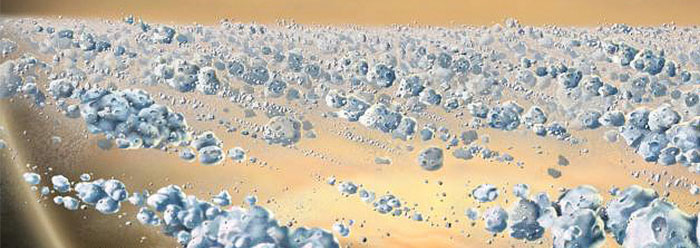
The rapture of seeing Saturn's rings in a telescope for the first time has been enough to inspire many young people to become astronomers. Galileo called them a "most extraordinary marvel." In today's age of planetary reconnaissance, we now have close-up data and pictures beyond his imagination.

The Burgess Shale and Complex Life
If evolution is correct, the first life was quite simple, evolving more complexity over time. Yet the Cambrian Explosion of Life has revealed life's complexity from the start, giving evolution a black eye. The vast array of complex life that appears in the lowest (or oldest) stratigraphic layer of rock, with no apparent ancestors, goes hard against evolutionary dogma.
Pages
