Evolutionary teachings hold that all mankind arose from a population of ape-like ancestors from which chimpanzees also evolved. But Genesis, the rest of the Bible, and Jesus teach that all mankind arose from Noah's three sons and their wives. A new analysis of human mitochondrial DNA exposes two new evidences that validate the biblical beginnings of mankind.
Mitochondrial DNA comes from mothers. Mother egg cells transmit their mitochondrial DNA (mtDNA) into the cellular mitochondria of every child born. This unique annex of DNA contains 16,569 bases—either adenine, guanine, cytosine, or thymine (A, G, C, T)—that encode vital cellular information, like an instruction manual.
Scientists have been comparing the genetic differences between every major people group around the globe. How did those differences arise?
Assuming that God placed the ideal mtDNA sequence into Eve, all those differences arose by mutations since the Genesis 3 curse, about 6,000 years ago. Other scientists measured the rate at which these copying errors occur. Though very slow—we acquire about one mutation every 6 generations—a few dozen mutations could appear after several millennia.
This sets the stage for researchers to compare competing models' predictions against measured mtDNA differences.
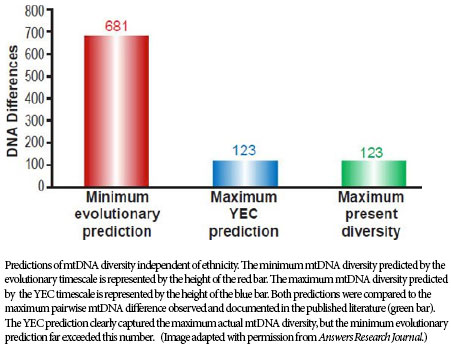 Bible-believing molecular biologist Dr. Nathaniel Jeanson downloaded publicly available human mitochondrial genome sequence data to do exactly that. Publishing in Answers Research Journal, his results show that the number of today's mtDNA differences exactly matches the number predicted by the Bible's 6,000 years of human history.1 Mitochondrial DNA from around the world shows no trace of the 200,000 or so years' worth of mutations that the evolution model predicts.
Geneticists construct tree diagrams using software that places the most similar genetic sequences near one another, and the most dissimilar sequences on the longest branches. Jeanson found at least two distinct patterns in the human mtDNA tree diagram that confirm Genesis.
The center of the diagram shows three main trunks. Each reflects a specific mtDNA sequence with only a handful of differences from the other two.
Could these three trunks represent the unique mtDNA from the wives of Shem, Ham, and Japheth?
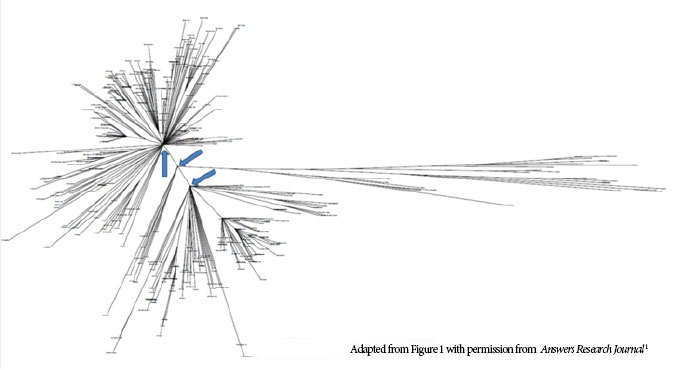
A second pattern emerges that also fits the three wives explanation. Assuming longer times between each generation, according to the biblical record of lifespans before the Flood, and using today's slow mutation rate, the 1,656 years between Adam and Noah would have produced the small number of differences that the short lines between each trunk represent.
Jeanson compared the small number of mtDNA differences between each trunk, or central node, with the relatively large number of differences in the branches. He wrote, "About 1,660 years passed from Creation to the Flood, whereas 4,365 years passed from the Flood to the present—a ~2.6:1 time ratio. Consistent with this, the branches connecting the nodes to one another were much shorter than the branches spraying out from the nodes—as if the short branches represented pre-Flood mutations, and the long branches represented post-Flood mutations."1
It appears that modern genetics confirms Genesis, which says, "So Noah went out, and his sons and his wife and his sons' wives with him."2
This study produced two Genesis-confirming results. First, the human mtDNA tree has three trunks, which fits the Genesis model that all peoples descended from three foundational mothers—the wives of Shem, Ham, and Japheth. Second, 6,000 years of today's slow mutation rate would exactly produce today's measured number of mtDNA differences. Genetics again confirms Genesis.
References
- Jeanson, N.T. 2016. On the Origin of Human Mitochondrial DNA Differences, New Generation Time Data Both Suggest a Unified Young-Earth Creation Model and Challenge the Evolutionary Out-of-Africa Model. Answers Research Journal. 9 (2016): 123-130.
- Genesis 8:18.
*Mr. Thomas is Science Writer at the Institute for Creation Research.
Article posted on May 16, 2016.