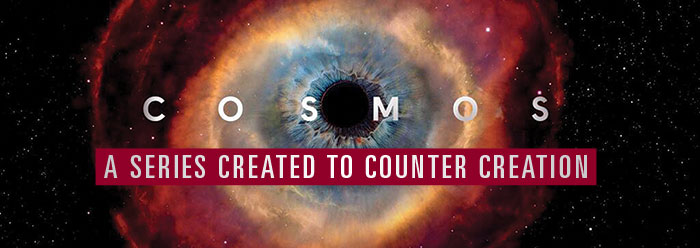
“The universe is all that is, or was, or ever will be.” Does this statement raise any red flags? It was the opening line of the popular 1980 TV series Cosmos and was repeated in its current incarnation. The statement crystallizes the philosophy of the late Carl Sagan, one of the 20th century’s best communicators of science and naturalism. It imagines a reality that excludes God, essentially replacing Genesis 1’s “In the beginning God” with “In the beginning…hydrogen.” Matter pops into existence without a cause? Now that’s a red flag.
The current Cosmos series raises so many such flags—mingling some good science with historical falsehoods, scientific errors, oversimplifications, and logical lapses—that one article cannot manage them. Its makers’ beliefs reveal a common source for all these problems.
Consider Cosmos’ award-winning producer, Seth MacFarlane, a brilliant artist, outspoken atheist, and creator of debauched cartoon shows like Family Guy. Los Angeles Times asked him, “What are you hoping to get out of [Cosmos]?” MacFarlane replied, “We’ve had a resurgence of creationism and intelligent design quote-unquote theory. There’s been a real vacuum when it comes to science education.”1 In Cosmos, he applied his creative skills in an attempt to eradicate creation thinking from popular thought.
How about Cosmos writer Ann Druyan?2 In 2004 she won the Richard Dawkins Award, granted by Atheist Alliance International for raising public consciousness of atheism. Druyan told the Skeptical Inquirer:
I think the roots of this antagonism to science run very deep. They’re ancient. We see them in Genesis, this first story, this founding myth of ours, in which the first humans are doomed and cursed eternally for asking a question, for partaking of the fruit of the Tree of Knowledge.3
Only tortured atheistic reasoning could twist the Genesis account into a tale of mankind being unfairly cursed for simple curiosity, a trait God graciously gave us, instead of being cursed for disobeying and distrusting Him. Why else would Druyan render the “Tree of the Knowledge of Good and Evil” as merely “the Tree of Knowledge,” as though God desires His children be ignorant of everything, instead of just ignorant of experiencing evil?
But surely Cosmos host Dr. Neil deGrasse Tyson, a scientist, is more objective than his cohorts? Though careful to not disclose his personal beliefs, Tyson has let slip statements that reveal his God-omitting way of thinking. How could this trio not bring their atheistic religious beliefs into the series?
The caustic threads of this philosophy wind through the tapestry of Cosmos’ imaginative illustrations, visual feasts, and carefully crafted scripts. For example, in Episode Five Tyson said, “Give me a star’s spectrum, and I’ll tell you what it’s made of.”4 He then described other aspects that starlight reveals before saying, “In microwave light, we can see all the way back to the beginning of our universe.” Experts can discern elements in a star by its starlight; repeatable science reveals this. However, light does not necessarily show the past, and certainly does not show the beginning. By wrapping scientific statements around false philosophy, the series’ craftsmen weave a beginning without a Beginner.
MacFarlane told Los Angeles Times, “I thought we solved this whole evolution thing years and years ago but I guess not, I guess it still needs to be explained.”1 The purpose of Cosmos is not to explore God’s wondrous cosmos with objective science but to more convincingly retell the tattered evolutionary story. Viewers beware: Cosmos was created to counter creation.
References
- Blake, M. Seth MacFarlane hopes ‘Cosmos’ counteracts ‘junk science,’ creationism. Los Angeles Times. Posted on la-times.com March 7, 2014, accessed March 18, 2014.
- Ann Druyan co-wrote the 1980 Cosmos series and was Carl Sagan’s third wife.
- Druyan, A. November/December 2003. Ann Druyan Talks About Science, Religion, Wonder, Awe...and Carl Sagan. Skeptical Inquirer. 27 (6).
- MacFarlane, S. et al, executive producers. 2014. Cosmos: A Spacetime Odyssey. DVD. 20th Century Fox.
* Mr. Thomas is Science Writer at the Institute for Creation Research.