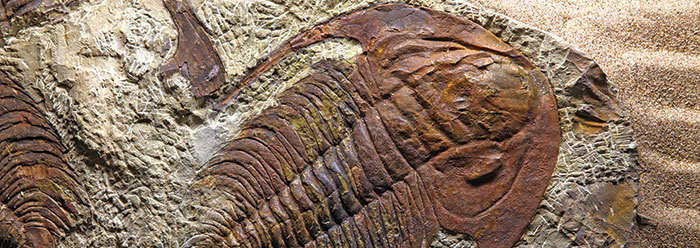
Trilobites are one of the most popular fossils for collectors and are found all over the world. The Ute Indians used one species as an amulet, and there is even a cave in France called the Grotte du Trilobite that contained a relic made out of one of these extinct marine creatures.1,2
Trilobites are members of the phylum Arthropoda, which includes spiders, insects, and crustaceans. Today, members of this group make up at least 85 percent of the species on Earth and live in every environment. Insects alone account for over 870,000 of these species.1 God designed all arthropods with an exoskeleton (i.e., an outer skeleton) that is segmented into appendages. In Greek, arthron means joint and podos means foot. This exoskeleton does not grow as the animal grows but rather has to be shed— molted—as the animal matures.
Although arthropods dominate the biomass of the planet today, their fossil record is much more limited, with only about 30,000 fossilized arthropod species identified.1 Because most arthropods have an exoskeleton of organic, chitinous cuticle, they decompose easily and don’t preserve well as fossils. A few arthropod groups like the trilobites, whose shells were calcified, were preserved in the Flood. There are over 2,000 genera (the plural of genus, the category above species) of trilobites in the fossil record and thousands of named species.1
Arthropods represent a major part of the great evolutionary mystery called the Cambrian Explosion. In fact, they are one of the most common fossils in Cambrian system strata.1 They appear in the rock layers fully formed—without ancestors. Evolutionist Richard Fortey writes, “And yet how can it be that all this variety [the trilobite fossils] arose apparently instantly at the base of the Cambrian?” He continues, “Where then were these ancestors? Why were they apparently invisible?”2 These questions are easily answered by creationists, who explain the sudden appearance of fossils in the Cambrian system as part of the initial sediments deposited by the Flood. It seems likely that shallow marine organisms would be the first types of animals buried and preserved by advancing floodwaters.
And now trilobite fossils are producing some of the strongest evidence of catastrophic burial. A recent study found that many of these creatures were inundated rapidly while they were still alive!3 Numerous specimens are found in a rolled-up position—like giant roly-polies—to protect themselves from danger. However, a few varieties lacked the design to “lock their shells” and hold the ball-shaped position; these arthropods had to rely on their internal muscles to hold themselves in a rounded shape.
Recently, evolutionists were surprised when they discovered many of these trilobites with non-locking shells in a rolled, protective position. Javier Ortega-Hernandez and his co-authors reported, “After death, the muscles responsible for flexing the trunk would have relaxed, causing the carcass to return to the outstretched position. Thus, the best possibility of preserving rolled olenellids [this type of trilobite] would require rapid burial of live individuals.”3
Entombed in some of the earliest sediments of the great Flood, trilobites discovered in rolled-up positions demonstrate that many were buried while still alive. However, their sudden appearance in strata is not a mystery when viewed in a biblical context—it confirms that the Flood quickly inundated the earth, encapsulating many animals in mud in the process. Science continues to find evidence that confirms the Bible, even in these little rolled-up treasures.
References
- Prothero, D. R. 1998. Bringing Fossils to Life: An Introduction to Paleobiology. Boston: McGraw-Hill, 247-258.
- Fortey, R. A. 1997. Life: A Natural History of the First Four Billion Years of Life on Earth. New York: Alfred A. Knopf, 14, 103.
- Ortega-Hernandez, J., J. Esteve, and N. J. Butterfield. 2013. Humble origins for a successful strategy: complete enrolment in early Cambrian olenellid trilobites. Biology Letters. 9 (5): 20130679.
* Dr. Clarey is Research Associate at the Institute for Creation Research and received his Ph.D. in geology from Western Michigan University.