An international team of paleoanthropologists reported discovering the earliest human fossils found outside Africa at a dig in the country of Georgia.1 The team told Science that one specimen, "skull 5," is so different from other humans that it significantly widens the range of variation within ancient mankind. The Guardian wrote that among the human remains in Dmanisi researchers found a "spectacular fossilised skull of an ancient human ancestor," but there is actually more proof against this claim.2
The team found clearly human skeleton parts, along with five skulls or partial skulls. Even though skull 5 has several key features resembling an ape, not a human, the Science study authors wrote, "Skull 5 is probably associated with the postcranial [bones located below the head] elements of an adult individual with nearly modern human body proportions."1
The only definitive support for this connection is the statement that the skull and human bones "probably" match—and nothing more. This means they may not actually belong together. And the seven observations below indicate this might be another case of evolutionist experts mistakenly associating ape fossils for those of humans. Skull 5 does not ID as a human for the following reasons:
-
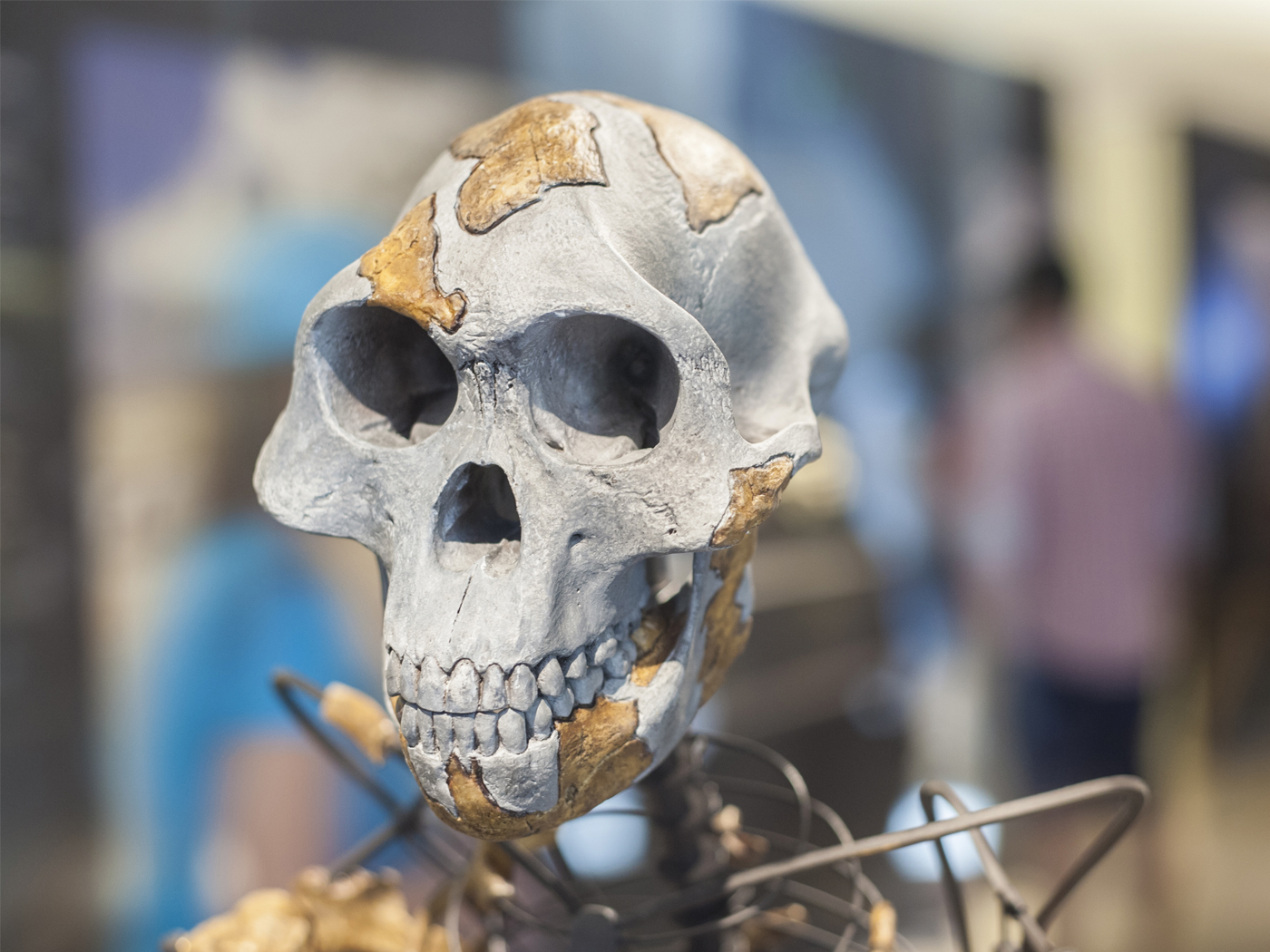
It is anatomically quite different from known human skulls. The Science authors wrote, "The morphology of skull 5 stands apart from that of any other known fossil Homo specimen through its combination of a small braincase with a large prognathic face."1 Maybe it "stands apart from" man because it was not a man. Could it actually be an ape's skull?
-
It is too loosely linked with human postcranial material. The study author's phrase "probably associated" cannot substitute for solid scientific evidence.
-
It has a very ape-like brain volume—far smaller than that of a human. It was estimated at 546cc, similar to that of gorillas and Australopiths, but only about half the average size of a human3
-
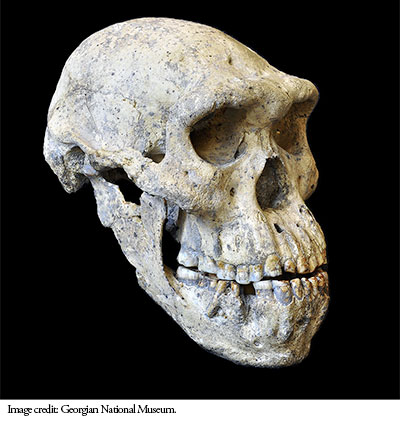 It has a heavily built, ape-like jaw. Skull 5 "has the largest face, the most massively built jaw and teeth and the smallest brain within the Dmanisi group," according to a news release from the University of Zurich where three of the Science authors work.4 But where is the evidence proving that all five Dmanisi skulls even belong to the human group?
-
It links to other material that is not clearly identified or dated. The Science authors reported, "Furthermore, the remarkably large and robust dentognathic remains of early H. erectus from Java (Trinil/ Sangiran) exhibit close affinities with skull 5."1 But the abstract describing the Java remains reads, "Temporal changes, within-group variation, and phylogenetic positions of the Early Pleistocene Javanese hominids remain unclear."5
Additionally, experts in human evolution have a long history of assigning human and ape remains to the Homo erectus human category.6 By tying skull 5 to past category confusion, the Science authors muddied their own identification of skull 5 as human.
-
The researchers' approach to skull 5 may be similar to other fraudulent or dubious finds. Dutch physician Eugene Dubois, anxious to find proof of human evolution, uncovered the famous Java "man" fossils in 1891. It was not until 30 years later that Dubois revealed the truth behind the find and admitted he had been hiding fully human skulls from the same Javan site. Some later suggested that his Java man skull cap was actually that of a gibbon.6 Could today's scientists be subject to the same eagerness to prove evolution, leading to skewed analyses? Because human origins research can be so subjective, one researcher of the history of paleoanthropology voiced a relevant caution: "We have only to recall the Piltdown adventure to see how easily susceptible researchers can be manipulated into believing that they have actually found just what they had been looking for."7
The Science authors also wrote that skull 5 looks like the famous KNM-ER 1470 found in Africa. But skull 1470 was pieced together from so many separated fragments that it may not constitute a real, single individual.8 Understandably, its identification has long been difficult. Who knows which pieces were from humans and which were from apes?
Even so, the part of skull 1470 showing a forehead and human-like brow ridges differs from the apish appearance of skull 5. Did the Science authors link skull 5 to Africa's KNM-ER 1470 for evolutionary rather than anatomical reasons?
- It is replete with ape features. Skull 5 has a U-shape dental arch, not the more parabolic shape humans present. Its chin slopes back like an ape without the forward-jutting bottom point of a human chin. There is no human nose bridge, and it has prominent attachment points for enormous jaw and neck muscles.
The assumption that skull 5 represents an ancient human permeates the original report and the news, but it ignores the seven basic observations that refute it.
Biblical creationists are not restricted to interpreting skull 5 according to evolution. Instead, they are free to exercise a healthy scientific skepticism of current interpretations. If Dmanisi skull 5 ends up not being human at all, then its titillating implications for human evolution fizzle. It would then simply become an extinct ape kind's skull found in a long-collapsed animal den into which saber-toothed cats may have dragged both human and other prey.2
References
- Lordkipanidze, D. et al. A Complete Skull from Dmanisi, Georgia, and the Evolutionary Biology of Early Homo. Science. 342 (6156): 326-331.
- Sample, I. Skull of Homo erectus throws story of human evolution into disarray. The Guardian. Posted on theguardian.com October 17, 2013, accessed October 23, 2013.
- The tiny, fully-human skull Homo floresiensis also shared a small brain size, so this factor alone should not be the sole determiner of a fossil's identity. See Thomas, B. New 'Species' Was Just a Tiny Human. Creation Science Update. Posted on icr.org December 31, 2008, accessed November 7, 2013.
- Unique skull find rebuts theories on species diversity in early humans. University of Zurich news release, October 17, 2013.
- Kaifu, Y. et al. 2005. Taxonomic affinities and evolutionary history of the early Pleistocene hominids of Java: Dentognathic evidence. American Journal of Physical Anthropology. 128 (4): 709-726.
- Gish, D. 1995. Evolution: the Fossils Still Say NO! El Cajon, CA: Institute for Creation Research, 280-282.
- Maienschein, J. 1997. The One and the Many: Epistemological Reflections on the Modern Human Origins Debates. In Clark, G. A. and C. M. Willermet (eds.), Conceptual Issues in Modern Human Origins Research. Hawthorne, NY: Aldine de Gruyter, 413.
- Gish, D. 1974. Richard Leakey's Skull 1470. Acts & Facts. 3 (2).
Image credit: Copyright © 2013 Georgian National Museum. Adapted for use in accordance with federal copyright (fair use doctrine) law. Usage by ICR does not imply endorsement of copyright holders.
* Mr. Thomas is Science Writer at the Institute for Creation Research.
Article posted on November 13, 2013.