In 1809, Jean Baptiste Lamarck speculated that the necks of giraffes could grow longer simply by reaching higher and that they could pass this trait on to their offspring.1 A half-century later, Charles Darwin suggested that giraffes born with longer necks than their rivals could reach more food and were thus better fit to survive. If either one of these ideas were true, scientists should find ancient “giraffe” fossils reflecting a pattern of transformational neck growth over time. However, after generations of searching, paleontologists have failed to uncover any evidence of transitional giraffe necks. What about the long-neck dinosaurs—do they show neck-growth evolution?
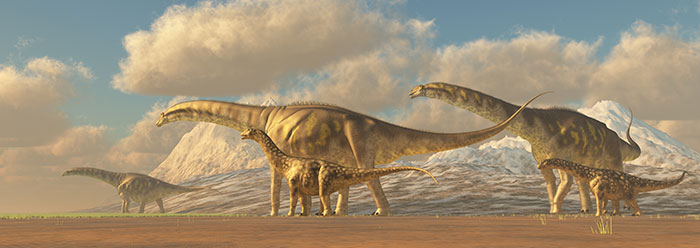
A recent study of sauropodomorph dinosaurs published in PeerJ has unlocked secrets to their marvelous design.2 Sauropodomorphs are commonly referred to as the “long-necks” for a reason: All possessed at least 10 elongated neck vertebrae, making sauropodomorph necks six times longer than the tallest giraffe’s neck, at minimum!2 Almost all mammals have seven neck vertebrae, by contrast.3 Although the researchers claimed that sauropods (the most common subgroup of sauropodomorphs) “inherited long necks from their basal sauropod ancestors,” they offered no transitional fossils to back their claim.2
However, they did find that sauropod necks—some reaching as long as 48 feet in length—possessed a set of seven special characteristics that facilitated having an extremely long neck: 1) the body size to support a long neck, 2) the skeletal stability of a quadrupedal stance, 3) small heads, 4) ten or more neck vertebrae, 5) elongated neck vertebrae, 6) an apparent air-sac breathing system, and 7) vertebrae designed with “pneumaticity,” i.e., many holes to lessen the weight.2
Without this combination of characteristics, the long-neck sauropods could not have survived. A large body size and stance are essential foundations for a long neck because they stabilize long appendages and literally prevent the animal from toppling.2 Sauropods’ small heads also reduced the required lifting power of their necks.
A unidirectional air-sac breathing system would have eliminated some “dead space” caused when used air is re-inhaled before it can be fully exhaled—a limiting factor in the length of mammal necks. Allowing only one direction of air flow through the lungs, as in extant birds, this type of system always keeps freshly inhaled air passing across the lungs and eliminates the leftover, stale air that collects in mammals.4
Finally, the authors determined that sauropods had neck bones that were composed of 50 to 70 percent air space in volume, greatly reducing weight. Overall, sauropods possessed the perfect set of features to facilitate their long necks.2
These seven special characteristics had to be present and change simultaneously for long-neck dinosaurs to grow, function, and survive. Removing just one element would have caused the sauropod to fall flat and fail as an organism.
Another recent paper found the unique design of sauropods extends even to their limb bones. The authors, publishing in PLOS One, found that gigantism in dinosaurs was achieved by a thickening of the cartilage between the leg bones, opposite to the thinning trend of cartilage between mammal leg bones as they grew larger. This thickening of cartilage, they suspect, allowed for better cushioning or “shock absorption” and reduction in joint friction.5
It is this all-inclusive, concurrent combination of features that makes any form of intermediate creature impossible and points, not to a fortunate accident, but to an all-encompassing plan. The Creator made fully-formed sauropods, along with man—and giraffes—on Day Six of the creation week.
References
- Wicander, R. and J. 2010. Historical Geology, 6th ed. Belmont, CA: Brooks/Cole Cengage Learning, 133-134.
- Taylor, M. P. and M. J. Wedel. 2013. Why sauropods had long necks; and why giraffes have short necks. PeerJ. 1: e36.
- Manatees and sloths are the only exceptions. Three-toed sloths have eight to 10, with nine being the most common. Two-toed sloths have five to eight, with six being the most common. Manatees have six.
- Wedel, M. J. 2003. Vertebral pneumaticity, air sacs, and the physiology of sauropod dinosaurs. Paleobiology. 29 (2): 243-255.
- Bonnan, M. F., et al. 2013. What lies beneath: sub-articular long bone shape scaling in Eutherian mammals and Saurischian dinosaurs suggests different locomotor adaptations for gigantism. PLOS One. 8 (10): e75216.
* Dr. Clarey is Research Associate at the Institute for Creation Research and received his Ph.D. in geology from Western Michigan University.