How do butterfly's wings shine? Like almost all other butterflies, the Morpho has wings covered with scales. Typically, pigmentation patterns across these scales generate wing colors, but a Morpho's scales deploy an additional feature.
On top of their scales, Morpho butterflies have countless tiny, tree-like structures with suspended branched arms that manipulate light waves. Spacing among the branches helps match targeted light-wavelengths, like blue for example. Repeated reflections of the same wavelength cause interference effects that, when viewed from certain angles, generate stunning iridescence.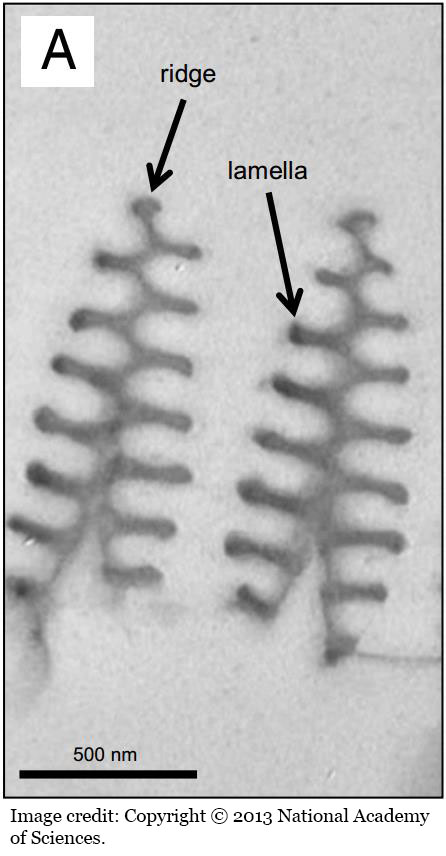
Given the incredible detail of this system, it seems that whoever designed these precise, tree-like features had expert knowledge of optics and nanotechnology.
But secularists regularly assert that such a conclusion would not be "scientific"—by which they likely mean that God cannot be considered as an origins option, even if His craftsmanship is the best explanation for the evidence.1
Evolution's solution?
In 1858, Darwin named "natural selection" as a process whereby external factors, such as predators or habitats, formulate plant and animal traits.2 Yet Morphos occupy the same habitats as dull-colored butterflies, indicating that habitat alone did not lead to their iridescence. Furthermore, how would predators, being more apt to see the most brilliant butterfly prey, have played any role other than destroying—not generating—that very brilliance? According to Darwinism, nature selects traits that enhance survival. But brightly shining wings would more likely do the opposite. It's a wonder blue Morphos still exist.
Researchers recently reported the discovery of another unique attribute embedded in Morphos that also offers no known survival advantage: the tree-like scale structures are strongly polar at their tops and non-polar where they attach to each scale.3,4 Publishing these findings in the Proceedings of the National Academy of Sciences (PNAS), the study authors wrote, "Although this surface polarity gradient may not be essential for butterfly survival, but rather is a by-product of the process of scale development, this perspective on biological pattern design can offer opportunities for a variety of technological applications."3
Put bluntly, if this newly found polarity gradient is not "essential for butterfly survival," then how could natural selection be its cause?
In an attempt to solve this kind of dilemma, Darwin later invented what he termed "sexual selection."5 Supposedly, animals select mates based on preferences that, over eons, generate new traits in the opposite sex. And these new traits help the species survive by breeding more readily. But this simplistic story fails to fit key observations.
For example, assuming sexual selection is a biological reality, it would only select trait variations that already exist. Thus, it might explain how some variations are removed but not how any are made. Also, sexual selection would only work on trait variations for which the mate already had a programmed preference, begging the question of that preference's origin.6
The PNAS study authors wrote, "Morpho butterflies are a brilliant spectacle of nature's capacity for photonic engineering."3 However, there is no reason—other than sheer bias—to credit nature with engineering butterfly optic structures that even human engineers have not yet been able to replicate.1,7
The Creator God of the Bible shines as the real Engineer here.
References
- Naturalist Richard Lewontin once wrote, "We are forced by our a priori adherence to material causes to create an apparatus of investigation and a set of concepts that produce material explanations, no matter how counter-intuitive, no matter how mystifying to the uninitiated. Moreover, that materialism is absolute for we cannot allow a divine foot in the door." See: Lewontin, R. C. Billions and Billions of Demons. The New York Review of Books. Posted on nybooks.com January 9, 1997.
- Lyell, C. et al. 1858. On the tendency of species to form varieties; and on the perpetuation of varieties and species by natural means of selection. Journal of the Proceedings of the Linnean Society of London: Zoology. 3 (9): 45-62.
- Potyrailo, R. A. et al. Discovery of the surface polarity gradient on iridescent Morpho butterfly scales reveals a mechanism of their selective vapor response. Proceedings of the National Academy of Sciences. Published online before print, September 9, 2013.
- Polar molecules contain an uneven distribution of electrons. Non-polar molecules, used near the base of each tiny tree-structure, have evenly distributed electrons.
- "Sexual selection" came from Darwin's book titled The Descent of Man. Also, Darwin touched on the butterfly color dilemma in a letter to Nature. See: Darwin, C. 1880. The Sexual Colours of Certain Butterflies. Nature. 21 (Jan. 8): 237.
- Bergman, J. 2004. Problems in sexual selection theory and neo-Darwinism. Journal of Creation. 18 (1): 112-119.
- Vukusic, P. and J. R. Sambles. 2003. Photonic structures in biology. Nature. 424 (6950): 852-855.
* Mr. Thomas is Science Writer at the Institute for Creation Research.
Article posted on September 20, 2013.