Animals benefit from a variety of unique eye designs, but where did they come from? Two clearly seen eye observations point to Genesis origins.
First, animals within a single, broad group often use different eye designs. For example, most vertebrates have the classic “camera eye.” They use a transparent cornea and convex lens to refract (i.e., bend) images onto a light-sensitive layer of tissue lining the back of the eye called the retina.
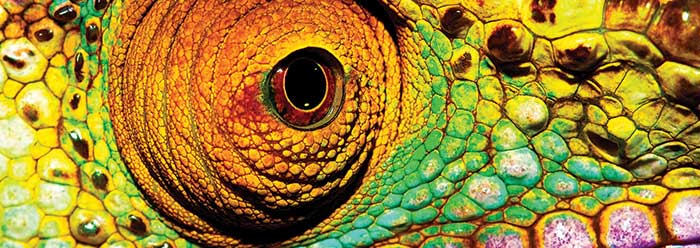
The supposed evolutionary ancestor of all vertebrates should have passed its specific camera eye design down to its descendants—modern vertebrates. But certain vertebrates use completely different eyes. For example, the deep sea “spookfish” uses reflective mirror lenses, not refractive lenses.1 Also, the chameleon’s pinhole eye design uses concave lenses that spread out a narrow section of incoming light onto a broader retina.
Now for the second observation. Similar eye designs occur in animals from very different groups. Eye designs crisscross imagined evolutionary tree branches. Those branches should show similar designs within similar groups. Instead, for example, spineless squids and octopi use the same basic camera-eye anatomy as vertebrates—albeit with a few optimizations for life underwater. Even some jellyfish use small camera eyes.2
Arthropods illustrate both observations. The classic and unique arthropod compound eye works effectively, as anyone who has tried to catch a fly knows. Its many refractive lenses fit into round or hexagonal light-sensitive, tiny, tube-like units called ommatidia.
With evolution, the ancestor of all arthropods should have passed its compound eye design on to its descendants. But some arthropods use completely different eyes, again illustrating the first observation that points to Genesis origins—a single animal grouping contains a variety of radically different eyes.
For example, lobster and shrimp ommaditia gather images from light reflected off each ommatidia’s perfectly proportioned square side walls. And the mantis shrimp’s eyes detect 12 primary colors, not just three!3
However, some worms have compound eyes. They also illustrate the second observation, that different animals share similar eye designs. Sabellids are marine tube worms, and each of their ommatidia consists only of two cells. Similarly, “most known starfish species possess a compound eye at the tip of each arm, which, except for the lack of true optics, resembles [the] arthropod compound eye.”4 And clams from the family Arcidae use compound eyes. Other than their compound eyes, worms, sea stars, and clams have almost nothing in common with the arthropod body plan.
Yet, the giant clams use pinhole eyes. The chambered nautilus, a cephalopod along with squid, hunts its prey with pinhole eyes, albeit without lenses. Many more examples could illustrate both observations that
- Animals within one group use very different—and always fully formed—eyes, and
- Certain animals from very different groups share the same basic eye structure.
Neither observation fits the expected evolutionary pattern. This forces proponents to speculate that the same eye designs evolved multiple times in separate organisms. But this assertion lacks an important detail—evidence. Typically, magic words like “emerge,” “evolve,” and “appear” substitute for evidence or for a realistic explanation of each supposed gradual step in eye evolution. No wonder Charles Darwin wrote to Asa Gray in 1860, “The thought of the eye made me cold all over.”5
According to Genesis, God formed all the required parts for each animal eye in all their required sizes, shapes, and opacities in a single step when “He commanded, and it stood fast.”6
References
- Thomas, B. Fish’s Mirror Eyes Reflect the Creator. Creation Science Update. Posted on icr.org January 15, 2009, accessed July 8, 2013.
- Sherwin, F. 2007. The Eyes of Creation. Acts & Facts. 36 (7).
- Thomas, B. Shrimp Eye May Inspire New DVD Technology. Creation Science Update. Posted on icr.org November 4, 2009, accessed July 8, 2013.
- Seeing starfish: The missing link in eye evolution? Society for Experimental Biology Press Release via Eurekalert! Posted on eurekalert.org July 4, 2013, accessed July 8, 2013.
- Darwin’s letter quoted in Bergman, J. 2011. The Dark Side of Darwin. Green River, AR: Master Books, 118.
- Psalm 33:9.
* Mr. Thomas is Science Writer at the Institute for Creation Research.
Cite this article: Thomas, B. 2013. Amazing Animal Eyes. Acts & Facts. 42 (9): 16.