The human Y-chromosome has been a sore point among secular scientists in recent years because of its many anti-evolutionary surprises. Adding to the Darwinian grief, is yet one more shocking Y-chromosome study that more clearly illustrates the boundaries of human genetic diversity.
Much controversy has brewed during the past few years over the genomic sequences of what have been termed "archaic" humans. This so-called "ancient DNA" was extracted from bone fragments of "Neandertal" and "Denisovan" specimens and then sequenced, providing draft blue prints of these respective genomes.1, 2 While much hypothetical speculation has raged over how much interbreeding went on between modern humans and archaic humans, the fact remains that both types were shown to be fully human.
Now, a modern living human has been discovered who has Y-chromosome variation that increases the range of human DNA diversity beyond that of so-called archaic humans.3 This new data unequivocally proves that Neandertals and Denisovans were well within the DNA variability range of modern humans—not extinct primitive evolutionary offshoots of the human lineage.
Earlier DNA studies attempted to prove that archaic humans were different than modern humans, based on slight variations in their mitochondrial DNA—a small circular piece of DNA outside the nucleus in the cell’s mitochondria that is inherited maternally. In fact, because the Y-chromosome undergoes very little DNA change, and is considerably larger in size than the mitochondrial genome, it is a much more reliable measure of human DNA diversity.
Not surprisingly, this new discovery confirms the conclusions and predictions first proposed by researchers when the entire Neandertal genome draft sequence was published in 2010.1 In this report, the authors state, "Neandertals are expected to be more closely related to some present-day humans than they are to each other." The new Y-chromosome study now fully confirms this hypothesis made by evolutionists themselves.
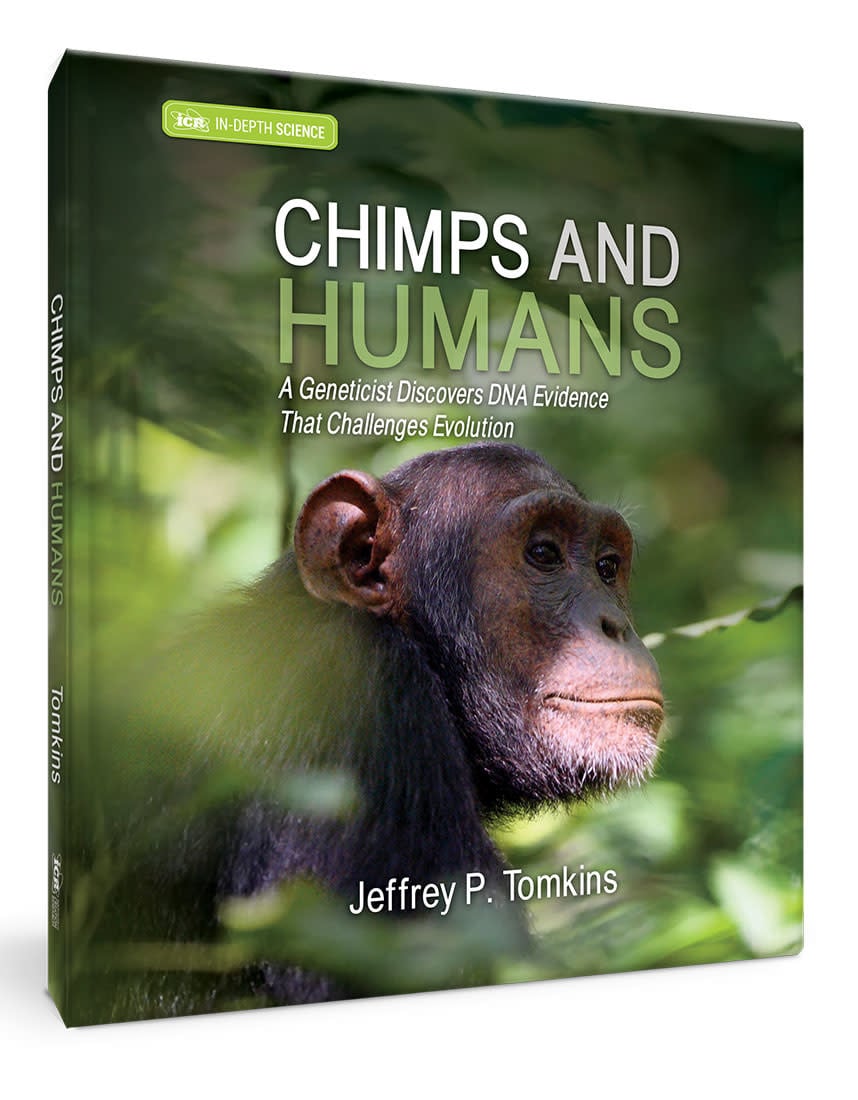
Another Y-chromosome study of great importance in the human-origins debate is the recent report of extreme differences between the human and chimpanzee MSY (male determining) regions. The MSY region contains most of the genes in the Y-chromosome. In this report, approximately 50% of the DNA sequence did not even match between chimps and humans. Humans also had twice as many genes as chimps in the MSY region. In fact, the evolutionary authors of the study shockingly note that given "6 million years of separation, the difference in MSY gene content in chimpanzee and human is more comparable to the difference in autosomal gene content in chicken and human, at 310 million years of separation."4
Confirming this stunning human-chimp Y-chromosome data is another recent research report in which the analysis of all chimpanzee chromosomes showed only a 70% DNA similarity on average to human.5
These scientific discoveries related to human origins, as revealed by modern DNA sequencing technologies, can be summarized by the following key points.
- Modern humans, Neandertals, and Denisovans are all part of the same human "created kind."
- Chimpanzees are simply a type of ape, created distinctly and uniquely as their own "kind."
These findings fully confirm the Bible which states in the book of Genesis that all living things were created with distinct genetic boundaries "after their kind." The Bible also clearly tells us that, concerning mankind’s genetics, God "hath made of one blood all nations of men for to dwell on all the face of the earth" (Acts 17:26).
References
- Green, R. E. et al. 2010. A Draft Sequence of the Neandertal Genome. Science. 328 (5979) : 710-722.
- Reich, D. et al. 2010. Genetic history of an archaic hominin group from Denisova Cave in Siberia. Nature. 468 (7329): 1053-1060.
- Mendez, F. L. et al. 2013. An African American Paternal Lineage Adds an Extremely Ancient Root to the Human Y Chromosome Phylogenetic Tree. The American Journal of Human Genetics. 92 (3): 454-459.
- Hughes, J. F. et al. 2013. Chimpanzee and human Y chromosomes are remarkably divergent in structure and gene content. Nature. 463(7280): 536-539.
- Tomkins, J. 2013. Comprehensive Analysis of Chimpanzee and Human Chromosomes Reveals Average DNA Similarity of 70%. Answers Research Journal. 6 (2013): 63-69.
*Dr. Tomkins is Research Associate at the Institute for Creation Research and received his Ph.D. in Genetics from Clemson University.
Article posted on May 6, 2013