What should an astronomer think of a galaxy with tremendous mass but very few stars? Karl Gephardt of the University of Texas in Austin and his colleagues studied one recently, and he said, "This is a really oddball galaxy…. It's almost all black hole."1
It's odd because astronomers over the years have invented an array of models to depict galaxies forming by themselves. But these newly described galaxies with jumbo black holes confront the assumption that galaxies formed with no outside help.
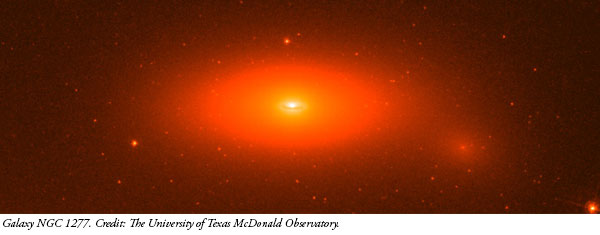
Gephardt and his team used the Hobby-Eberly telescope at the McDonald Observatory in the Davis Mountains in West Texas to pinpoint six galaxies with far fewer stars than expected, based on their overall masses. One of the six, photographed by the Hubble telescope, is named NGC 1277. Fourteen percent of its mass is from its central black hole, instead of the approximately 0.1 percent in most other galaxies. The researchers published their description in the journal Nature.2
The standard reaction from secular astronomers who observe oddball galaxies is to admit that their theories on how galaxies form need revision. As an example, Princeton University cosmologist Jim Peebles told New Scientist in 2011, "Galaxies are complicated and we don't really understand how they form. It's really an embarrassment."3 This was in response to newfound galaxies that were inexplicably flat, without the expected central bulge of stars.
Astronomers offered similar responses to discovering what they consider mature-looking galaxies in some of the most distant reaches of space—places that supposedly represent the early universe. The problem with them is that the universe had not been around long enough to form those "mature" spiral galaxies under their own assumptions.4
Galaxies also have magnetic fields that have not yet been explained in the context of "billions of years" dogma.5
In addition to galaxies that are too magnetic, too far away, or too flat, astronomers now describe galaxies with central black holes that are too massive for naturalistic conjectures to rationalize.
The Nature study authors admitted that although these relatively nearby galaxies are uncommon in local space, "They are quantitatively similar to the typical red, passive galaxies at much earlier times [much more distant space]."2 But if galactic evolution is true, then the faraway "younger" ones should not have evolutionarily matured and the nearby older ones should appear mature. But like spiral galaxies and short-lived blue stars, these big black hole galaxies are found both near and far with the same levels of apparent maturity.5 It is as if they are parts of a fully formed and purposefully displayed stellar creation.
Just as evolutionary biologists would prefer to find creatures along a morphological continuum that could better justify their axiom that all living things descended from a single common ancestor, evolutionary astronomers would prefer to find galaxies along a morphological continuum. Instead, creatures and galaxies both occur as distinct and separate creations that refuse to fit evolutionary scenarios. Distinct-looking galaxies found throughout space confound the assumption that galaxies form by nature alone.
References
- Texas Astronomers Measure Most Massive, Most Unusual Black Hole Using Hobby-Eberly Telescope. University of Texas at Austin News. Posted on utexas.edu November 28, 2012, accessed December 4, 2012.
- van den Bosch, R. C. E. et al. 2012. An over-massive black hole in the compact lenticular galaxy NGC1277. Nature. 491 (7426): 729-731.
- Thomas, V. and R. Webb. 2011. Slim and beautiful: Galaxies too good to be true. New Scientist. 2816: 32-35.
- Baldwin, E. Stars born 200 million years after big bang. Astronomy Now. Posted on astronomynow.com April 13, 2011, accessed December 4, 2012.
- Lisle, J. 2012. Blue Stars Confirm Recent Creation. Acts & Facts. 41 (9): 16.
Image credit: NASA
* Mr. Thomas is Science Writer at the Institute for Creation Research.
Article posted on December 12, 2012.