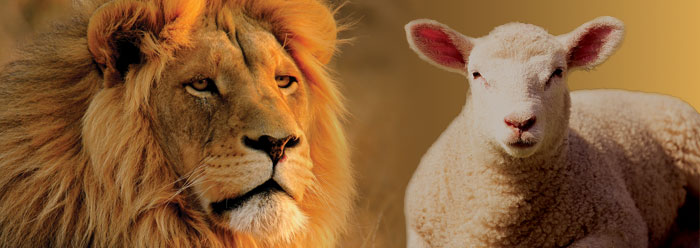
One of the more vivid biblical portraits of the Lord Jesus is the paradox of His presentation as a lamb and also as a lion. In the magnificent book of Revelation, the scene in heaven unfolds as the great seven-sealed scroll is revealed. The apostle John aches when no one is found worthy to open the scroll, but one of the enthroned elders says: “Weep not: behold, the Lion of the tribe of Judah, the Root of David, hath prevailed to open the book…and, lo, in the midst of the throne…stood a Lamb as it had been slain” (Revelation 5:5-6).
Perhaps the best way to understand the dual emphasis of the lamb and the lion is by gaining the perspective of these portraits revealed in the rest of Scripture.
First Mention of the Lamb in Scripture
God asks Abraham to sacrifice his son in this poignant record, in which we first see the mention of a lamb as the sacrificial offering (Genesis 22:2-8). When young Isaac asks what the sacrifice will be, the original wording of the text is quite unusual, saying, “God will provide himself a lamb for a burnt offering.” The Greek translation of that Hebrew passage is literally rendered “the God (will) later himself furnish unto a whole burnt offering, a son.” There is no punctuation in the early languages. Thus, the ending of this phrase with “son” could easily be understood that God will later furnish His Son as an offering.
Yet it pleased the LORD to bruise [crush] him; he hath put him to grief: when thou shalt make his soul an offering for sin, he shall see his seed, he shall prolong his days, and the pleasure of the LORD shall prosper in his hand. (Isaiah 53:10)
The Lamb and the Passover Sacrifice
Celebrating the Passover of the death angel and the exodus of Israel, the Lord told Moses to instruct the congregation that every household was to take a firstling male lamb, without any blemish, separate it from the rest of the flock, and slaughter it in the presence of the household on a specified day. The blood was collected and spread on the outer door in a very public demonstration of identification with the sacrifice. The lamb was roasted and every bit eaten that very night, and all the leftovers were burned. The sacrifice was totally consumed by those for whom the sacrifice was made (Exodus 12:3-10).
Everyone who participated in the Passover event dressed for travel—with bags packed—and were ready to leave. The death of the lamb signaled the new life of freedom from slavery. “For even Christ our passover is sacrificed for us” (1 Corinthians 5:7).
The Lamb of the Daily Sacrifice
The freed Israelites were instructed to publically sacrifice two lambs every day—one in the morning and one in the evening. This was a continual offering by fire, always before the Lord (Exodus 29:38-39). The nation of Israel was never to forget that an innocent sacrifice must be made to “atone” (cover) sin from the righteous judgment of a holy God.
There were other offerings that required a lamb, each representing an act of forgiveness for an individual trespass or an acknowledgment on the part of God of a vow—continual reminders of an ultimate sacrifice that would one day be made. All of these sacrifices were public, bloody, smelly, and unpleasant in every physical way. They were not intended to please the participants, but to instill in the nation the horror of sin in the eyes of God and the absolute necessity of a substitutionary sacrifice.
Behold the Lamb of God
The very first public display of the incarnate Christ to the world was accompanied with the announcement by John the Baptist at the Jordan River: “Behold the Lamb of God, which taketh away the sin of the world” (John 1:29).
Many Scriptures were fulfilled in the person of the Lord Jesus, but the majestic prophecy of Isaiah is a beautiful summary.
All we like sheep have gone astray; we have turned every one to his own way; and the LORD hath laid on him the iniquity of us all. He was oppressed, and he was afflicted, yet he opened not his mouth: he is brought as a lamb to the slaughter, and as a sheep before her shearers is dumb, so he openeth not his mouth. (Isaiah 53:6-7)
The Christian gospel is widely known in the Western world, as is fitting. There is a constant emphasis in the New Testament on the complete redemption provided for by “the precious blood of Christ, as of a lamb without blemish and without spot” (1 Peter 1:19). Jesus of Nazareth is most assuredly the ultimate Lamb foreshadowed by the thousands and thousands of sacrificial examples prior to His incarnation.
The Lion of the Tribe of Judah—Revelation 5:5-6
But He is also the Lion of prophecy! At the gathering of the 12 sons of Jacob at his deathbed, the great patriarch of Israel proclaimed the first prophecy of the “Lion” who would one day rule the universe.
Judah is a lion’s whelp: from the prey, my son, thou art gone up: he stooped down, he couched as a lion, and as an old lion; who shall rouse him up? The sceptre shall not depart from Judah, nor a lawgiver from between his feet, until Shiloh come; and unto him shall the gathering of the people be. (Genesis 49:9-10)
The Lion of God Rules During the Millennium
As the final judgment of the Godhead is worked out in heaven and on earth, the Lord Jesus mounts the white horse of victory and leads the host of heaven in His triumphal return. This time He comes not as the humble Son of man, but as the King of kings and Lord of lords.
And out of his mouth goeth a sharp sword, that with it he should smite the nations: and he shall rule them with a rod of iron: and he treadeth the winepress of the fierceness and wrath of Almighty God. (Revelation 19:15)
It Is Still the Lamb That Rules
The dual nature of the Lamb-Lion is spoken of several times as the processes of His dealings with the enemies of God and the redeemed in Christ are revealed in the book of Revelation.
These shall make war with the Lamb, and the Lamb shall overcome them: for he is Lord of lords, and King of kings: and they that are with him are called, and chosen, and faithful. (Revelation 17:14)
And I looked, and, lo, a Lamb stood on the mount Sion, and with him an hundred forty and four thousand, having his Father’s name written in their foreheads….And they sung as it were a new song before the throne, and before the four beasts, and the elders: and no man could learn that song but the hundred and forty and four thousand, which were redeemed from the earth. (Revelation 14:1, 3)
Let us be glad and rejoice, and give honour to him: for the marriage of the Lamb is come, and his wife hath made herself ready. (Revelation 19:7)
The Lamb and His Book of Life
The Lamb is forever etched in the message of God because our sins require an innocent substitute before the holiness and justice of God can be satisfied. Jesus is the only possible sacrificial Lamb—the sinless Son of man and the infinite only begotten Son of God has substituted Himself in our place. Now the Lamb sits on the Throne of Heaven.
And I saw no temple therein: for the Lord God Almighty and the Lamb are the temple of it. And the city had no need of the sun, neither of the moon, to shine in it: for the glory of God did lighten it, and the Lamb is the light thereof.…And there shall in no wise enter into it any thing that defileth, neither whatsoever worketh abomination, or maketh a lie: but they which are written in the Lamb’s book of life. (Revelation 21:22-23, 27, emphasis added)
The perfect Lamb died on the cross as payment for our sins, but roared out of the grave as the almighty Lion, now anointed King of kings and Lord of lords. Once victory is implemented and judgment is complete, the Lamb-Lion will oversee the “new heavens and a new earth, wherein dwelleth righteousness” (2 Peter 3:13). Those who have been twice-born in this world by the Lamb’s work on Calvary are now secured by the power of the Lion of the tribe of Judah, who sits on the right hand of the majesty on high until He returns for His own.
Even so, come, Lord Jesus.
* Dr. Morris is Chief Executive Officer of the Institute for Creation Research.
Cite this article: Morris III, H. 2012. The Lamb and the Lion. Acts & Facts. 41 (12): 4-5.