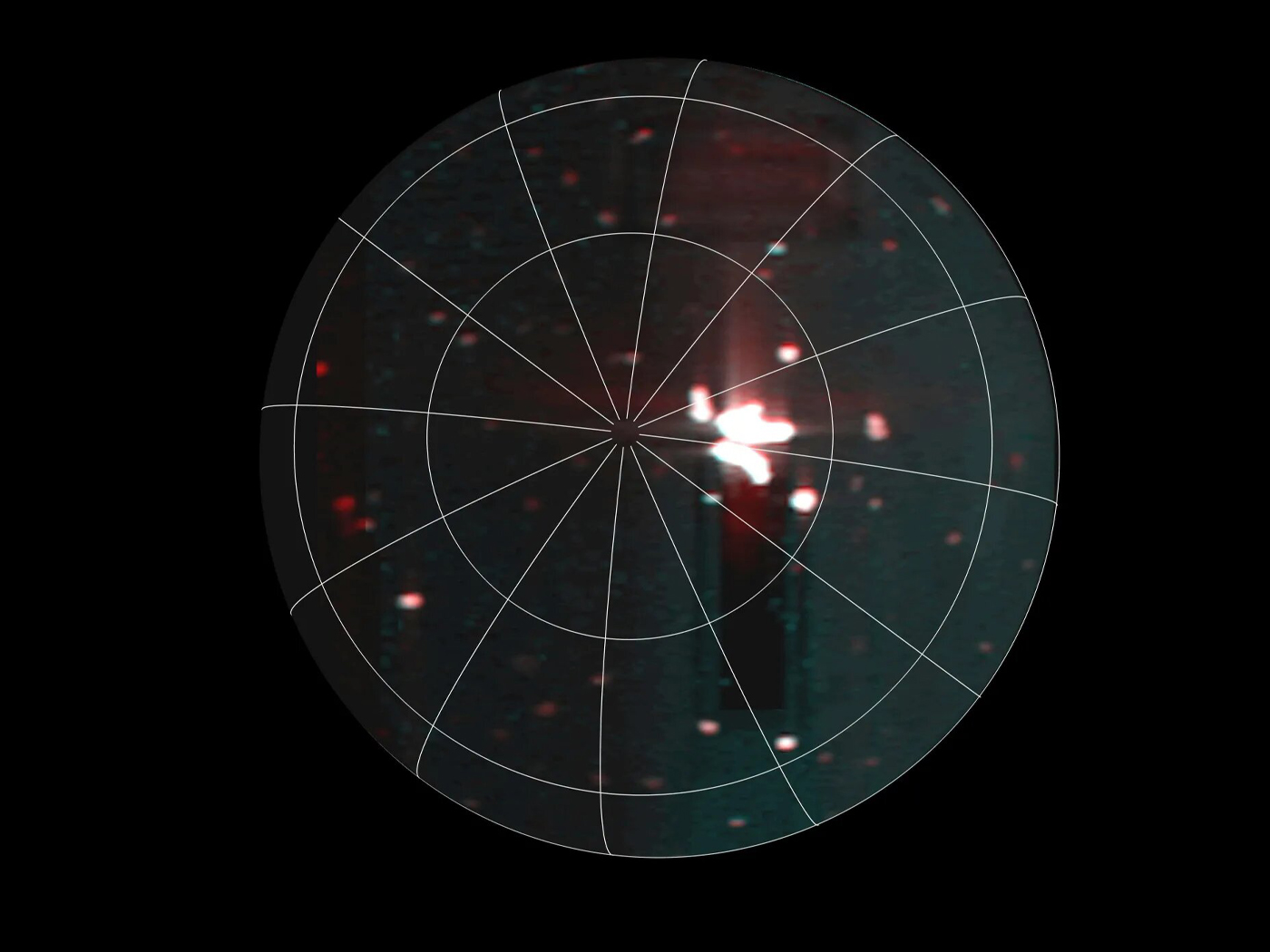
The Cassini spacecraft detected what appear to be lakes and ponds near Titan's equator. If so, one lake is almost forty miles long, 25 miles wide, and at least three feet deep. Natural processes on the moon's surface rain down methane mixed with hydrocarbons, but only near the poles. Near the moon's equator, natural processes evaporate the methane. So, after many millennia, any ancient equatorial methane lakes on Titan should have completely dried. The methane lakes' continued presence baffles astronomers, leaving them to face the difficult task of explaining it.
Caitlin Griffith, planetary scientist at the University of Arizona in Tucson, is lead author of the study results published in Nature.1 She told Nature News, "Lakes at the poles are easy to explain, but lakes in the tropics are not."2
These observations are easy to explain if evaporation has only been occurring for thousands, not billions of years. How could methane lakes still exist on Titan's equator after billions of years of evaporation?
"Because tropical lakes on Titan should evaporate over a period of just a few thousand years, the researchers argue that these ponds and lakes are being replenished by subsurface oases of liquid methane," according to Nature News.2 That kind of argument is very familiar.
For example, in 2008 Cassini discovered frozen carbon dioxide on Iapetus, another of Saturn's moons, even though sixty-trillion tons of the carbon dioxide are lost to space during each orbit. To explain this, researchers proposed that it is replenished from below the surface or from impacts, but neither explanation has supporting evidence.3
Another case in point involves comets. Researchers continue to imagine an invisible cloud or belt of comet sources lying near the solar system to explain how comets with short life spans still swing through the Solar System, even though they are supposed to be billions of years old.4
Likewise, to explain the moon recession problem—it would have been touching the earth and making life impossible at only a fraction of the earth's supposed billions of years—many suggest with no evidence to back the claim that the moon's current drift rate away from earth is abnormally fast these days.
Rescuing devices are a central feature of long-age astronomy. Thus, it is no surprise to read of another one. The claim that an unseen subsurface methane reservoir exists is an attempt to rescue Titan's supposed old age from scientific evidence of its youth.
References
- Griffith, C.A. et al. 2012. Possible tropical lakes on Titan from observations of dark terrain. Nature. 486 (7402): 237-239.
- McKee, M. Tropical lakes on Saturn moon could expand options for life. Nature News. Posted on nature.com June 13, 2012, accessed June 18, 2012.
- Coppedge, D. 2008. Iapetus: Youth in Black and White. Acts & Facts. 37 (6): 15.
- Humphreys, D.R. 2006. Evidence for a Young World. Acts & Facts. 34 (6).
* Mr. Thomas is Science Writer at the Institute for Creation Research.
Article posted on July 16, 2012.