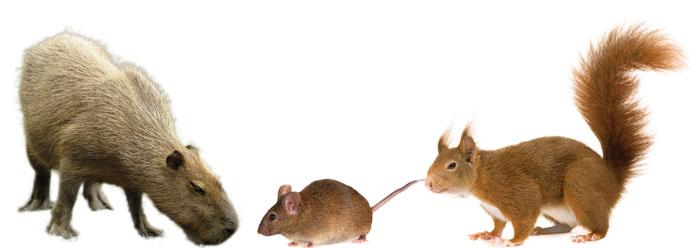
Everyone is familiar with porcupines, beavers, rats, squirrels, and, of course, mice—common representatives of the order Rodentia or the rodents. They are defined by zoologists as having a single pair of constantly growing upper and lower jaw incisors. Over 40 percent (about 1,700) of mammal species are rodents.
They suddenly appear in the fossil record—as rodents. There is no trace of any ancestry linking them to non-rodent ancestors. The fossils are reasonably common, but they show no expected evolutionary progression. Paleontologist Michael Benton states, “Rodent phylogeny [evolutionary history] has been much discussed and there has been a broad range of viewpoints.”1 Edwin Colbert writes:
Dr. A. E. Wood, one of our leading students of fossil rodents, has said, “The current status of rodent phylogeny and classification is such that anyone can point out inconsistencies in anybody else’s classification.”2
Some of the latest evolutionary candidates for rodent ancestors are the Eurymylidae, from the early Tertiary of Asia. Recently, evolutionists suggested that a creature called Heomys may be the possible ancestor of rodents, although it is too advanced and its appearance is too late to be an ancestor. Other eurymylids such as Matutinia, Rhombomylus, and Eurymylus are a side branch and not directly ancestral to rodents.3
In the pre-Flood and, possibly, post-Flood world, rodents achieved massive proportions. In 2000, scientists discovered Phoberomys, an extinct rodent discovered in Venezuela.4 Nicknamed Mighty Mouse or Ratzilla, they estimate that it weighed in at over a half-ton (1,500 pounds or 700 Kg)! The largest rodent today is the capybara, weighing a modest 150 pounds. Regarding Phoberomys, Benton stated, “At the time of discovery, it was said that ‘if you saw it in the distance on a misty day, it would look much more like a buffalo than a rodent.’”5
An even larger South American creature was the formidable (and extinct) Josephoartigasia monesi, the largest rodent known.6 It could possibly have weighed 2,200 pounds to well over a ton. Meanwhile, North America had its giant beaver (Castoroides), growing over eight feet long and weighing 220 pounds (100 Kg), on par with the modern black bear. Its incisors were just under six inches long.
Fossils of mouse-size, 100 percent rodents have also been discovered in South America. They were evolutionarily dated at “41 million years old,” causing evolutionist Daren Croft to say, “This really pushes back the date of the first South American rodents.”7
Along with openly questioning the extreme dates, creationists maintain the obvious: Rodents have always been rodents—created on Day Six, just thousands of years ago.
References
- Benton, M. J. 2015. Vertebrate Paleontology, 4th ed. Wiley Blackwell Science, 385.
- Colbert, E. H., M. Morales and E.C. Minkoff. 2001. Colbert’s Evolution of the Vertebrates, 5th ed. New York: Wiley-Liss, Inc., 366.
- Meng, J. et al. 2003. The Osteology of Rhombomylus (Mammalia, Glires): Implications for Phylogeny and Evolution of Glires. Bulletin of the American Museum of Natural History. 275: 1-247.
- Sanchez-Villagra, M. 2003. The anatomy of the world’s largest extinct rodent. Science. 301 (5640): 1708-10.
- Benton, Vertebrate Paleontology, 386.
- Rinderknecht, A. and R. E. Blanco. 2008. The largest fossil rodent. Proceedings of the Royal Society B. 275 (1637): 923–928.
- Oldest Fossil Rodents in South America Discovered. ScienceDaily. Posted on sciencedaily.com October 11, 2011, accessed May 18, 2012.
* Mr. Sherwin is Research Associate, Senior Lecturer, and Science Writer at the Institute for Creation Research.
Cite this article: Sherwin, F. 2012. Big or Small—Rodents Have Always Been Rodents. Acts & Facts. 41 (7): 17.