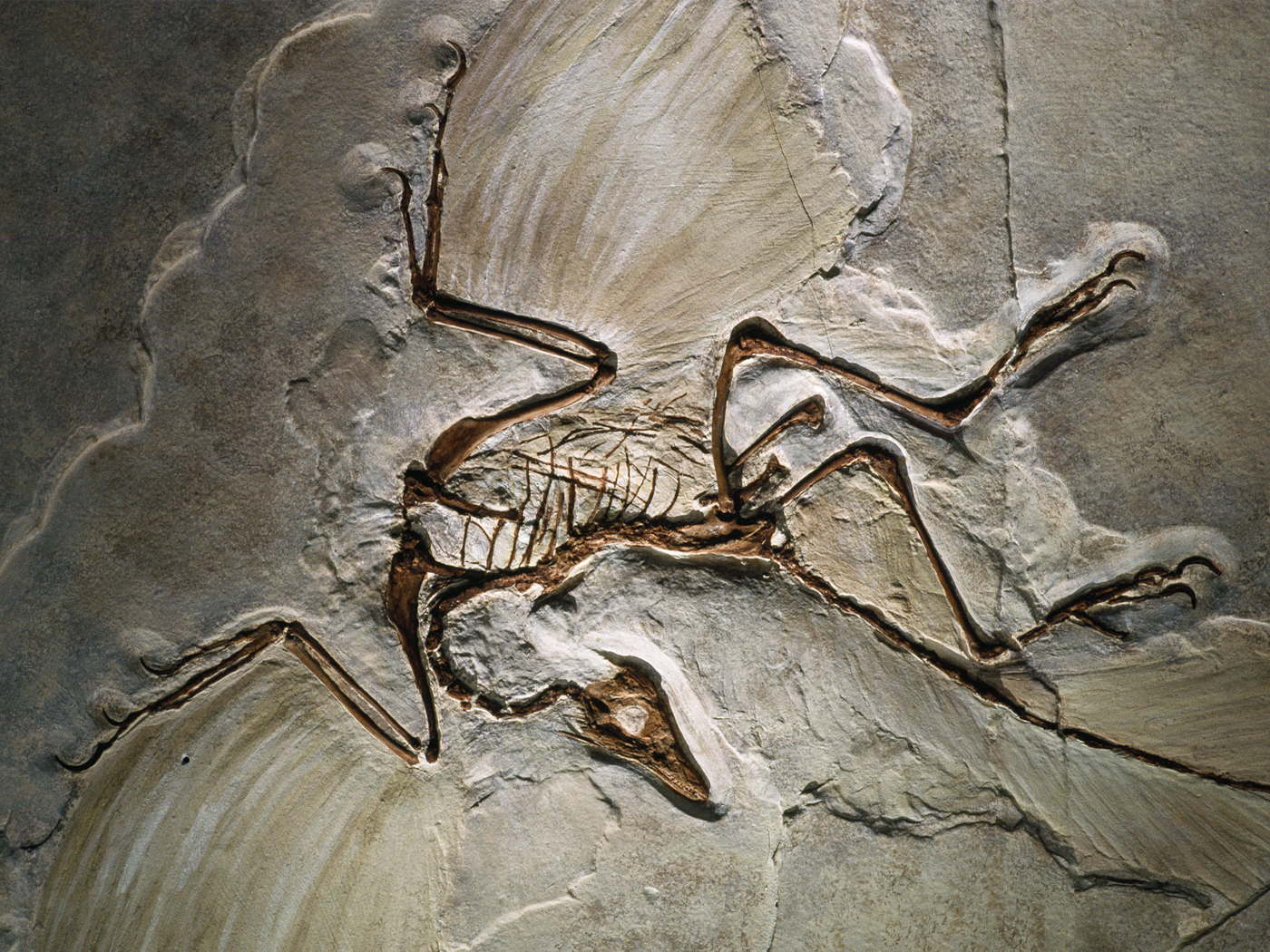
Cambrian rock layers contain many strange animal fossils, and very few fossils appear in layers below them. Called the "Cambrian explosion of life," the creatures in these layers come from all the major groups of animals alive today (including fish, which represent the vertebrates), plus many more that later became extinct.
Evolutionists, starting with Charles Darwin, have had a difficult time explaining why such richly diverse aquatic life forms appeared so suddenly and with no trace of evolutionary ancestry in lower (pre-Cambrian) rocks. According to neo-Darwinism, new life forms develop through time, chance, and death. Without the time, the formula cannot work, and yet Cambrian fossils are a parade of well-designed creatures that lived at the same time, not in separate evolutionary ages.
This problem is what some scientists term the "Cambrian Conundrum,"1 and researchers recently made another attempt to solve it. But their scenario, published in the journal Science, is a series of unfounded ad hoc stories coated with a scientific-sounding façade.
The standard tale is that Cambrian creatures did not evolve until about 500 million years ago. In contrast, these authors suggested that animals were actually alive and evolving 800 million years ago. But without the fossils to support their story, why should other scientists believe it?
Their answer was to ignore the fossils and emphasize molecular clocks. When the idea of a molecular clock was first conceived, researchers believed that DNA bases change at a steady rate over time, and thus "tick" at a reliable rate.
However, a decade of abundant research has clearly shown that DNA base change rates are not steady at all, and they are restricted to mutational "hot spots" and non-lethal changes that are different for various genes. For these reasons, and because most molecular clock-based evolutionary histories are markedly different from fossil-based ones, researchers routinely "calibrate" molecular clocks to fossils of supposedly "known ages."2, 3 The molecular clock estimates in this Science study were adjusted to 24 fossil-based "ages."
Thus tuned, the researchers' clocks indicated that "the last common ancestor of all living animals arose nearly 800 Ma [million years ago]."1 This falls within the range reported by Stony Brook University's Barry Levinson, who wrote in BioScience in 2008 that the molecular-based histories constantly contradict the fossil-based histories of life on earth.4
But if this molecule-based age of 800 million years is true, then how did animals avoid fossilization for 300 million years?
The Science authors dismissed this problem and wrote that "teasing apart the mechanisms underlying the Cambrian explosion requires disentangling evolutionary origins from geological first appearances, and the only way to separate the two is to use a molecular clock."1 In other words, they asserted that molecular clock procedures, though known to be unreliable, provide the real evolutionary history, not fossils.
The fact that these authors calibrated their "clock" to fossil age assignments proves that their clock was just as unreliable as prior clocks. It relied on the very fossil ages that their attempted solution to the Cambrian Conundrum tried to avoid! They can't have it both ways, and they should not have cherry-picked parts of the fossil record to serve their story—or the seven genes that best served their molecular clock estimates.
The Cambrian Conundrum is still a fossil-based problem for evolution. But now that evolution-based molecular clocks fly in the face of the evolution-based history attached to fossils, the conundrum has only worsened.
But the creation model suffers no such difficulties. Since vast marine animal varieties were killed and deposited at the same time when swept up and buried by Noah's Flood, it would be expected to find a sudden "explosion" of them in the rock record.
References
- Erwin, D. H. et al. 2011. The Cambrian Conundrum: Early Divergence and Later Ecological Success in the Early History of Animals. Science. 334 (6059): 1091-1097.
- Thomas, B. Darwin's Evolutionary Tree 'Annihilated.' ICR News. Posted on icr.org February 3, 2009, accessed December 2, 2011.
- Thomas, B. New Study Contradicts Flower Fossil Dates. ICR News. Posted on icr.org April 9, 2010, accessed December 2, 2011.
- Levinton, J. S. 2008. The Cambrian Explosion: How Do We Use the Evidence. BioScience. 58 (9): 862.
* Mr. Thomas is Science Writer at the Institute for Creation Research.
Article posted on December 12, 2011.