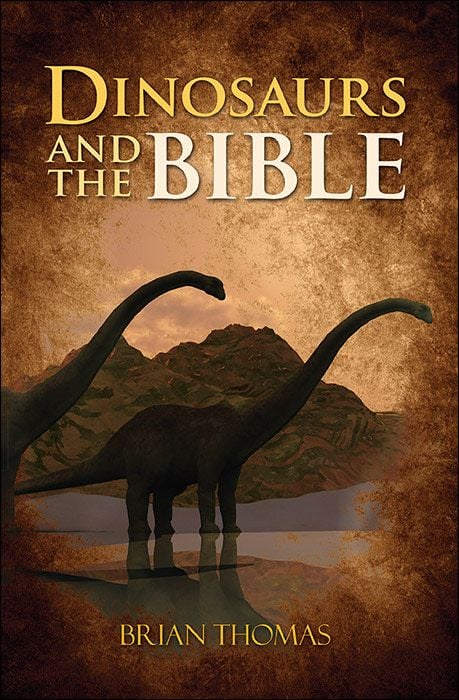
Sauropods, such as Diplodocus and Apatosaurus, were immense, four-footed dinosaurs. By their fossils, researchers know that their unique skeletal design features were specially equipped to support their bulk. In a recent Nature report, an attempt to trace an evolutionary backstory for each of these features clung doggedly to evolution despite the evidence against it…evidence highlighted in the article itself.
Fredric Heeren wrote in Nature that sauropods' long necks allowed them a wide reach through the treetops, so they could gather foliage without having to continually move their massive bodies. In this way, they were able to obtain food fast enough to maintain their size. Some of the largest may have required up to a ton of vegetation per day. Heeren wrote:
That kind of feeding required long necks, which would have been impossibly heavy if they were built with solid vertebrae. But large sauropods had vertebrae riddled with holes. These air-filled, or pneumatic, bones weighed only about 35% as much as solid ones.1
Thus, sauropods had hollowed vertebrae and small brains, which meant small heads, to lighten the overall load placed on their necks. Also, the "pelvis and limbs" of sauropods were very different from those of much smaller dinosaurs, having extra sacral vertebrae and interlocking leg bones that formed pillars which "created a frame sturdy enough to support their heft," according to Heeren.1
Sauropods also grew very quickly during their juvenile years, so that their sheer size soon became their best defense against predators. Imaginary transitional semi-sauropods, with the slower growth rates of other dinosaurs and without large, tooth-adorned jaws, or horns, claws, or clubs for defense, may well have been too easily eaten…thus putting a stop to evolutionary progress.
These dinosaurs' fast bone and body growth was unique, complicated, and precisely coordinated. Heeren quoted University of Bonn paleontologist Martin Sander as saying, "A scaffold of bone is thrown up very quickly, making the bone grow in thickness by about one tenth of a millimetre per day."1 The scaffold material was later filled in with minerals as the creature grew in size.
Clearly, sauropods had all-or-nothing design features. Thus, evolutionists have imagined that all of them arose suddenly in "an evolutionary jump."1 The Nature news feature suggested that isolated sauropod-like features found in non-sauropod dinosaur kinds illustrate an evolutionary backstory for sauropod origins.
For example, a small non-sauropod named Pantydraco had interesting pits in its vertebrae, "potential precursors" for the hollow vertebrae. Also, the thirty-foot-long "prosauropod" Plateosaurus might have had "signs" of fast-growing bone.1
Similarly, Aardonyx, a two-legged dinosaur, probably did not have fleshy cheeks, which might have enabled it to open its jaws wide enough to grab big mouthfuls of foliage, like sauropods could. No comparison with "cheekless" carnivores was given. Though Heeren wrote "that adaptation enabled the development of extremely long necks," such wishful thinking merely begs the question of sauropod long neck evolution since no explanation is given for how one adaptation could have led to the other.1
Leonerasaurus, another two-legged dinosaur, had extra sacral vertebrae like sauropods. And though they are considered by some to have been "near-sauropods," Heeren noted that they "were not the ancestors of sauropods." Why even mention them in the context of sauropod evolution if they were not part of sauropod evolution? Heeren wrote, "Near-sauropods of the Jurassic preserve information about the adaptations that appeared among the unknown ancestors of sauropods."1
Thus, after presenting a parade of dinosaur candidates with supposed sauropod precursor features, Heeren acknowledged that the ancestors of sauropods are still "unknown."
If sauropods evolved, then why are there no fossil "pre-sauropods" that have at least two, three, or four of the uniquely sauropod features, instead of just one or merely a possible part of one? And why are the candidate "prosauropods" perfectly developed creatures of their own types, just like sauropods were, with no hint of evolutionary experimentation among the fossils?
The reason that sauropods have no known evolutionary ancestor, and the reason why their evolution is imagined to have happened in a "jump," is because they were intentionally built at one time, not gradually or even suddenly morphed from another creature. This is what their all-or-nothing structure demands, and what the Bible presents.2
Reference
- Heeren, F. 2011. Dinosaurs: Rise of the titans. Nature. 475: 159-161.
- Genesis 1:24-25.
* Mr. Thomas is Science Writer at the Institute for Creation Research.
Article posted on September 15, 2011.