Archaeopteryx has long been hailed as a "missing link" between birds and dinosaurs. After a recent analysis of a different fossilized creature, however, Chinese researchers concluded that Archaeopteryx was not the first bird to have evolved, but was instead more like a dinosaur. This new categorization aptly illustrates the unreliability of evolutionary tree analyses.
Archaeopteryx had unique features that distinguish it from most modern birds, including teeth in its beak and a long, narrow tail. But it had core features that define birds, such as flight feathers, wings, perching feet, and a wishbone.
Based on these characteristics, scientists have referred to Archaeopteryx as a bird and not a reptile since the late 19th century. One popular book on birds stated that it was an "early bird" from which modern birds later evolved.1 Of course, science has not shown that it evolved from any reptile, or that it evolved into today's birds.2 It had no transitional features like half scale/half feather structures, but instead possessed fully formed flight feathers just like modern flying or gliding birds.
John Morris, president of the Institute for Creation Research, wrote in his 2010 book, The Fossil Record, "It is not enough that Archaeopteryx has some skeletal features in common with reptiles, for so does every bird or mammal alive today. Does this imply relatedness?"3
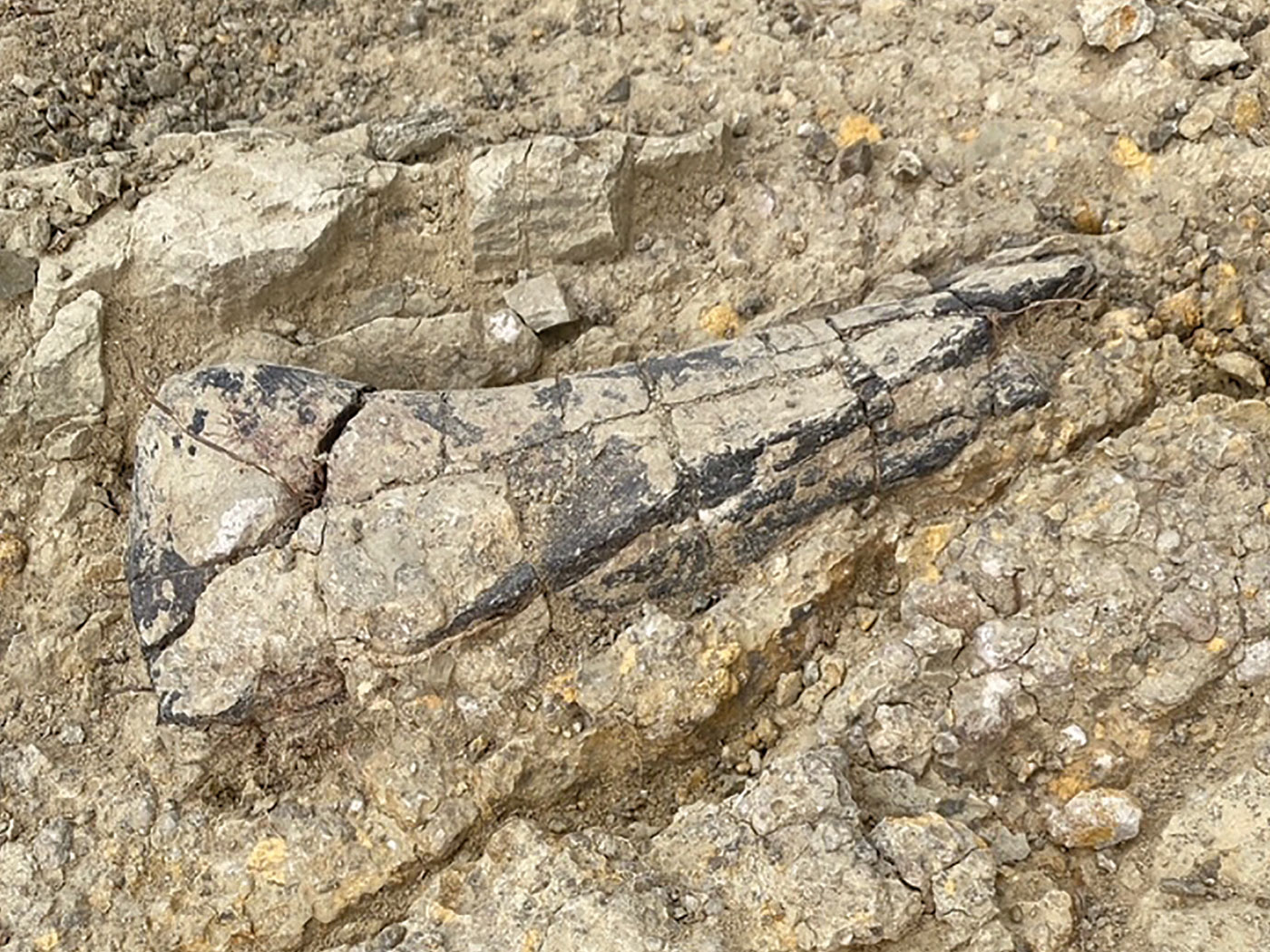
So what prompted Archaeopteryx's being reassigned from the bird group to a mostly dinosaur grouping? Oddly enough, it happened after a research team reviewed a new fossil found in China… Xiaotingia zhengi…and formulated an evolutionary tree that factored in the new fossil's characteristics. The methods used to manufacture such phylogenetic trees, which show proposed evolutionary relationships, are notoriously subjective, so it's no surprise that the new tree portrayed something quite different from those manufactured by other scientists.4
The Chinese authors published their results in Nature, saying that their analysis of characteristic traits placed Archaeopteryx "within the Deinonychosauria," even though "Archaeopteryx is placed within the Avialae by nearly all numerical phylogenetic analyses."5 In other words, these authors' results went against the consensus and moved Archaeopteryx from a category that included extinct birds to a separate category that included an even more evolution-inspired mixture of mostly dinosaurs with some extinct birds added in.
Nature News reported, "Analysis of fossil traits suggests that Archaeopteryx is not a bird at all."6 It's as though the scientists somehow found, after 150 years of looking at the fossil specimens, new Archaeopteryx "traits" that indicate it was not a bird after all. But the "analysis" was actually a comparison of a host of tiny skeletal details, all processed through algorithms that were pre-set to show evolutionary relationships even if no such relationships ever existed. This means that the reclassification was based on a study rigged with assumptions instead of straightforward analysis of the particular fossil that was reclassified.
In reality, Archaeopteryx is still just an extinct bird, and it is still not even close to an evolutionary transitional form, which evolution predicts most fossils ought to be. Only among the twisted branches of evolutionary thought can a creature be reclassified to a different taxonomic category not by direct examination of its features, but by an analysis of features from a totally different creature.
References
- Perrins, C. 1979. Birds: Their Life, Their Ways, Their World. New York: The Reader's Digest Association, 9.
- Gish, D. 1989. As a Transitional Form Archaeopteryx Won't Fly. Acts & Facts. 18 (9).
- Morris, J. D. and F. J. Sherwin. 2010. The Fossil Record. Dallas, TX: Institute for Creation Research, 86.
- Thomas, B. and F. Sherwin. Darwin's Withering Tree of Life. Acts & Facts. 38 (5): 16.
- Xu, X. et al. 2011. An Archaeopteryx-like theropod from China and the origin of Avialae. Nature. 475 (7357): 465-470.
- Kaplan, M. Archaeopteryx no longer first bird. Nature News. Posted on nature.com July 27, 2011, accessed July 28, 2011.
Image credit: Copyright © 2011 Nature Publishing Group. Adapted for use in accordance with federal copyright (fair use doctrine) law. Usage by ICR does not imply endorsement of copyright holders.
* Mr. Thomas is Science Writer at the Institute for Creation Research.
Article posted on August 5, 2011.