It is simple to learn a subtle method shared by evolutionists promoting evolution. Notice a common approach toward nature starting with Charles Darwin, who said in 1859:
I can see no very great difficulty...in believing that natural selection has converted the simple apparatus of an optic nerve merely coated with pigment and invested with transparent membrane, into an optical instrument.1
In May 2010, the current authority, Dr. Jerry Coyne, stated:
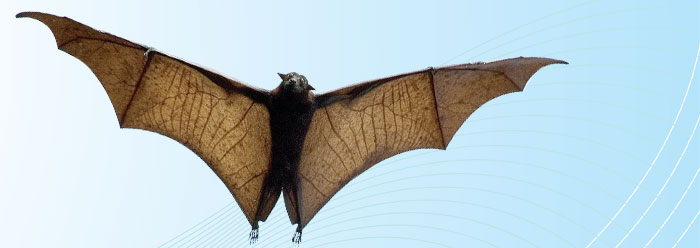
Bats evolved from small four-legged mammals, probably resembling shrews . . . .
[S]election simply retooled the forelegs into wings, along with modifying the animal's weight, shape, musculature, nervous system and bones for flying (no feathers needed). One of the great joys of being a biologist is learning about the many species in nature whose evolution would appear, a priori, impossible.2
The approach they adopt is this: Attach the word "simple" to biological processes, anatomy, and, especially, presumed evolutionary changes. Why? Because simple changes made to simple creatures are more easily believed.
Via classrooms or television, the objective is to make all biological entities look very simple. So prompting someone to view the latest Discovery Channel episode about origins is a good way to start a conversation. Warn them that they will find the program drenched in words like "simple." To enhance careful listening, they should identify and tally the use of "simple words" or non-explanatory magic words--such as tissue "converted" into optical instruments or shrews being "retooled" into bats.
That bats are designed to fly is clearly seen, but seeing that is not the challenge. Evolutionists would have people replace their natural understanding that bats are very complicated--and thus, designed--with a belief that changing shrews to bats is simple, meaning bats only look designed, but really aren't.
To point people back to reality, creationists must learn to describe the organized features that are unique to complex things. Human study confirms that design is always the source of these features; furthermore, any part of any living creature reveals these features in abundance.
Recognizing Complex Patterns of Design
When someone watches a car engine run, they observe many patterns of design. Even though people can perceive a pattern, that does not mean they can readily transmit what they see through words. Help them make that mental connection by pointing out some basic patterns of design:
- Numerous interconnected parts
- Particular arrangement
- Proper alignment
- Moving parts
- Precise timing
- Exact dimensions and shape
- Tight fit
- Balance
- Definite sequence for correct assembly
- Synchronized coherent process
These patterns are found exclusively in human-designed items or living creatures--and none are simple. A useful way to express these patterns is to emphasize their operation. Thus, biologically complex entities demonstrate many intricately arranged elements (parts or multi-step processes) that are functionally interconnected to satisfy an intended purpose.
Identifying patterns indicating exact dimensions or precise timing is an objective and verifiable activity--plainly within scientific methodology. It is these elaborate relationships of parts in living systems that intrigue human researchers. In fact, a system can be identified as complex by the challenge it presents to an intelligent mind in deciphering the intricate interactions of its component parts.
A jumbled pile of car parts would not be considered complex, even though the odds of getting the parts in that particular arrangement may be low. When jumbling parts, some arrangement is a certainty. But in real life, complexity usually escalates rapidly with increasing numbers of distinct parts because, in order to work, a specific predetermined arrangement must be matched. It is the large number of specifically arranged parts that moves biological systems mathematically from the realm of simple to complex and greatly reduces--some mathematicians would say eliminates3--chance alone as an explanation.
Designers select words like "particular" or "exact" to restrict fabrication to specific traits. This type of information reflects intent--detected only in real design. Since intent is a hallmark of intelligence and is not a characteristic of natural environments, its presence allows a clear distinction for formulating questions, such as what best explains a bat's wings--are they a suitably specified feature intended for flight, or a purposeless retooling of forelegs into wings?
Environmental Processes Cannot Fashion Intricately Arranged Parts
The existence of complex biological features allows a test for their origins. This test only needs careful observation. However, it must be done right. Since the origination of how living things operate--especially their ability to generate diverse offspring--is the issue in dispute, ensure that it is not used as part of the explanation in any way. Stay alert to the evolutionist's habit of appealing to the living world's capabilities to explain its own origination. Thus, the cause of biological complexity for creationists is an intelligent mind, while for evolutionists it is chance coupled to environmental elements (sunlight, wind, rain, gravity, etc.).
The test is best utilized in conversation. Everyone should describe observations where environmental elements produce even two interconnected parts. Some chemical processes have a chance of going a few multiple steps. But, the discussion will make apparent the severe limitations of environmental elements--devoid of the living world's information.
Evolutionists correctly assert that natural processes alone can produce ordered arrangements. After molten aluminum cools, atoms naturally align into ordered lattices. But only after being worked into specifically shaped and precisely arranged parts can aluminum become a complex engine. While an ordered status has more structure than a chaotic one, it is far from the status of many intricately arranged parts. Thus, comparing order to biological complexity is irrelevant.
Many evolutionists claim the poor quality of living creatures proves they are not designed. But this is also beside the point. Human-designed items range in quality from careless to extremely fine. Words describing quality, such as "seamless," "blemish free," or "durable," are qualifiers that add weight to correctly perceiving patterns of design--but so do words like "crude" or "sloppy." Quality in itself is not the sign of intellectual activity. Several points flow from this fact: 1) Genuine design does not demand anything be of the best quality; 2) in their prime, living things normally do exhibit breathtaking fit and finish; and 3) environmental elements alone do not achieve even shoddy design--since they cannot produce any design.
Learning a Short Example
A March 2010 episode of the popular series Life on the Discovery Channel was about mammals. On the origin of bats, it stated, "Up close it's easy to see that this is a mammal. Bats evolved about 50 million years ago, probably from a small squirrel-like mammal that had learned to glide through the air. From there it was only a hop, skip, and a jump to true flight."4 Is this, or Dr. Coyne's account of how "selection simply retooled" a shrew, what someone should actually believe about bats?
Helping someone recognize obvious patterns of design--in just the bat's wing--may provide a more realistic explanation. Bat wings integrate unique properties in regard to composition, shape, and movement. In flight, tremendously elastic wing skin is cyclically folded close to the body, then rapidly extended in precisely coordinated motions. Extremely synchronized rapid twitch muscles deftly modulate bone interactions at dozens of joints, allowing subtle alterations of wing shape. Thus, at slow speeds, bats generate more lift and greater maneuverability than many birds. Even evolutionary descriptions of the supposedly earliest bat fossils, Onychonycteris finneyi or Icaronycteris, are like living bats in every aspect--though a few features were scraped together that they envision to be "primitive."5
Pulling It All Together
Helping someone discover patterns of design can be exciting. A brief description could be:
When I drive my car, I observe many organized features that are patterns consistent with design. There are interdependent parts and lots of moving parts, arranged in a particular order, with very precise shape, alignment, and timing. A single human cell has the same precise fit and timing, but also finely-tuned feedback loops for self regulation, a materials packaging and delivery system, a microscopic railway system, hundreds of communication pathways, and information stored, retrieved, and translated as a functioning language. Features like these are only found in human-designed items and living things. No known environmental elements alone can produce such interconnected parts.
I recently saw a program where the origination of these things all the way up to flight abilities of bats was portrayed as very simple. If you start looking for the word "simple" in evolution-based education, you may be shocked at how often it is used. Simple changes made to simple creatures are more easily believed, but in real life biologically complex entities have many intricately arranged parts that are functionally interconnected to satisfy an intended purpose. The best explanation for this still remains the infinite power of the Lord Jesus Christ, who packed all of this complexity into creatures whose workmanship stands unequaled.
References
- Darwin, C. 1859. On the origin of species. London: John Murray, 218.
- Coyne, J. The Improbability Pump. The Nation, May 10, 2010.
- The Wistar Institute Symposium at Philadelphia, PA, in April 1966 was the first forum in which mathematicians exchanged findings challenging Darwinian theory. See Schützenberger, M. 1967. Algorithms and the neo-darwinian theory of evolution. Mathematical Challenge to the Neodarwinian Theory of Evolution. Monograph No. 5 Wistar Institute Press, 73-80. See also Hoyle, F. 1984. The Intelligent Universe. New York: Holt, Rinehart and Winston, 17.
- Life: Mammals. First aired on Discovery Channel on March 28, 2010.
- Simmons, N. et al. 2008. Primitive Early Eocene bat from Wyoming and the evolution of flight and echolocation. Nature. 451 (7180): 818-821.
* Dr. Guliuzza is ICR's National Representative.
Cite this article: Guliuzza, R. 2010. Discovering Life's Complex Patterns of Design. Acts & Facts. 39 (7): 10-11.