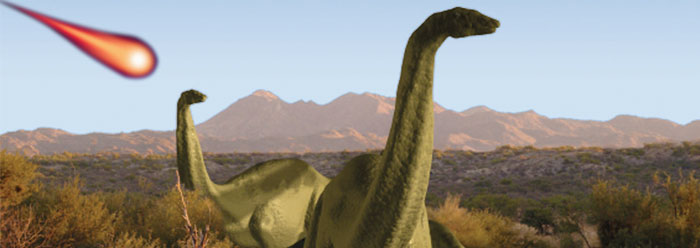
For decades, various scientists have suggested that an impact from space ended the "age of dinosaurs." But most dinosaur fossil-bearing rock layers better support the biblical history of God's worldwide watery judgment, which destroyed all land-dwelling, air-breathing creatures not on the Ark--including dinosaurs.
Researchers have been tracking one of these fossil-bearing layers, a mysterious clay deposit found in numerous places over the globe. Called the K-T boundary, most creation geologists consider it to be near the upper border of late Flood-deposited Cretaceous rocks. By ignoring the Flood, evolutionists have become confused and conflicted in their interpretations of dinosaur fossils, massive sediments, and the K-T boundary.
Paleontologist and anti-creationist Donald Prothero1 once described
the bare-knuckle fisticuffs over the "K/T boundary" controversy. The debate has become so angry and polarized that almost no evidence will change the minds of the major players, because they are so committed to the positions they have argued for so long that they cannot afford to change positions and lose face as well as funding.2
Recently, 41 scientists revisited the impact theory. They examined the Chicxulub crater, which is buried below Mexico's Yucatan Peninsula and a corner of the Gulf of Mexico. It may have resulted from a meteoroid or asteroid impact, because some such event caused shock-metamorphosed crystals in the K-T boundary layers worldwide. The scientists stated in the March 5th issue of Science:
The correlation between impact-derived ejecta and paleontologically defined extinctions at multiple locations around the globe leads us to conclude that the Chicxulub impact triggered the mass extinction that marks the boundary between the Mesozoic and Cenozoic eras ~65.5 million years ago.3
Thus, headlines confidently declared, "It's official: An asteroid wiped out the dinosaurs."4 But enough unanswered questions remain to doubt this pronouncement.
The researchers noted a drop in the prominence of impact-altered minerals found in the corresponding layer farther away from Chicxulub, so the impact did not leave a global footprint. The associated sedimentary layer also thins out farther away from the crater. They stated that this rock unit, "up to 80 meters thick in places, was deposited in [an] extremely brief period," which corresponds to a tsunami resulting from the impact.3
Something the authors did not address is the close, flat contact between the impact layers and the strata above and below them. Erosion ruts, chemical weathering, or sediment stirring by creatures or roots appears to be absent. It is as if the impact layer was deposited after the sediment below it had just been laid down.
Also, dinosaur fossils in Montana and New Mexico were found above the K-T boundary. That puts them after the event that caused it, so dinosaurs did not die off completely at the time of the impact!5,6 Biblical creation predicts this, since dinosaur kinds did not go extinct (if they all have) until after the Flood, which occurred only thousands of years ago.7
An object may have struck the earth, but that alone does not explain the dinosaurs' demise. Physicist Donald DeYoung noted that such an impact would not have targeted dinosaurs for extinction and left less mobile creatures--such as turtles, crocodiles, and some mammals and birds--alive. Prothero also mentioned this problem, including sensitive salamanders among the curious survivors.
When it comes to dinosaur extinction, pronouncements that the case is closed seem premature. Further investigation of both geological and biblical data is still required.
References
- In 2007, Prothero published Evolution: What the Fossils Say and Why it Matters, an uninformed and malevolent "critique" of creation science.
- Prothero, D. 2004. Bringing Fossils to Life. New York: McGraw-Hill, 90.
- Schulte, P. et. al. 2010. The Chicxulub Asteroid Impact and Mass Extinction at the Cretaceous-Paleogene Boundary. Science. 327(5970): 1214-1218.
- Kelland, K. It's official: An asteroid wiped out the dinosaurs. Reuters, March 4, 2010.
- DeYoung, D. B. 2001. Chicxulub and the Demise of the Dinosaurs. Acts & Facts. 30 (4).
- Thomas, B. Rewriting the Last Dinosaur's Tombstone. ICR News. Posted on icr.org May 11, 2009, accessed March 8, 2010.
- Morris, J. 2008. The Dinosaur Next Door. Acts & Facts. 37 (6): 13.
* Mr. Thomas is Science Writer at the Institute for Creation Research.
Cite this article: Thomas, B. 2010. Did Dinosaurs Die from an Impact? Acts & Facts. 39 (5): 16.