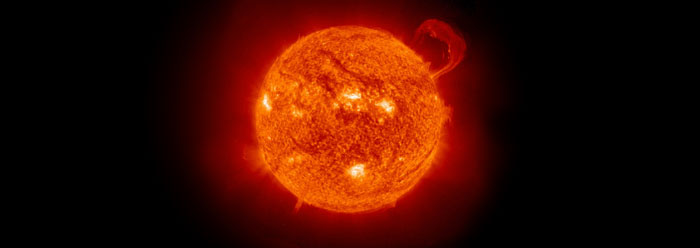
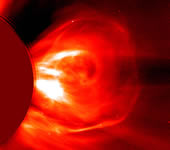
Recent solar activity caused great concern among many people, including "New Age" prophecies that the sun was burning out, and the end was near. While we don't know the timetable for end-time events, we do know that giant solar flares shot far into space, producing beautiful displays of Northern Lights while disrupting the functions of communications satellites worldwide. We also know that such flares happen from time to time on the sun, related to its 11-year cycle of sunspots, and its rotating magnetic field. This series of flares in late October, however, was perhaps the largest ever record-ed, causing many to wonder, "just how long will the sun last?"
 Despite the pronouncements of overly enthusiastic astronomers, processes within the sun are not fully known, and controversy swirls around even their nature. The most common view of the sun's nature is related to uniformitarian ideas of stellar evolution, in which the entire solar system coalesced out of an inter-stellar cloud of mostly hydrogen, some five billion years ago. The vast majority collapsed into the center where it concentrated and eventually became so dense and hot that it spawned nuclear fusion, with some hydrogen combining to form helium, giving off unthinkable amounts of energy. Energy levels, and thus the sun's brightness, have increased over time to its present level. The earth and the other planets collected from the leftover dust, which included a wide array of other atoms and molecules. Parenthetically, in this theory, the sun was only about 40% as bright as now when life is thought to have evolved, thus the earth would have been completely frozen and inhospitable to life throughout most of its history.
Stellar evolution proposes that a star goes through many stages during its life, and astronomers can point to stars which appear to be at each stage. Most stars are quite unstable (our sun being a notable exception), periodically convulsing and erupting, throwing off vast amounts of material into space, all the while using up their internal fuel. A star "dies" when it runs out of energy or catastrophically explodes in a nova or super nova. We see the remnants today as expanding gas clouds, which are not contracting into new stars. In stellar evolution theory, our sun still has about five billion years of life left. Other theories of stellar life predict a shorter tenure, but still quite long.
Thankfully the Creator of stars has told us about the birth of the stars on Day Four of Creation Week (Genesis 1:17) and their ultimate destiny. They were created for man's use and enjoyment, and to bring the Creator great glory (Psalm 19:1). He has also told us that sin's penalty affects all of creation (Romans 8:20-22), and thus even stars "die." One day the heavens and earth will pass away, but will be made new once again (II Peter 3:10,13), with no scars of sin and death. The sun won't have the same function in eternity (Revelation 21:23), but it will continue forever (Psalm 148:3,6) and praise its Creator.