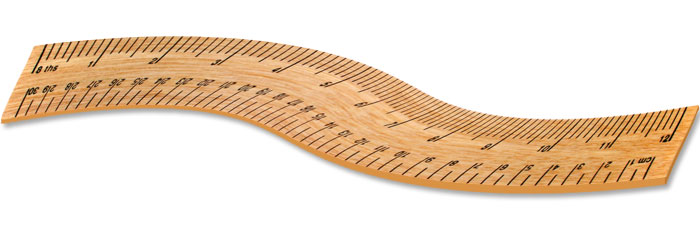
A key element of the scientific method is the ability to test whether a hypothesis is true or false. A theory that can neither be confirmed nor falsified cannot be considered "scientific," and there's just no falsifying Darwin's strange idea that all creatures originated through descent with modification (macroevolution). Like measurements taken with a rubber ruler, the theory is automatically stretched to fit any and all scientific evidence. As Darwinian critic Phil Johnson stated:
If new forms appear, the credit goes to creative natural selection; if old forms fail to change, the conservative force is called stabilizing selection; and if some species survived mass extinctions while others perished, it is because the survivors were more resistant to extinction.1
Darwinism's plasticity is also seen in Stephen Gould's punctuated equilibrium, which was invented to "explain" the lack of credible transitional links in the fossil record. He proposed that species are stable for eons, then transmutate from one body plan to another so fast that the changes are not captured in the rock record.2 In this case, no ruler is even needed, since there's essentially nothing to measure.
Broad-scale evolution is commonly associated with natural selection, or survival of the fittest. But evolutionary theory has recently been expanded to accommodate "survival of the weakest."3 An article last December pointed to "a growing body of evidence [showing] we are evolving to become more compassionate and collaborative in our quest to survive and thrive." The same article stated, "Researchers at the University of California, Berkeley, are challenging long-held beliefs that human beings are wired to be selfish."4
Evolutionists have thus decided that--surprise--evolution makes "weaker" or more compassionate behavior part of its processes as well.
Doesn't man's supposed journey from a single-celled ancestor clearly imply an upward progression from one kind to another? Not necessarily--now some scientists have surmised that evolution goes backward. Diapsids are considered "primitive reptiles," from which crocodiles and dinosaurs supposedly evolved. They are also seen as the ancestors of synapsids, some of which are believed to have evolved backward to become birds and dinosaurs. But others are thought to have maintained their synapsid anatomical features and evolved into people. The ruler must look like a Mobius strip if it can accommodate these possibilities.
Indeed, it's thought that even human evolution may have gone backward. Science writer J. N. Wilford reported, "Australopithecus africanus, which lived in southern Africa, had more archaic, apelike arms and legs than the earlier A. afarensis." Wilford quoted evolutionists Drs. Henry McHenry and Lee Berger as saying, "For Lucy and her kind to evolve into descendants with more apelike limbs...evolution would have to go backward, which rarely happens."5
A 2007 New Scientist article suggested that, over evolutionary time, things have gotten simpler, not more complex.
Since they began delving into DNA, biologists have been finding that organisms with features that look alike are often not as closely related as they had thought. These are turbulent times in the world of phylogeny, yet there has been one rule that evolutionary biologists felt they could cling to: the amount of complexity in the living world has always been on the increase. Now even that is in doubt.6
Macroevolution is too malleable to be scientific. Conflicting data can always be made to fit by flexing its rubber ruler. As ICR founder Dr. Henry Morris concluded long ago:
Evolution is, therefore, neither fact, theory, nor hypothesis. It is a belief--and nothing more.7
References
- Johnson, P. 1993. Darwin on Trial. Downers Grove, IL: InterVarsity Press, 90.
- Gould, S. J. 1980. Is a new and general theory of evolution emerging? Paleobiology. 6 (1): 119-130.
- Survival of the Weakest? Cyclical Competition of Three Species Favors Weakest as Victor. ScienceDaily. Posted on sciencedaily.com February 24, 2009, reporting research published in Berr, M. et al. 2009 Zero-One Survival Behavior of Cyclically Competing Species. Physical Review Letters. 102 (4): 048102.
- Anwar, Y. Social scientists build case for 'survival of the kindest.' University of California, Berkeley press release, December 8, 2009.
- Wilford, J. N. New Analysis of Fossils May Muddy Accepted Path of Human Evolution. The New York Times, July 28, 1998.
- Spinney, L. 2007. Evolution: hacking back the tree of life. New Scientist. 2608: 48-51.
- Morris, H. 1973. Evolution, Creation, and the Public Schools. Acts & Facts. 2 (3).
*Mr. Sherwin is Senior Science Lecturer at the Institute for Creation Research.
Cite this article: Sherwin, F. 2010. Darwinism's Rubber Ruler. Acts & Facts. 39 (2): 17.