Scientists discovered something remarkable in a recent study—evolution can’t be reversed. In tracing the supposed evolution of a common protein, they introduced mutations to move the protein “backward” to each of its hypothetical transitional stages and discovered that each one wouldn’t work. What does that mean to the theory of evolution?
Darwinian evolution teaches that over billions of years, living things evolved from simpler to more complicated forms through the natural selection of certain mutant individuals. Theoretically, if an organism evolved along a certain natural path of acquiring new features and abilities, then it should be able to retrace its evolution backwards along the same path to its original form. Recently, scientists were stunned when they found that certain proteins were utterly unable to retrace their supposed evolutionary history.
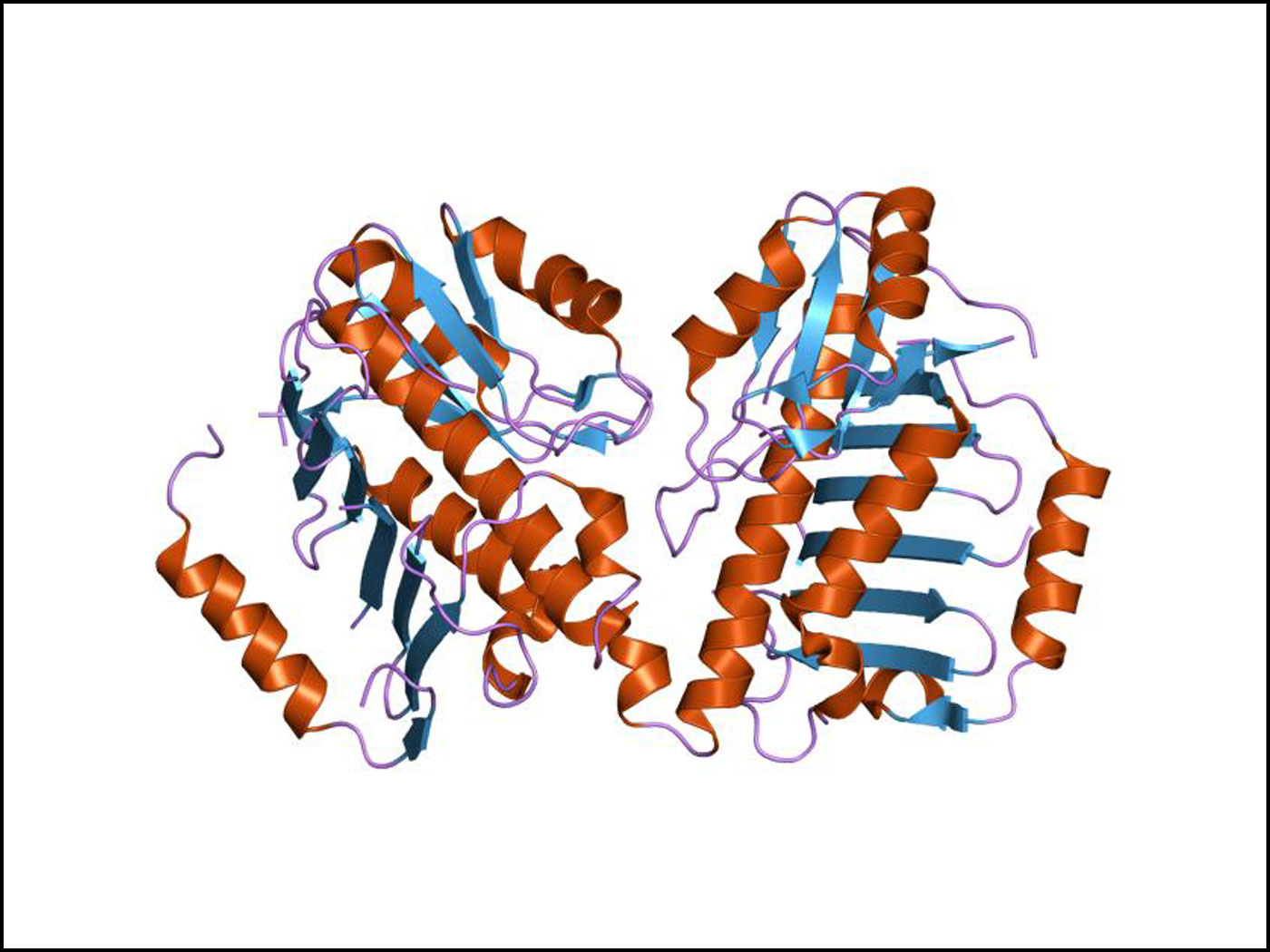
The proteins in question help vertebrate tissues recognize the stress hormone cortisol. Three researchers synthesized and characterized the various hypothetical evolutionary incarnations of the proteins. Each version had the mutational changes that were theorized to have taken place if the protein had evolved from an earlier form. Given the sequence and structure of the versions known today, the scientists wanted to see what biological functions the “transitional” proteins would have if the modern form were to evolve back to its supposedly original version.
They found, “surprisingly,” that none of the transitional proteins functioned at all.1 “The more recent version can’t tolerate having the ancestral structure and function restored,” according to a report in New Scientist.2
Joseph Thornton of the University of Oregon, a co-author of the study that appeared in Nature, told New Scientist, “Effectively, the five mutations burn the bridge evolution had just crossed.”2 Since none of the theoretical “backward” transitions produced functionality, this begs the question of whether evolution ever crossed the bridge going forward in the first place.
If this study’s conclusions are valid, they directly imply that evolution’s innovative abilities are very restricted. Even before the results of the study were published, other evolutionists resisted the suggestion that evolution had the weakness of “limits.” Michael Lynch of Indiana University offered, “The problem with the irreversibility argument is that it is based on the idea that evolution occurs by jumping from one pure state to another in single steps, like a chemical manipulation.”2
In their attempt to test “reverse evolution” one specific mutation at a time, these researchers discovered that it simply could not work. Thus, the irreversibility argument does not find its basis in an idea (as Lynch alleges), but on experimental results. Thornton’s team presented data that demonstrate those limitations.
While they expected their engineered transitional proteins to be useful for something, they found that the relevant proteins require either all of one specified configuration, or all of a separate specified configuration in order to function. In this case, point-by-point mutations produced useless intermediates—and useless proteins like these are known to be degraded by cellular quality control mechanisms. Could this case represent others in which evolution cannot reverse itself? The authors suggested that it does.
Lynch, though, argued that “in a real population facing selection pressure to re-acquire a previously lost trait by ‘going backwards,’ there will be plenty of intermediate ‘reverse’ genes remaining in the gene pool.”2 In other words, evolution could just choose the correct protein version from a wide selection available in the population.
However, there is no evidence that there is any such pool of leftover, spare genetic material that manufactures an array of functionless proteins for evolution to choose from. The vast majority of DNA that has been tested has proven to be useful.3, 4 So, having whole populations of organisms, each of which is packed full of useful DNA, does not provide the pool of “intermediate” genetic material that evolution needs and that Lynch has imagined.
Also, there is no evidence that nature can select a single gene. According to observation, only whole organisms are selected out of populations.5 And with perhaps none of the “plenty” of “intermediate ‘reverse’ genes,” and with no real mechanism to cull and keep them, Lynch’s proposal falls flat, as does large-scale evolution by mutation.
If evolution cannot go backward, as has been empirically demonstrated in these proteins, then what scientific reason is there to back up the assertion that evolution could ever have gone forward to begin with?
References
- Bridgham, J. T., E. A. Ortlund, and J. W. Thornton. 2009. An epistatic ratchet constrains the direction of glucocorticoid receptor evolution. Nature. 461 (7263): 515-519.
- Coghlan, A. 2009. For proteins, evolution can’t go backwards. New Scientist. Posted on newscientist.com September 23, 2009, accessed December 14, 2009.
- The ENCODE Project Consortium. 2007. Identification and analysis of functional elements in 1% of the human genome by the ENCODE pilot project. Nature. 447 (7146): 799-816.
- Faulkner, G. J. et al. 2009. The regulated retrotransposon transcriptome of mammalian cells. Nature Genetics. 41 (5): 563-571.
- The “noise problem” for the macroevolutionary mechanism was described in Sanford, J. S. 2005. Genetic Entropy and the Mystery of the Genome. Lima, NY: Ivan Press, 89. Briefly, a single base difference may or may not affect its gene’s transcription, which may affect the transcript integrity or frequency or efficacy, and that may affect its protein abundance or structure, which may affect a metabolic pathway, which may affect cell division, which may affect the tissue in which it is located and the organ and perhaps the organ system, which might impact the organism, which may affect its probability of reproduction, which may then affect the chances of the mutation carrying to the next generation. By the time the mutational effect reaches the organism level, it is so scattered and diluted by “noise” that it has become invisible to selection, which exclusively acts at the whole organism level, not the single mutation level.
* Mr. Thomas is Science Writer at the Institute for Creation Research.
Article posted on December 16, 2009.