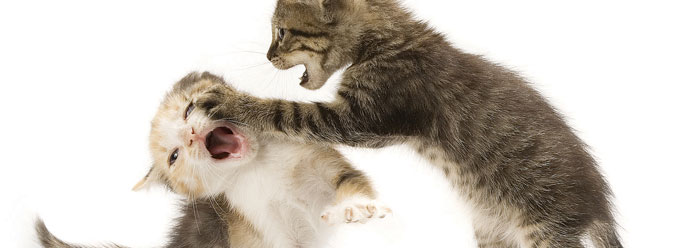
A 19th-century poet spoke of "nature red in tooth and claw,"1 and the sometimes gruesome deaths that became integral to the concept of Darwinian evolution certainly occur. But sometimes animals play. If nature is inexorably locked in a battle for the survival of the fittest, where did frolicking come from?
Humans are probably most familiar with the playful behavior of dogs. Some breeds seem to have a greater affinity for playing, but dogs are generally fond of frolicking, either with people, other dogs, or even other animals. In a National Geographic video documentary series "Unlikely Animal Friends," Surya the orangutan met Rosco the hound dog at a river park, and the two "carry on like long lost friends," wrestling, running, hugging, rolling, and being silly.2 Did God engineer this behavior as an instinct, or is it an accidental byproduct of natural forces?
Many animals play, and possibly all mammals do. Squirrels scamper, kangaroos kid around, monkeys are renowned clowns, and even turtles seem to engage in slow-motion silliness. Nor are sea creatures immune to fun. Sea otters spend an inordinate amount of time twirling about, seemingly to just express their joy in being able to do so.
Crows play pranks on other creatures, and even team up to play. One report stated that a group of crows "would fly toward each other, drop the tin plate and a member of the other team would swoop down and catch it in mid air, turn and fly back toward the other team, drop the plate and continue this game while they were being very vocal. What fun it was to watch."3
Animal play "has challenged students of behavior for a long time."4 Researchers typically presume a Darwinian history of life in which all traits, and even behaviors, evolved in response to selection. However, experts in animal play behavior admitted in 1998 that this question remains unanswered: "What exactly does play do for a young animal?"5 An even more fundamental question is: Does play really do anything to help a young (or old) animal become a fitter survivor, especially considering the energy and risk that it involves?
If the answer is negative--if animals play perhaps for enjoyment and not to enhance their survivability--then it would come as no surprise that researchers still do not have an answer to their evolutionarily-biased question. With such blinders on, they are no nearer the true answer, despite decades of "much previous and subsequent speculation."5 If animals play just to be silly, then Darwinism is at a loss to explain the behavior's origin. If they evolved by purely natural forces, as mainstream scientists believe, then every creature's features should be purely pragmatic. Fun does not fit this formula.
Could creation suffice as an alternative explanation? What kind of God condones playing? According to the Bible, it is the God of creation. Psalm 104:25-26 states,
So is this great and wide sea, wherein are things creeping innumerable, both small and great beasts. There go the ships: there is that leviathan, whom thou hast made to play therein.
Exactly what kind of creature the leviathan is or was is no longer known, but it was apparently "made to play," which can also be translated "fashioned for sporting jest." Animal play, like those overdressed peacock feathers which bothered Darwin so much, adds to a long list of features that appear to have been designed not for survival, but to display attributes of the Creator.6
References
- Tennyson, A. 1849. In Memoriam A. H. H., Canto 56.
- The Orangutan and the Hound. National Geographic Channel Video. Posted on channel.nationalgeographic.com, accessed November 30, 2009.
- Crows Playing Catch with a Pie Pan. Observation report posted on crows.net August 28, 2009, accessed November 30, 2009.
- Bekoff, M. and J. A. Byers, eds. 1998. Animal play: evolutionary, comparative, and ecological perspectives. Cambridge, UK: Cambridge University Press, xiii.
- Bekoff and Byers, xiv.
- "For the invisible things of him from the creation of the world are clearly seen, being understood by the things that are made, even his eternal power and Godhead, so that they are without excuse" (Romans 1:20).
* Mr. Thomas is Science Writer at the Institute for Creation Research.
Cite this article: Thomas, B. 2010. Why Do Animals Play? Acts & Facts. 39 (1): 16.