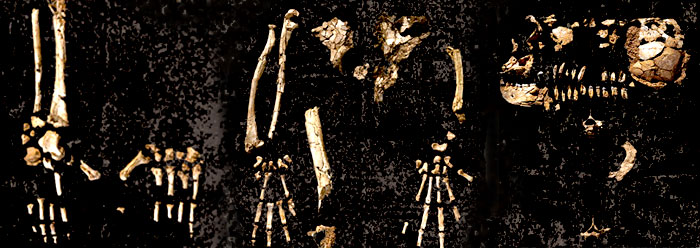
Ardipithecus ramidus is an extinct primate whose fossilized remains were first found along the Awash River in Ethiopia about fifteen years ago. Many fragments were collected, including shattered bones from a four-foot-tall female nicknamed "Ardi." She was chosen to represent her kind, apparently because of the comparative completeness of her remains.
Now Ardi's discoverers believe they have collected enough data to reconstruct her history--but what does their data actually reveal?
A Scientific Splash
Ardi was splashed onto the scientific scene with eleven technical articles in a special issue of Science, accompanied by depictions of the reconstructions of her bones. The reconstructions are based on CT scans of fossils, interpretative speculation in areas where there were no bones available, and more interpretation on how all the pieces fit together.
According to the researchers who found her, Ardi spent time as a human ancestor, based on their assumption that humans either evolved from her or some creature quite like her. "The Ar. ramidus fossils therefore provide novel insights into the anatomical structure of our elusive common ancestors with the African apes," stated one of the Science papers, concluding that "Ar. ramidus implies that African apes are adaptive cul-de-sacs rather than stages in human emergence."1
Another paper viewed Ardi as the source of a new model of hominid evolution:
Referential models based on extant African apes have dominated reconstructions of early human evolution since Darwin's time….Ardipithecus essentially falsifies such models, because extant apes are highly derived relative to our last common ancestors.2
Yet none of these statements carry meaning without the presupposition of evolution in general, and unless Ardipithecus is presumed to be an ancestor to man.
Evolutionary Guesswork
To place Ardi into human ancestry, as these authors insisted, creates more problems than it solves. For example, Ardipithecus' body structure shows no objective or undisputable transition toward uniquely human features. The authors themselves listed some of these differences: Humans have unique and interdependent sexual organs and reproductive biochemistry, unique feet, ankles and musculature, unique hip structure, unique teeth and crania, totally unique cognitive abilities, a distinct "gut structure," upright walking, unique vocal apparatus, a "precipitous reduction of olfactory receptors," mammary glands that retain a stable size, unadvertised female proceptivity, and an "unusually energy-thirsty brain."3
Speculation and evolutionary guesswork, not scientific observations, are offered to bridge these gaps. Consistent with this is the broad use of speculative verbiage on the part of the authors. In the eleven papers in Science, the word "probably" appeared about 78 times, and "suggest," "suggesting," "suggestive," or "suggests" were used 117 times, among other terms that are associated with an unsubstantiated story rather than a scientific description.
If Ardi is presumed to be a human ancestor, then the century-long concept that has been taught as virtual fact--that humans evolved from a chimpanzee-like creature (based most recently on the strength of a supposed 99 percent agreement between their genome sequences)--must be discarded! This is because of Ardi's unique features, which she does not share with African apes (or humans). In other words, arbitrarily placing Ardi at the foot of humanity's evolutionary tree means that she negates the long-held concept of an African ape-like heritage. The chimpanzee, then, would have to have evolved on its own separate path.
Getting off on the Wrong Foot
Ardi's foot structure presents another problem for her assigned role in human ancestry. A lone Ardipithecus foot bone was described in 2001, and "it also shows a mosaic morphology that has features of both apes and A. afarensis [a.k.a. Lucy]."4 The other bones of her feet present no exception to the concept that Ardi possessed a mosaic of features, characteristics shared with other creatures and yet integrated into a uniquely created primate. She had hands for feet, and the long, curved bones of her fingers and toes clearly show that Ardi was adept at living in trees.
The Ardipithecus foot has its big toe "thumb" projecting strikingly sideways, which is hardly human-like. Nor are its other foot bones like those of chimps and gorillas, which have specially flexible feet that enable them to climb vertical tree trunks. Ardi's feet are like those of some of today's monkeys, which have a stable platform from which to leap, along with a fully developed grasping structure. Though the authors insisted that this stable platform was adequate for walking, other experts already disagree with this assessment.5
Ardipithecus-as-ancestor promoters stated, "The foot of Ar. ramidus shows that none of these ape-like changes were present in the last common ancestor of African apes and humans."6 However, Ar. ramidus only "shows" what was present in pre-human "hominids" if Ar. ramidus is presumed, a priori, to be an evolutionary antecedent of apes and humans. It looks instead like an extinct but unique animal, which the authors themselves hinted at when they stated that "the Ardipithecus foot was an odd mosaic."6
Did Ardi Walk Upright?
Most artists' depictions show Ardi standing upright in a distinctly human pose, a portrayal in keeping with the researchers' contention that she had a human-like walking ability. Clearly, if humans evolved from some other primate, then somewhere along the way the hip and related bone structure must have changed. Most primates waddle when they "walk," with knees aimed outward. Human hips are angled such that the articulating legs (and knees) instead point forward. What did Ardie's hips look like?
The paleontologists painstakingly reconstructed her hip bones from the fossilized pieces that had been recovered. Their efforts were hampered by the incompleteness, fragmentation, erosion, and distortion of the bones. They completed their structure by inserting a "conjectural sacrum," and correcting "various additional dimensions,"7 leading one to wonder how close their digital model is to what originally existed.
Adding further reason for skepticism, the authors admitted, "We based the anterosuperior projection of the ASIS on the well-preserved AIIS and their typical relationship in hominoids." Since the very word hominoid is a term employed in the study of "human evolution," one wonders what role evolutionary dogma played in the necessary reconstructions, and whether the data--consciously or unconsciously--was made to appear human to advance Ardi’s candidacy as a human predecessor.
William Jungers of Stony Brook University expressed a concern that the researchers’ presentation of Ardi's hip structure as being similar to human's was possibly premature: "This is a fascinating skeleton, but based on what they present, the evidence for bipedality is limited at best."5 Which means the depiction of "Ardi as our ancestor" is limited at best.
Conclusion
In his assessment of the significance of Ardipithecus ramidus, bipedality expert C. Owen Lovejoy wrote, "We can no longer rely on homologies with African apes for accounts of our origins and must turn instead to general evolutionary theory."2 Thus, setting aside evolution-inspired ideology, there is no scientific reason--or observed evidence--to believe that Ardi was an ancestor of mankind. In fact, there is every reason to believe it is solely an extinct primate, as uniquely created as any monkey still alive today.
Based on the Bible's description of origins, one would predict that all "hominids" should actually be either wholly man or wholly ape. Based on the scientific evidence, Ardipithecus was clearly an ape, and as such fits the Genesis account that each creature group was created as its own kind.
References
- Lovejoy, C. O. et al. 2009. The Great Divides: Ardipithecus ramidus Reveals the Postcrania of Our Last Common Ancestors with African Apes. Science. 326 (5949): 100, 104.
- Lovejoy, C. O. 2009. Reexamining Human Origins in Light of Ardipithecus ramidus. Science. 326 (5949): 74e1.
- Ibid, 74e7.
- Harcourt-Smith, W. E. H., and Aiello, L. C. 2004. Fossils, feet and the evolution of human bipedal locomotion. Journal of Anatomy. 204: 404.
- Shreeve, J. Oldest Skeleton of Human Ancestor Found. National Geographic News. Posted on nationalgeographic.com October 1, 2009.
- Lovejoy, C. O. et al. 2009. Combining Prehension and Propulsion: The Foot of Ardipithecus ramidus. Science. 326 (5949): 72.
- Lovejoy, C.O. et al. 2009. The Pelvis and Femur of Ardipithecus ramidus: The Emergence of Upright Walking. Science. 326 (5949): 71.
Ardi image adapted from White, T. D. 2009. Ardipithecus ramidus and the Paleobiology of Early Hominids. Science. 326 (5949) 64, 75-86. (This image is used for non-profit educational presentation purposes only.)
* Mr. Thomas is Science Writer at the Institute for Creation Research.
Cite this article: Thomas, B. 2009. Did Humans Evolve from "Ardi"? Acts & Facts. 38 (11): 8-9.