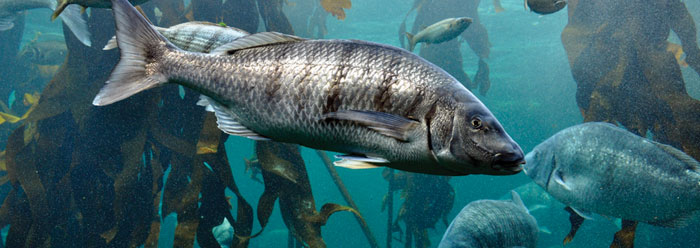
Massive schools of cod fish once dominated regions of the North Atlantic Ocean. The New England coast, according to the December 18, 1497, record of John Cabot, was "swarming with fish which can be taken not only with the net but in baskets."1 But like the bison herds that are reputed to have extended beyond sight before reckless hunting annihilated them, the plentiful cod were drastically diminished through overfishing.
Recently the World Wildlife Federation (WWF) offered a plan that called for reducing the amount of cod bycatch, which occurs when cod are inadvertently caught by those fishing for other species.2 One report found that the fishing industry is not doing enough to give cod a chance to recover.3 The WWF is lobbying the North Atlantic Fisheries Organization to adopt "long-term recovery goals,"2 including setting immediate catch reduction numbers and protecting spawning and brooding areas of the ocean.
It is possible that cod populations would still be healthy today if the fishing industry of yesterday had not been misdirected by evolutionary philosophy. During the late 19th century, fishermen were forced to travel farther for fewer cod, a longstanding economic staple. They sought counsel from a British Royal Commission on trawling, of which Thomas Henry Huxley--an evolutionary biologist famous for determinedly defending Darwinian dogma--was a leading member.
Huxley advised the fishermen to continue fishing wantonly, citing their complaints as "unscientific." At an 1883 National Fisheries Exhibition, Huxley delivered an address in which he stated, "Any tendency to over-fishing will meet with its natural check….This check will always come into operation long before anything like permanent exhaustion has occurred."4 Huxley reasoned that only the weak cod would get caught, and the "stronger" ones left would continue to evolve.
Mark Kurlansky, author of Cod: A Biography of the Fish That Changed the World, summarized, "The lesson gleaned from Charles Darwin, especially as interpreted by the tremendously influential British scientific philosopher Thomas Henry Huxley, was that nature was a marvelous and determined force that held the inevitable solutions to all of life's problems."4 However, history reveals that cod did not evolve into fishing-resistant life forms, and science shows that cod cannot do so. Like many other animals, it was not the fittest cod that avoided death, just the luckiest.
And cod continue to dwindle. "Cod…is on the verge of collapse. In 1966, when large fishing fleets dragged for cod on Georges Bank, fishermen landed 53,853 metric tons of cod from the bank. In 2004, fishermen landed 4,583 metric tons."5 Huxley was wrong about fish survival because he was wrong about where fish came from. What masqueraded as "science" was actually Darwinian philosophy, and it matched neither ecosystem and population dynamics, nor codfish design limitations.
Genesis 1:21 states that "God created great whales, and every living creature that moveth, which the waters brought forth abundantly, after their kind." This matches the fact that cod have remained cod throughout history, as the fossil record shows. Further, extinctions and endangerment of creatures across the globe demonstrate that there is no magic principle in nature that compels creatures to morph into other basic forms. Application of the biblical principles of studying and managing natural resources might restore cod populations. If not, it is not only human greed, but a false philosophy that will be to blame for their demise.
References
- Kurlansky, M. 1998. Cod: A Biography of the Fish That Changed the World. London: Penguin Books Ltd., 48.
- Europe a key culprit as Grand Banks cod bycatch stalls recovery. World Wildlife Federation press release, April 30, 2009.
- Davies, R. W. D. et al. 2009. Defining and estimating global marine fisheries bycatch. Marine Policy. 33 (4): 661-672.
- Kurlansky, Cod: A Biography, 121-122.
- Lovewell, M. A. Cod in State of Collapse; Haddock Sees Recovery at Fabled Ocean Ground. The Vineyard Gazette, September 23, 2005.
* Mr. Thomas is Science Writer at the Institute for Creation Research.
Cite this article: Thomas, B. 2009. Huxley Error Led to Cod Calamity. Acts & Facts. 38 (8): 17.