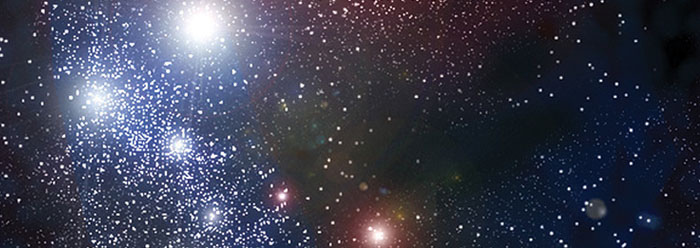
Carl Sagan famously said "we are all star stuff" in his 1980s TV series Cosmos. The stuff theme stuck. Lawrence Krauss wrote in New Scientist for February's Darwin Bicentennial that we should all "celebrate evolution as only star children can." He said, "Since the days of Galileo, astronomy has established a fundamental connection between humans and the cosmos. We have learned that 'star stuff' and 'earth stuff' have the same elemental composition. The very atoms in our bodies come from the stars."1
Logically, the statement is reversible. One could say that stars are made of human stuff. But evolutionists don't want the statement to be commutative. They want to teach a one-way progression from Big Bang to stars to man to mind. Why not teach it the other way? Mind first, then a plan, then the creation of a diverse array of living and nonliving phenomena, all sharing the same basic atomic structure.
The star stuff metaphor commits the fallacy of reductionism. It is like saying the Constitution is earth stuff. Reductionism distracts attention from the most important properties of an object. We think of the Constitution for its political philosophy, not its atoms of ink on paper. The outstanding features of human nature are not the carbon, hydrogen, oxygen, and other elements that make up our physical bodies, but rationality, morality, aesthetics, and spirit. God breathed the breath of life into Adam to make him a living soul. A soul is not star stuff.
Krauss could not sustain his reductionist doctrine. In the New Scientist article, he launched into a crusade:
[T]he intimate connections between humanity and the entire cosmos, as illustrated by both evolution and astronomy, suggest that the only sensible perspective of humanity is a global one. The need for a global perspective is of vital importance now, as we are the first generation in history that must seriously confront global limits to our future on Earth, from energy to climate change.1
Star stuff suggests no such thing. Krauss just appealed to morals. Here is another logical fallacy, a non sequitur (Latin, "it does not follow"). How did "sensible perspective" and "vital importance" emerge from atoms? Krauss followed this statement by saying that "science raises the human spirit." Now he smuggled in spirituality and science (knowledge).
If anything is "suggested" by the linkage of our bodies to star stuff, it is the fundamental ability of intelligence to organize materials, and the inadequacy of atoms alone to describe the mind. Stars have a simple structure defined by physical laws. We, however, can order and direct our material bodies by our minds.
When someone says you are star stuff, ask if a computer is star stuff, too, or a car, or a book. Yes, we have stuff, but we are not mere stuff. "For he knoweth our frame; he remembereth that we are dust" (Psalm 103:14)--yet He took on human form and died to save us. The dry bones in Ezekiel's vision were just stuff until God organized them into an army (Ezekiel 37:3). Even then, they were merely organized stuff until God’s Spirit breathed life into them.
Christians can choose to order their "stuff" toward a star-like goal: "And they that be wise shall shine as the brightness of the firmament; and they that turn many to righteousness as the stars for ever and ever" (Daniel 12:3).
Reference
- Krauss, L. Celebrate evolution as only star children can. New Scientist, February 24, 2009.
* David Coppedge works in the Cassini Program at the Jet Propulsion Laboratory. The views expressed are his own.
Cite this article: Coppedge, D. 2009. More Than Star Stuff. Acts & Facts. 38 (6): 18.