"There are no weaknesses in the theory of evolution." This was the testimony of Eugenie Scott to the Texas State Board of Education in January when the Board was debating new state science curriculum standards.1 Dr. Scott is Executive Director of the National Center for Science Education (NCSE), a watchdog group committed to exposing and ridiculing any group that questions the strange paradigm of Darwinism. Is it true "there are no weaknesses" in this particles-to-people worldview?
Clearly, there is a very real problem with what biological molecules (DNA and proteins) tell the evolutionary scientist, versus what morphology (fossils) says. Evolutionary medical journalist Trish Gura exposed this weakness when addressing a raging debate within evolutionary circles:
When biologists talk of the "evolution wars," they usually mean the ongoing battle for supremacy in American schoolrooms between Darwinists and their creationist opponents. But the phrase could also be applied to a debate that is raging within systematics. On one side stand traditionalists who have built evolutionary trees from decades of work on species' morphological characteristics. On the other lie molecular systematists, who are convinced that comparisons of DNA and other biological molecules are the best way to unravel the secrets of evolutionary history.2
When the fossil record tells one evolutionary scenario while biological molecules tell a different story--that's a weakness that schoolchildren, for example, have a right to hear. Indeed, New Scientist recently admitted that the neat, classical Darwinian tree of systematics "lies in tatters, torn to pieces by an onslaught of negative evidence."3
In 1984, evolutionary molecular biologist Michael Denton wrote Evolution: A Theory in Crisis, a very revealing book describing in detail the very weaknesses in evolution that Dr. Scott and the NCSE maintain do not exist. For example, Denton could not imagine a Darwinian scenario that could possibly have produced the first bird--complete with continuous lungs connected to air sacs, and with flight feathers--that did not sound like utter fiction. He is not the only reasoned voice who would dissent from Scott's misinformed doxology. Anti-creationist Barbara Stahl wrote an informative book in 1974 entitled Vertebrate History: Problems in Evolution.4
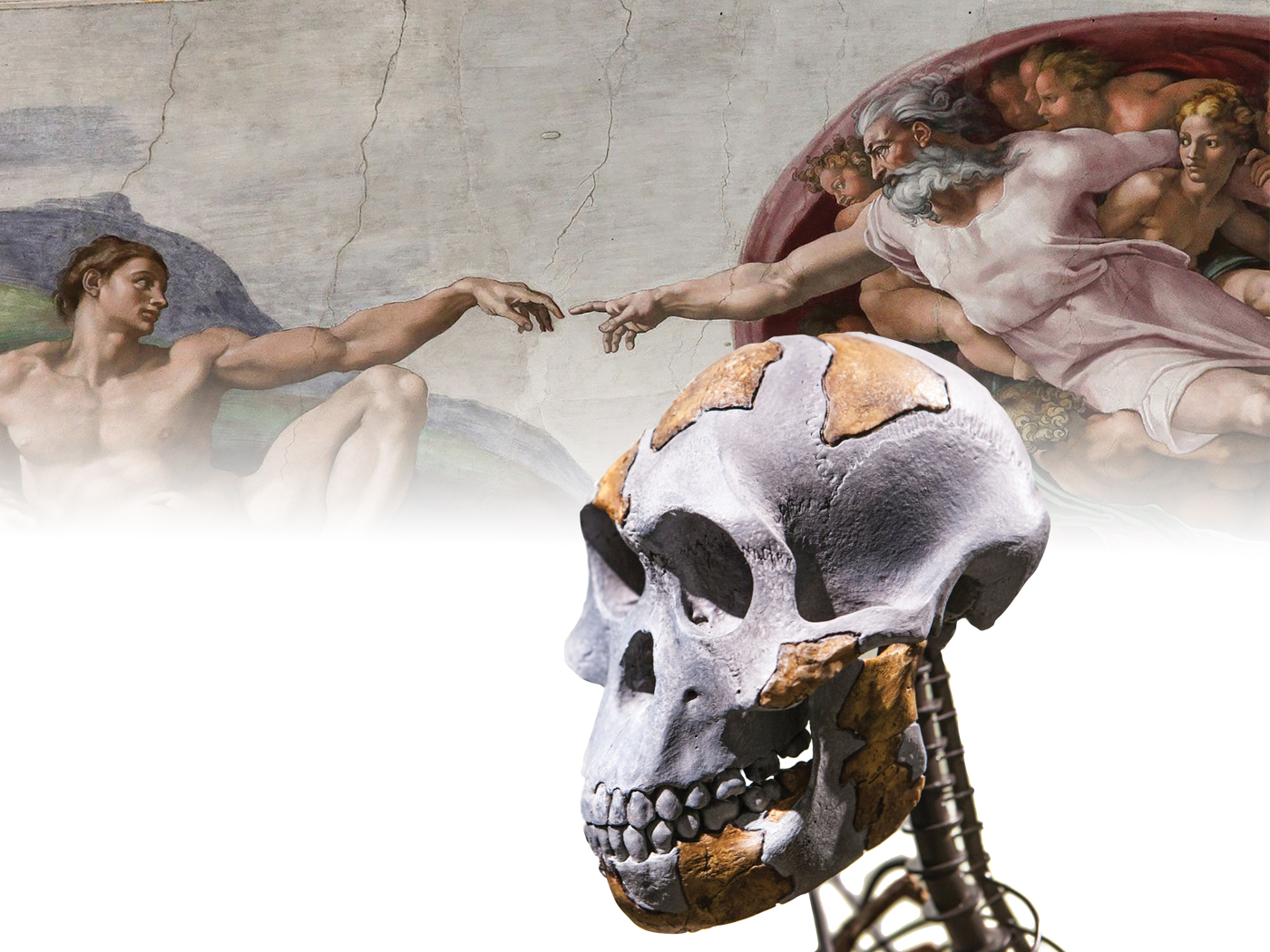
“Human evolution” has also recently taken a pummeling from within. Formerly rock-solid examples of our alleged ape-like ancestors have been removed, without fanfare, from the classic transitional ape-to-man series that is still found in public school textbooks. "DNA makes clear that [Homo erectus] was almost certainly a dead end and not our ancestor."5 Even "Lucy" is no longer a missing link:
Lucy's kind occupied only a side branch of human evolution. A. afarensis evolved into the relatively small-brained, large-jawed robust australopithecines but didn't contribute to the evolution of modern people, says anthropologist Yoel Rak of Tel Aviv University.6
Many ICR articles are available that list the weaknesses in the theory of evolution, including recent discoveries that pose serious problems for Darwinists such as dinosaur soft tissue and grass (angiosperm plants) fossilized with dinosaurs.7
Evolutionists would say that these are only unexplained problems with evolution, not issues that are unexplainable. Very well, let's teach children in taxpayer-funded schools the as-yet unexplained problems (weaknesses) with evolutionary theory. If evolution is truly a valid scientific theory, it should be able to easily weather a reasoned inquiry as to its weaknesses and strengths. The irrational and visceral reaction by secular scientists to this suggestion says otherwise.
References
- Stutz, T. Texas education board debates teaching of evolution. Dallas Morning News, January 21, 2009.
- Gura, T. 2000. Bones, molecules…or both? Nature. 406: 230-233.
- Lawton, G. 2009. Why Darwin Was Wrong About the Tree of Life. New Scientist. 2692: 34-39.
- A partial update of this book can be found in Mr. Sherwin's article "Stalling over Transitional Forms" (Acts & Facts, February 2007), available on www.icr.org.
- Begley, S. 2007. Beyond Stones & Bones. Newsweek. 149 (12): 55.
- Bower, B. 2007. Disinherited Ancestor: Lucy's Kind May Occupy Evolutionary Side Branch. Science News. 171 (15): 230.
- Sherwin, F. 2007. Follow the Evidence! Acts & Facts. 36 (4). See also Sherwin, F. 2007. Scientific Discoveries Continue to Erode Darwinism. Acts & Facts. 36 (3).
* Mr. Sherwin is Senior Science Lecturer.
Cite this article: Sherwin, F. 2009. No Weaknesses in the Theory of Evolution? Acts & Facts. 38 (3): 15.