J. Harlen Bretz published an article in the Journal of Geology in 1923 that described a catastrophic flood that swept across eastern Washington state near the end of the Ice Age. He claimed that it eroded massive channels through solid rock and flooded the Columbia River Gorge to nearly 400 feet in depth as far downstream as Portland, Oregon. Bretz's theory that a lobe of ice from the ice sheet in Canada blocked the Clark Fork River in western Montana, created a lake as far upstream as Missoula, and released walls of water across eastern Washington when the dam was breached was rejected by most geologists until he lay on his deathbed in 1981.
The reason his observations were ignored for so many years was because the floods in eastern Washington required ice lobes to block the valleys, the sudden releases of the ice dams, and massive flows of water hundreds of feet deep over thousands of square miles. These events smacked of similar stories found in the Bible. However, the evidence of rapid, catastrophic erosion that was carved in the rocks eventually overwhelmed the ridicule of the conventional geological community and is widely accepted today. The Lake Missoula Flood is only one of many events that have led to the development of a rapid, high-energy explanation for geological process called neo-catastrophism.
Rapid Ice Age processes similar to those associated with the ice lobe that caused the Lake Missoula Flood have also begun to be recognized in the formation, movement, and melting of ice sheets in the upper Midwest. During the Ice Age, large ice lobes surged from the Laurentide ice sheet from central Canada southward into the Dakotas, Minnesota, and Iowa. If the Ice Age was a relatively short event of only a few thousand years, as implied by biblical constraints, then these ice lobes must have moved rapidly. Yet, it has been commonly assumed until recently that ice moves relatively slowly.
Mark Horstemeyer and Philip Gullet reported at the 5th International Conference on Creationism (ICC) on their finite element simulations in one dimension of ice sheets.1 They studied the rate at which steep edges could move and deform under heavy accumulations of snow and found that the rapid movement of ice and multiple surges were plausible during a short Ice Age on the order of 500 years. Jesse Sherburn and associates reported at the 6th ICC in the summer of 2008 even more detailed simulations in three dimensions specifically for the Des Moines ice lobe in Iowa.2 They considered deformable till under the ice lobe, various porosity and crack levels, and various temperatures, slopes, and load angles. They agreed with previous simulations that surging could reach peak velocities of approximately 6.5 km/year and that the movement of ice lobes could in fact fit within a biblical time frame.
Even the conventional glaciology and paleoclimatology communities have come to believe that ice sheets several thousand feet thick in Canada may have melted in just a few hundred years. A major event during the deglaciation of the ice sheets called the Younger Dryas is now thought to have occurred in as little as a few decades. So, fewer and fewer pieces of evidence seem to justify hundreds of thousands of years for the Ice Age. Several of the articles presented at the ICC in the summer of 2008, including the one on the Des Moines ice lobe, may be found on the ICR website at www.icr.org/research.
References
- Horstemeyer, M. and P. Gullet. 2003. Will Mechanics Allow a Rapid Ice Age Following the Flood? Paper presented at the Fifth International Conference on Creationism, August 4-8, in Pittsburgh, PA.
- Sherburn, J. A., M. F. Horstemeyer and K. Solanki. 2008. Simulation Analysis of Glacial Surging in the Des Moines Ice Lobe. Paper presented at the Sixth International Conference on Creation-ism, August 3-7, in Pittsburgh, PA.
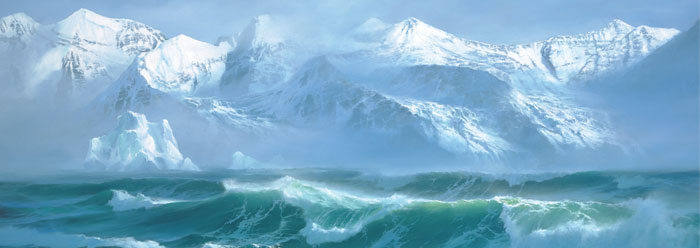
Image: Painting of Glacial Lake Missoula by Byron Pickering, www.pickeringstudio.com. Used by permission.
* Dr. Vardiman is Chair of the Department of Astro/Geophysics.
Cite this article: Vardiman, L. 2008. Rapid Surging of Glacial Ice Lobes. Act & Facts. 37 (12): 6.