"Surprise effect" was a term used by information-theory pioneer Claude Shannon to indicate the presence of information. In a string of symbols, it's not surprising to find randomness or patterns produced by natural law. It is surprising, though, to find a message. The SETI program, for example, looks for just such an information-bearing surprise in radio waves reaching earth. Scientists at our end of the transmission would infer an intelligent civilization was at the source. What if the source is non-intelligent, but still produces a surprise at the destination? That implies that the receiver is having an internal malfunction. Such a phenomenon can be witnessed in science reports. These surprise effects carry a different message: that scientific theories are vulnerable to internal malfunction when confronted with unexpected empirical evidence.
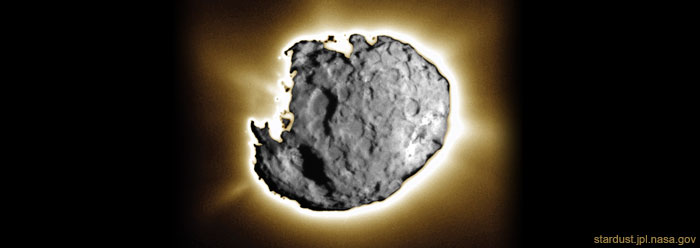
Here are a few "surprise" stories from astronomy this year, starting with the local solar neighborhood. You were probably taught that comets are remnants of pristine material from the outer solar system. The comet-tail particles that NASA's Stardust spacecraft returned from Comet Wild 2 in 2006, however, were completely opposite to what leading theories predicted. National Geographic News quoted a team member as saying, "The first surprise was that we found inner solar system materials, and the second surprise was that we didn't find outer solar system materials."1 There were three similar "surprising" references in the press release from Lawrence Livermore National Laboratory.2
Moving into the realm of the stars, the Orion nebula "continues to surprise" astronomers, according to Science.3 Plasma flows detected there were so hot--two million degrees--that they were emitting x-rays. "The energy requirement to heat the large-scale x-ray emitting plasma is severe," the discoverers said of the Orion plasmas.4 In fact, the entire nebula may be much hotter than previously thought. Only high-velocity winds from the hottest stars could have produced such elevated temperatures, they said, but those stars are thought to be short-lived. The team simply reported the observation and left it to theorists to come up with an explanation.
In May, astronomers were surprised to find "a millisecond pulsar that is in the wrong kind of orbit around what appears to be the wrong kind of star."5 Standard models do not permit this "wacky pulsar" to exist. Elsewhere, the Spitzer Space Telescope team found a surprise with the help of high school students: a dust disk around a binary star. The "surprising finding" has "important implications," the BBC said.6 It could alter theories about subjects as diverse as black holes and the formation of planets.
Moving on to cosmic scales, the Hubble Space Telescope team announced in February a new record for the oldest galaxy.7 Despite being nearly as old as the Big Bang in the consensus timescale, it appeared bright and active. A member of the research team said, "We certainly were surprised to find such a bright young galaxy 13 billion years in the past."8
What is the message in these surprise effects? Science is tentative at best. Consensus is no measure of factuality. Even long-trusted scientific theories can be challenged by anomalies. As Thomas Kuhn and subsequent philosophers of science have pointed out, scientists typically work within paradigms, or accepted explanatory frameworks. Anomalies are surprises that don't fit the paradigm. When too many anomalies accumulate, a scientific revolution may occur, and a new paradigm may take its place. If you compromise the Bible with the latest paradigm, your position could become a casualty of the next one. The Bible has outlasted a great many paradigms. Considering its Author, that's no surprise.
References
- Minard, A. Comet Built Like an Asteroid, Scientists Find. National Geographic News, January 24, 2008.
- Stardust comet dust resembles asteroid materials. Lawrence Livermore National Laboratory press release, January 24, 2008. Similar surprises had come from the Deep Impact mission in 2005, which found carbonates and clays and olivine in Comet Tempel 1, suggesting a mix of materials from all over the solar system; see NASA Deep Impact Mission News from September 7, 2005, at www.nasa.gov.
- O'Dell, C.R. and L.K. Townsley. 2008. Orion Continues to Surprise. Science. 319 (5861): 289-290.
- Gudel, M. et al. Million-Degree Plasma Pervading the Extended Orion Nebula. Science. 319 (5861): 309-312.
- Moskowitz, C. Bizarre Star Gets Stranger. Space.com, May 15, 2008.
- Lintott, C. Cosmic dust disc to force rethink. BBC News, January 14, 2008.
- Astronomers Find One of the Youngest and Brightest Galaxies in the Early Universe. Hubble NewsCenter press release, February 12, 2008.
- Hubble Finds Strong Contender for Galaxy Distance Record, posted on Science-Daily.com February 13, 2008. See also Coppedge, D. 2006. Mature at Birth: Universe Discredits Evolution Acts & Facts. 35 (10).
*David Coppedge works in the Cassini Program at the Jet Propulsion Laboratory. The views expressed are his own.
Cite this article: Coppedge, D. 2008. The Message in Surprise Effects. Acts & Facts. 37 (8): 15.