The world before the Flood evidently enjoyed substantial equilibrium. Scripture doesn't provide all the details, but we get the impression that earth movements, ocean currents, and atmospheric circulation were at a minimum. Evaporation from one area fell that evening in the same general area, indicating a more gentle environment than today's, which is dominated by major weather fronts that are in turn fueled by a greater temperature differential between the oceans and the continents. The tides still operated, but these were due to the earth's rotation and the moon's gravity. Earth basked in God's created blessings, although sin and its resultant curse had caused the original Edenic "paradise" to be lost.
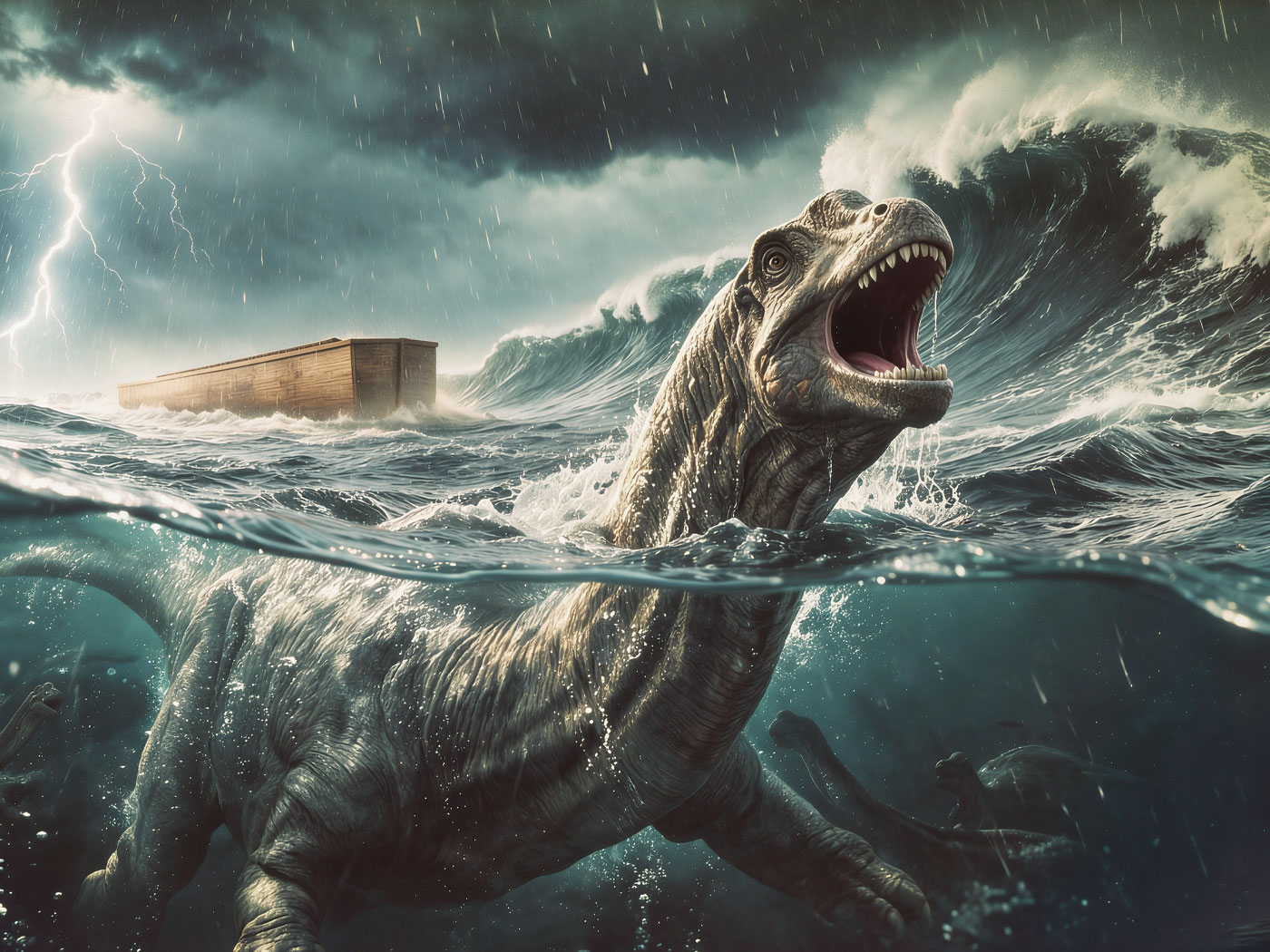
The Flood changed all that. On one eventful day, after Noah, his family, and the animals had entered the Ark, "were all the fountains of the great deep broken up, and the windows of heaven were opened" (Genesis 7:11). This launched a period of unimaginable tectonic and meteorologic horror. "And all flesh died that moved upon the earth…and Noah only remained alive, and they that were with him in the ark" |v. 21, 23|.
"And God remembered Noah…and God made a wind to pass over the earth, and the waters assuaged" (Genesis 8:1), commencing a cascade of events that ended the Flood. The ICR research wing has several ongoing research projects that propose to delve more deeply into these processes, so more may soon be known about the Flood and its aftermath. We know about wind and its effect, but this supernaturally-caused wind is beyond our experience.
Such a wind would have several implications. For one thing, it would have played a part in draining the land. The continents today are, in places, several thousand miles in width. To get the water from the continents' interior to the shores and into the ocean would normally have taken some time. The wind would have aided this.
Remember also that the land surface was fully saturated at the Flood's end, and a strong, prolonged wind would have helped dry it out. By sending out the ravens and the dove, Noah was testing to see how far this evaporation had progressed. Eventually, "the face of the ground was dry" (Genesis 8:13), but not yet able to support life. A month later "was the earth dried" |v. 14| and Noah was able to free the animals.
This evaporation was necessary on another front as well. Evaporating water removes significant heat from the system, and abundant heat was everywhere. Heat from the earth's interior was introduced to the surface by the rising "fountains of the great deep," probably boiling the oceans above the subterranean vents. Rapid lateral movements of the continents, as proposed by the best creationist model, would have generated immense heat from the friction involved. So too would the vertical uplift of the mountains, virtually all of which rose at this time as the down-warped sedimentary basins sought to regain isostatic equilibrium. No doubt Noah would have measured the average ocean temperature as quite higher than today's value.
This would in turn have been a major factor in the "Ice Age" that followed in the centuries to come. A hot ocean (more evaporation)--coupled with cold continents (greater temperature differential, sending the moisture inland) and an atmosphere filled with volcanic debris (less snowmelt due to decreased sunlight)--would have triggered staggering storms and immense snow buildup.
It was God's gracious providence to send the "wind" as He did. The great Flood of Noah's day employed recognizable geologic processes throughout, but they operated at rates, scales, and intensities far beyond their modern counterparts. His sovereign grace pervaded it all. "The Lord sitteth upon the flood; yea, the Lord sitteth King for ever" (Psalm 29:10).
* Dr. Morris is President of the Institute for Creation Research.
Cite this article: Morris, J. 2008. A Providential Wind. Acts & Facts. 37 (4): 13.