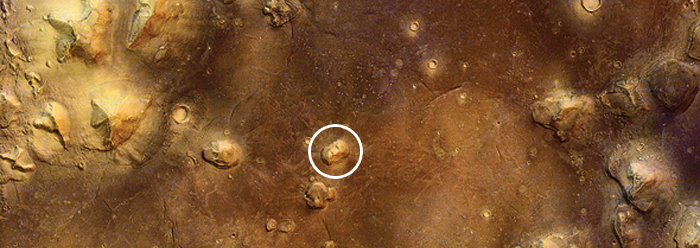
In 1976, Viking snapped a photo from Martian orbit that looked like a human face staring up from the plains of Cydonia. It launched a worldwide enterprise of imagination. For countless hours on late-night radio, enthusiasts offered speculations about long-lost civilizations that left monuments to their presence, along with conspiracy theories that NASA was covering up evidence. More recent orbiters with better camera resolution began to show the feature's true "face"--a windswept mesa. Photos from Mars Express in 2006 and Mars Reconnaissance Orbiter in 2007 have quieted all but the most incorrigible believers.
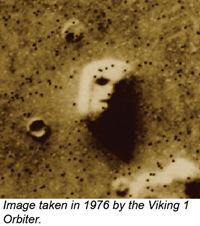
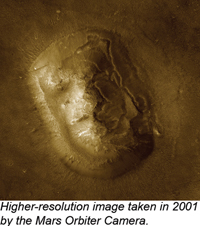
Our brains tend to find faces on mountains and messages in noise. Sometimes, though, genuine designs are hard to discern. How can we reliably detect intentional design versus the results of chance or natural law? It is tempting to ridicule the gullibility of believers in the Face on Mars, but we can make it a teachable moment. Turn the question around. Say that one day aliens land on Mars and find one of our rovers. Even if it were rusted and inactive by then, would they know it was a relic of civilization, rather than a product of the natural forces--wind, erosion, chemistry, electromagnetism-- acting in the planet's environment?
As explained in the excellent film Unlocking the Mystery of Life,1 design can be inferred when a structure 1) is improbable and 2) matches an independently specifiable pattern. Design as an explanation is a last resort after chance and natural law have been ruled out.2 Using these principles, the Face on Mars is explainable by chance and geological processes. The faces on Mt. Rushmore, by contrast, are both improbable and specified by the well-documented faces of four American presidents. It is ironic that the SETI (Search for Extra-Terrestrial Intelligence) program, staffed as it is by staunch evolutionists, depends on this ability to separate intelligent design from chance and natural law.
The Face on Mars can be a useful introduction for teachers and parents who want to present a lesson on design detection. Compare objects that look similar and ask whether they are products of intelligent design, chance/natural law, or both. Some examples would be cannonballs and concretions; burrow tracks and hieroglyphics; an archery target and a radiohalo; cave paintings and cave formations; a river and an aqueduct; columnar basalt and steel girders; sand ripples and sand castles; lenticular clouds and skywriting; a trail cairn and a random rock pile. Show these on a screen and have volunteers decide if they are "designed" or "not designed." Ask them how they know. Throw in some difficult ones, like a solar eclipse, or abstract art, or a bush trimmed like a rabbit next to a real rabbit. These discussions will lead to deeper questions about information, communication, and primary versus secondary design.
As Christians, we need to understand that not everything in nature is a product of God's direct intervention. In His rule over nature, God sometimes speaks in the thunder (primary causation, special revelation).3 More often, He lets the thunder obey the natural laws He has ordained (secondary causation, natural revelation).4 Since much of our creation apologetic depends on an argument from design, it is important that we understand and apply it properly. Some well-meaning Christians infer design when it is not warranted. When highly-improbable patterns fit an independent specification, though, the design inference can be compelling. The Face-on-Mars people deserve to blush for their credulity. The right kind of design reasoning can save face.
References
- Available at www.icr.org/store.
- Natural law is also designed by God, of course, but is usually considered secondary causation--i.e., not requiring direct intervention.
- John 12:28-30; Revelation 10:3-4.
- Psalm 29; Psalm 19:1-4.
* David Coppedge works in the Cassini Program at the Jet Propulsion Laboratory. The views expressed are his own.
Cite this article: Coppedge, D. 2008. The Face on Mars: A Teachable Moment. Acts & Facts. 37 (3): 15.