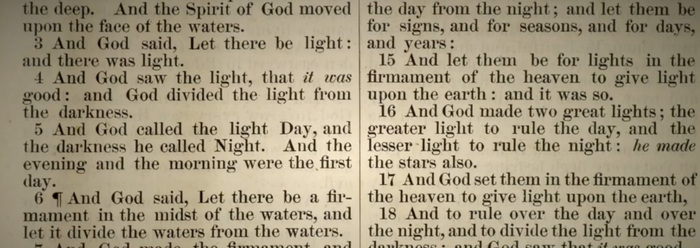
According to Scripture, God "created the heaven and the earth" on Day One of Creation Week (Genesis 1:1). Initially all was dark, until God said, "Let there be light" (v. 3). Days Two and Three saw the oceans, firmament (or atmosphere), continents, and plants formed, as the earth was being progressively prepared for man's habitation. It was on Day Four that God created the sun, moon, and stars, proclaiming, "Let there be lights in the firmament of the heaven" (v. 14), one purpose of which was "to give light upon the earth" (v. 15).
This light was directional, coming from a particular source. The earth was evidently rotating underneath it, causing alternating periods of light and dark. "And God called the light Day, and the darkness he called Night" (v. 5).
Skeptics have long ridiculed the science of biblical creation over this point. How could there be light bathing the earth before the sun was created? Obviously the Bible must be in error. But as always, this apparent error drives us to look more closely at the relevant data, both scientific and biblical.
Actually there are many sources of light, not just the sun. There are also many types of light, not just visible light. Short-wave light includes ultraviolet light, X-rays, and others. Long-wave light includes infrared light, radio waves, etc. Light is produced by friction, by fire, by numerous chemical reactions, as well as the nuclear reactions of atomic fission and fusion, which is what we think is occurring in the sun. God had at His fingertips many options to accomplish His purposes. Light does not automatically require the sun.
Furthermore, we have important data given by the Hebrew words used in the creation account. When God created "light" in verse 3, the word used connotes the presence of light only, while the word used for "lights" on Day Four is best translated "light bearers," or permanent light sources. Their purpose was not only to give light, but to serve as timekeepers for man once he was created. According to the best stellar creation theory now available, light from stars created anywhere in the universe on Day Four would reach earth in two earth days, and would be useful to Adam on Day Six. (For more information, see Dr. Russell Humphrey's cosmology articles on www.icr.org.)
Keep in mind that the Creation Week was a uniquely miraculous time, and we are justified in speculating that miraculous events may have been taking place outside of today's natural laws. Especially when we realize that "God is light" (1 John 1:5) Himself, thus no outside natural source is necessarily mandated.
For semi-creationists who claim that the "days" of Genesis 1 must have been long periods of time, a more serious problem arises. Genesis plainly teaches that plants appeared on Day Three, and the sun on Day Four. But plants need sunlight for photosynthesis and cannot wait in darkness for millions of years. If the days were long epochs, as demanded by critics of a literal Creation Week, plants could not survive.
How much better and more satisfying it is to accept Scripture as it stands. It doesn't need to be fully understood and explained by modern scientific thought; it just needs to be believed and obeyed.
* Dr. Morris is President of the Institute for Creation Research.
Cite this article: Morris, J. 2008. Sunlight Before the Sun. Acts & Facts. 37 (1): 14.